
Home / About
About us
About Redding Mobile Locksmith: How the Service Is Organized
This page explains how a mobile locksmith service works, what you can expect when the team arrives, and the values behind the work.
About us
A locksmith that comes to you
Redding Mobile Locksmith is a 24 hour mobile locksmith based in Redding, California, serving Shasta County and Siskiyou County. The word mobile is the heart of it. Instead of asking you to bring a lock, a car or a problem to a shop counter, the work travels to wherever the problem is, whether that is a porch, a parking lot or a trailhead.
That sounds like a small difference, but it changes the whole experience. A lockout is already stressful, and a car that will not start is already inconvenient. Asking someone in that position to find a ride, visit a shop and come back is a second problem stacked on the first. A mobile service removes the second problem.
This page is written for the person who is deciding whether to trust a locksmith with their door, their car or their business. It covers how the service is organized, how a visit works, and what we think good locksmith work looks like. It also says plainly what we do not yet say, because honesty matters more than polish.
What we can and cannot tell you right now
Let us be direct about something. This site sticks to what we can describe: the approach, the kinds of work, the places we serve. We will not invent names, a company history or years of operation to make a page look finished, and we would rather leave a gap than fill it with a story.
The phone line is also coming soon. For now, the way to reach us is the request form on the contact page. That is a limitation, and we would rather say so than hide it. Anyone who tells you more than they know is not someone you want at your door.
What we can describe with confidence is the approach, the kinds of work, the places we serve and the way a visit is meant to go. The rest of this page does exactly that. If you have questions, ask them when you make contact. A reasonable person asks, and a reasonable locksmith answers.
The team and the van
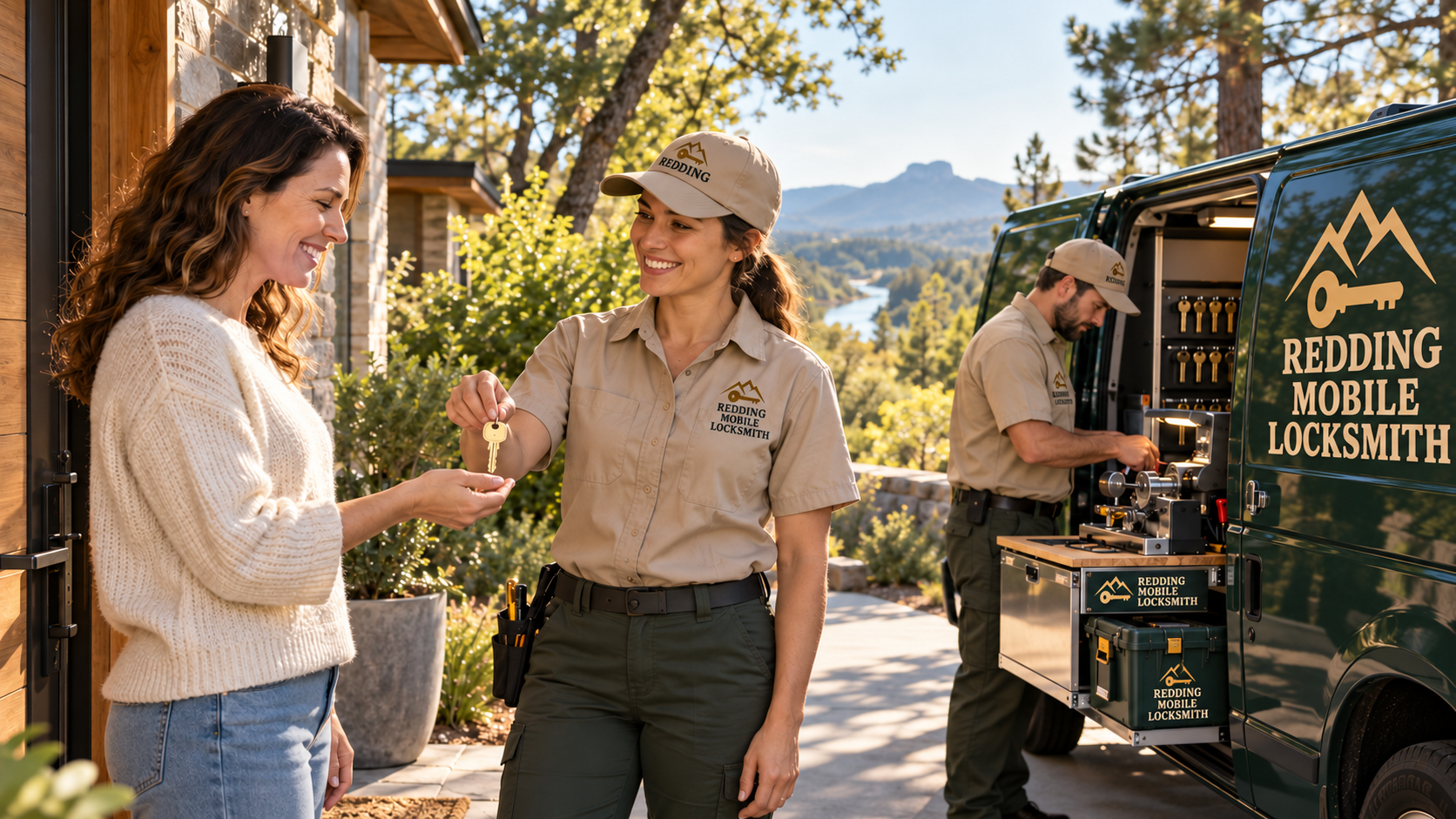
The service operates with a branded team in uniforms and a branded service van. That might sound like a cosmetic detail, but it has a practical purpose. When a stranger arrives at your home late at night, you deserve to be able to tell at a glance who they are and who they work for. A marked van and a uniform are the first, simplest signs of a legitimate visit.
Inside the van is the equipment that makes a mobile service possible. It carries professional tools, key cutting and programming equipment, and common hardware. That combination lets the team handle a wide range of problems in one trip. A lockout can be resolved, a worn deadbolt can be replaced, or a car key can be cut and programmed without the car going anywhere.
Not every job can be finished on the spot. Some vehicles need unusual equipment, some doors need parts that are not on hand, and some problems need a second visit. When that happens, you should hear it plainly and early, not discover it after the work has started.
Picture a car key job on a cold evening in a mountain town. A van that carries cutting and programming equipment means the person who arrives can make the key beside the car, test it in the ignition and hand it over, with no tow, no second appointment and no night spent wondering. That is the practical value of a van built as a small workshop on wheels.
What we do
The services fall into a few families. Emergency help covers the situations that cannot wait, at any hour. Automotive work covers car lockouts, replacement keys and key programming. Residential work covers house lockouts, rekeying, lock repair and new installations. Commercial work covers business locks and door hardware.
Behind each of those headings sit specific jobs. A car lockout, a house lockout, a replacement car key, a programmed fob, a rekeyed home, a repaired lock, a new lock, a set of commercial door hardware. Our help section has a page for each, written to explain how the work actually happens.
You can start with the family closest to your problem. Emergency help any hour is for urgent needs. Cars and trucks covers vehicles. Home lock service covers houses, and business lock service covers shops and offices.
The families overlap, and that is a strength. A person who calls about a lockout may discover a lock that needs repair. A business that asks about a new door may want to rethink its keys. Because one team handles the whole range, you do not have to explain your situation again to someone new each time.
- Emergency help for situations that cannot wait.
- Car lockouts, replacement keys and key programming.
- House lockouts, rekeying, repair and new locks.
- Business locks and commercial door hardware.
How a visit is meant to go
A good visit follows a rhythm. First, a conversation. You describe the problem and the team asks questions about where you are, what the door or vehicle looks like, and whether anything is damaged or unusual. This is not small talk. The answers decide what tools to bring and what to expect.
Second, a check on who you are. For a house, that means showing that you live there. For a vehicle, it means showing that it is yours. This step can feel like a nuisance when you are tired and cold, but it is the same check that keeps a stranger from being let into your home or driving away with your car.
Third, the work, explained as it goes. You should hear what is being done and why, and be asked before anything changes the hardware. Last, a test. Keys are tried, doors are cycled, and anything that feels rough is addressed. The visit ends when you are satisfied that the thing works, not when the tools are packed.
You can help the rhythm along. Have your identification ready. Know your address or location, and describe landmarks in general terms if you are somewhere without an obvious address, such as a trailhead or a country road. Keep children and pets safe and out of the way of the work. Small courtesies like these make the visit calmer for everyone.
Honesty as a working method
It is easy to say a company values honesty. It is harder to describe what that looks like in practice. For us, it means no invented numbers, no pretending a job is simpler or harder than it is, and no pushing a replacement when a repair will do. It also means saying when a problem is outside what we can handle.
It means being clear about what we know. We do not make promises about arrival times that depend on roads, weather and distance. We do not claim things we cannot back up. When something is unknown, we say it is unknown. That might feel less shiny than a slogan, but it makes everything else you read here more trustworthy.
If you want a way to judge any locksmith, ours or anyone's, our guide on how to know a locksmith is the real thing lists what to look for and what to ask. We would rather you checked than took our word.
Respect for your home, your car and your time
Locksmith work happens in private places. A porch, a bedroom door, a car that holds your belongings, a shop after closing. Respect for those places is part of the job. Doors are not damaged when they do not need to be, and a lock is opened with care because it belongs to someone.
Respect also means treating your time as valuable. You may be waiting in the cold, late for work or looking after children. A visit should not drag on with unnecessary talk. Clear steps, plain language and honest estimates of what is involved all help.
Respect extends to the people around you as well. Neighbors should not be disturbed more than necessary, and a late night visit should be handled as quietly as the work allows. The goal is to solve your problem and leave the street exactly as calm as it was. It also means treating every customer the same way. A person locked out of a small apartment deserves the same care as the owner of a large shop. The job might be bigger or smaller, but the standards of conduct do not change with it.
Where we work
The service covers 17 communities. In Shasta County, that means Redding, Anderson, Shasta Lake, Cottonwood, Palo Cedro, Millville, Lakehead and Sims. In Siskiyou County, it means Mount Shasta, Yreka, Dunsmuir, McCloud, Weed, Granada, Montague, Fort Jones and Etna.
Distance is a fact of life in a service area this large, and we do not pretend otherwise. A call in the valley and a call in a mountain town are different undertakings, and honest planning accounts for that. That is a wide area, running from the valley near Interstate 5 in Redding up through the mountain country around Mount Shasta. The landscape changes along the way, from hot dry summers in the valley to snow and cold in the mountain towns, and the work changes with it. Cold mornings stiffen locks, and long distances shape what a visit involves.
Our neighborhoods section has a page for each community describing what locksmith needs tend to look like there, and a set of local service pages that show how each service applies in that place. If you are not sure whether we cover your location, send the details through the request form and ask.
How this site is organized
The site is built to help you find an answer without hunting. The help section explains each service in depth. The neighborhoods section covers each community. The neighbors ask section collects plain answers to the questions people actually ask, such as what a transponder chip is or whether a door that will not close can be fixed.
Think of it as a library of explanations. You do not need to read it all. If your car key is missing, read the pages on cars and keys. If you are buying a house, read about rekeying. If you manage a shop, read about hardware. The idea is that you leave better informed, whether or not you ever call.
We also try to keep the language plain. Locksmith work has plenty of jargon, from strikes and backsets to transponders and keyways, and we explain each term the first time it appears. You should not need a trade dictionary to understand the page about your own front door. Every page is written to stand on its own, with links to related ones. That is deliberate. Locksmith topics overlap, and someone reading about a lockout may want to know about rekeying, while someone reading about rekeying may want to know about locks that wear out.
What to do next
If you need help now, use the request form. Tell us where you are, what happened, what kind of door or vehicle is involved, and whether anyone is in danger. If a child or pet is locked inside a vehicle or a person is in trouble inside a building, call emergency services first, then contact us.
If you are planning ahead, our guide on what to have ready when you call a locksmith makes any future visit smoother. A few minutes of preparation, like knowing your vehicle details and having identification handy, pays off at exactly the moment you least want to think.
And if you simply want to learn how locks and keys work, read on. We built this site to be useful before it is needed. Details like staff and history will appear here when there is something real to say, and until then you will find only what we can stand behind.
What we think good locksmith work looks like
Good locksmith work is mostly invisible. The door opens without a mark. The key turns smoothly. The lock you came away with is stronger than the one you started with, and you understand why. If you notice the work at all, it is because it went well and left you with something better.
It is also work that leaves you in charge. You should understand the options before you pick one, hear honest answers about what each choice means, and never feel pressured to buy something you did not ask for. A locksmith is a guide through a decision, not a salesperson on commission over your shoulder.
Finally, it is work that respects limits. Some things a locksmith will not do, such as opening a door for a person who cannot show they belong there, or explaining ways around a lock that would help a burglar. Those limits are part of the trade. They are why a community can trust the person with the keys.
- Doors and cars are opened without damage whenever possible.
- Options are explained in plain language before work begins.
- Proof of residence or ownership is checked every time.
- Anything that cannot be done safely is declined, with an explanation.
Good to know
Common questions
Who owns and runs Redding Mobile Locksmith?
We do not publish names or a company history on this site, and we would rather leave a gap than invent a story. If you have specific questions, ask them in your request and expect a straight answer.
Are you open at all hours?
The service is a 24 hour mobile locksmith, which means requests are welcome at any hour. We do not publish arrival promises, because roads, weather and distance vary across two counties. When you reach out, ask how the visit will be handled and plan around what you are told.
What areas do you serve?
We serve 17 communities in Shasta County and Siskiyou County: Redding, Anderson, Shasta Lake, Cottonwood, Palo Cedro, Millville, Lakehead, Sims, Mount Shasta, Yreka, Dunsmuir, McCloud, Weed, Granada, Montague, Fort Jones and Etna. If you are nearby but not listed, ask through the request form.
Why do you ask for proof before opening a door or making a key?
Because opening a door or making a car key for the wrong person causes real harm. Asking you to show that you live at the address or own the vehicle protects you, your neighbors and us. It is a normal, responsible step, and a locksmith who skips it is one to be careful with.
How can I contact you right now?
The phone line is coming soon. For now, use the request form on the contact page. Describe where you are, what happened and what kind of door or vehicle is involved. If anyone is in danger, call emergency services first and then send your request.
What does the service van carry?
The branded service van carries professional tools, key cutting and programming equipment, and common hardware. That lets many jobs be completed in a single visit at your location. Some situations need unusual parts or equipment, and you will be told plainly if yours is one of them.