
Home / Service areas / Millville
Millville, Shasta County
Doors, barns and private roads: locks in Millville
Millville is a small foothill community east of Redding where properties are spread out, roads are often private, and the barn, the well house and the farmhouse all depend on locks that nobody wants to think about.
Millville, Shasta County
A quiet corner of the foothills
Millville feels removed from the bustle of the valley, and that is much of its appeal. The land rises gently into the Shasta County foothills east of Redding, with ZIP 96062 covering scattered homes, small farms and country parcels. Many properties are reached by a private road, and the sound at night is mostly crickets and wind.
A place like this has its own approach to security. People know their neighbors, but they cannot see them from the kitchen window. They leave tools in the barn and pumps in the well house and trust that these will still be there in the morning. A little attention to locks turns that trust into something sturdier.
This page walks through what a Millville household or landowner might want from a locksmith. It follows the property from the end of the private road to the front door, and then out to the barn. When you are ready to ask for help, the request form is open, since our telephone line is coming soon.
Private roads and the first gate
Many Millville homes sit at the end of a road that is not public. A gate may stand at the entrance, shared between neighbors, or at the turnoff to a single property. It is the first thing a visitor meets and often the last thing anyone thinks about maintaining.
A shared gate raises practical questions. Who holds the keys or codes? What happens when a household sells or a tenant moves away? How is access arranged for deliveries, emergency services and utility workers? Settling these in advance spares everyone confusion. Our guide on gate lock questions for country driveways goes through them.
From the technical side, the gate lock should be protected from the chain that moves against it, should use a shackle that resists cutting, and should be easy to operate with cold or gloved hands. A lock that is awkward on a winter morning will be left open sooner or later, which defeats the purpose. Plan the hardware around how people really behave.
Emergency access deserves a thought as well. Fire crews, ambulances and utility workers must be able to reach the house, and a locked gate can slow them. Many rural households arrange for a way through that responders can use, and the details depend on local practice, so ask the relevant agency what they prefer. A lock that blocks the people you most need is no protection at all.
Country houses and their mixed hardware
Houses in the foothills often have a history. Some were built decades ago and added to over the years; others are newer but stand on land with a long family story. Doors in such houses may not match, and the hardware can be a patchwork from several eras.
A patchwork is not necessarily bad, but it can mean many different keys. Rekeying lets a technician bring all the cylinders on the main house to a single new key, without replacing every knob and lever. It is also the sensible reset after a purchase or after a period of renters. The pages on rekeying your home and home lock service explain how it works.
Old doors can also use a gentle hand. A door that has settled may no longer meet its latch, and forcing the lock only wears it. Adjusting the strike or the hinges often restores the fit. The guide on whether a door that will not close can be fixed describes what is involved.
- Rekey the main house after buying or after a rental period.
- Have a technician check doors that rub, bind or latch poorly.
- Replace worn or mismatched knobs with sound deadbolts.
- Make sure the garage entry door has a proper lock.
- Keep one clear record of how many keys exist for each door.
Wells, pump houses and water
Out here, water often comes from a well, and the pump that serves it lives in a small enclosure that is easy to forget. If that pump fails or is tampered with, a household can be without water in the heat of summer. A basic lock on the well house or pump enclosure is a small and sensible precaution.
The lock chosen should tolerate dampness, since pump houses are rarely dry. A body of brass or stainless steel handles moisture better than plain steel, and a closed shackle design is harder to attack. Check these locks each season, because corrosion tends to arrive quietly. A lock that has not been touched in a year may be frozen by rust.
Similar thinking applies to propane tanks, fuel storage, electrical panels and any other equipment outside. Not everything needs a lock, but things that could be hazardous in the wrong hands, or costly to replace, do. If you are unsure what is wise for your property, a technician can walk through it with you during a visit.
It also helps to look at the ground around the structure. A pump house with a path worn to it, a lock facing the road, or a door hidden from the house tells a visitor a lot. Moving a light, trimming brush, or turning a hasp so that it cannot be cut easily are small changes that cost little. None of them requires a new lock, only a fresh look at what is already there.
Barns, stalls and equipment
The barn is the heart of many Millville properties. It may hold animals, hay, feed, tack, tools and machinery, and each category has its own concerns. Feed and tack rooms are commonly locked, while the main barn doors are often left open during the day.
A good barn lock does three things: it resists forced entry, it survives dust, damp and temperature swings, and it is easy for the people who use it to operate with a gloved hand. Heavy hasps fixed through the door, sturdy padlocks, and slide bolts that cannot be reached from outside are all common. Our guide on shed and garage padlock questions has a good deal more.
Valuable items deserve a second layer. A locked tack room inside a barn gives two chances to deter a thief. A locked cabinet for tools means a stolen truck does not also mean a stolen toolbox. Layers cost little individually and add up to a lot of difficulty for anyone who should not be there.
Animals bring their own complications. A latch that a horse or a goat can work loose is not a lock, and a gate that swings freely is not a barrier. Double ended snaps, latches with a safety catch and locks mounted out of reach of curious muzzles all solve real problems. A technician cannot judge your animals for you, but can suggest hardware that suits how the building is used.
Trucks, trailers and long drives to town
Living in the foothills means driving. A trip to town can be a real commitment, so a vehicle that will not start because of a key problem is more than an annoyance. Trucks, trailers and tractors with keys of their own all need to be accounted for.
Chipped keys are the usual stumbling block. If you lose the only one, the vehicle will not run, and no hardware store counter can fix it. A mobile technician with the right equipment can cut and program a new key where the vehicle is parked, which saves the cost and difficulty of a tow. Read about replacement car keys and key programming and fobs.
Prevention is better still. Make a spare of every vehicle key while one still works, and keep it somewhere that does not depend on the vehicle. A spare locked inside the truck helps nobody. Our guide on teen drivers and spare keys is useful for households where the keys get passed around.
Tractors and utility vehicles deserve a mention. Many use simple keys that are shared across a whole make, so one key might start several machines. That is convenient until a key goes missing, since anyone who finds it can drive off with something expensive. Treat those keys like the ones for your truck, keep them in a safe place, and consider whether a more distinct key or a lock on the ignition is worth the trouble.
Weather in the foothills
The foothills share the hot, dry summers of the valley and a somewhat cooler, wetter winter. On some mornings there is frost, and on rare days a dusting of snow. That swing between hot and cold, dry and damp, is hard on hardware.
Metal contracts in the cold, grease stiffens, and moisture finds the gaps. A lock that was fine in September can be stiff in January. Dry lubricants behave better than oils in cold and dusty conditions. If a lock freezes, do not force the key; warm the lock gently and try again. Forcing a stiff key is how a stiff problem turns into a broken one.
A little routine helps. Twice a year, try every lock on the property, outdoor and indoor, and note any that feel rough. Wipe the outside, lubricate the inside with a suitable product, and replace anything that is visibly corroded. The guides on weather and seasons and which lubricant belongs in a lock explain the details.
When you check a lock in cold weather, listen as well as feel. A lock that gives a gritty or scraping sound is telling you there is dust or wear inside. A key that needs to be jiggled to turn is often a sign that the key itself has worn, and a fresh cut from the original may be a simpler cure than replacing the cylinder. A technician can compare the two and tell you which problem you really have.
Small businesses and home operations
Not every Millville property is purely residential. Some host a small business: an agricultural operation, a repair shop, a studio, a stand or a service run from a barn. These have commercial needs even when they look like part of the farm.
The most useful steps are practical ones. Keep records and cash behind a better lock than a standard knob. Make sure any door that visitors use is controlled. Decide who has keys and write it down. And if the building is open to the public in any way, make sure exits open easily from inside. See business lock service and door hardware for business for the options.
If you run a stand or sell from the property, think about the door that faces customers and the one that faces the rest of your land. A small lock and a clear boundary protect your home from the habits of commerce. The guide on a new business owner's lock checklist suggests a few early steps.
Keep your private life behind its own door. If a customer or a delivery driver only ever needs to reach one room or one building, make sure the way to everything else is locked and clearly marked. Politeness and boundaries are not opposites, and a lock on the right door lets you be welcoming without worrying about what a visitor might wander into.
Six pages for Millville
Each of these pages looks at one service through a Millville lens. Home lock service in Millville deals with country houses, and cars and trucks in Millville deals with the vehicles that get you to town.
For keys with chips, see key programming and fobs in Millville. For upgrades, read new lock installation in Millville, and for working buildings door hardware for business in Millville.
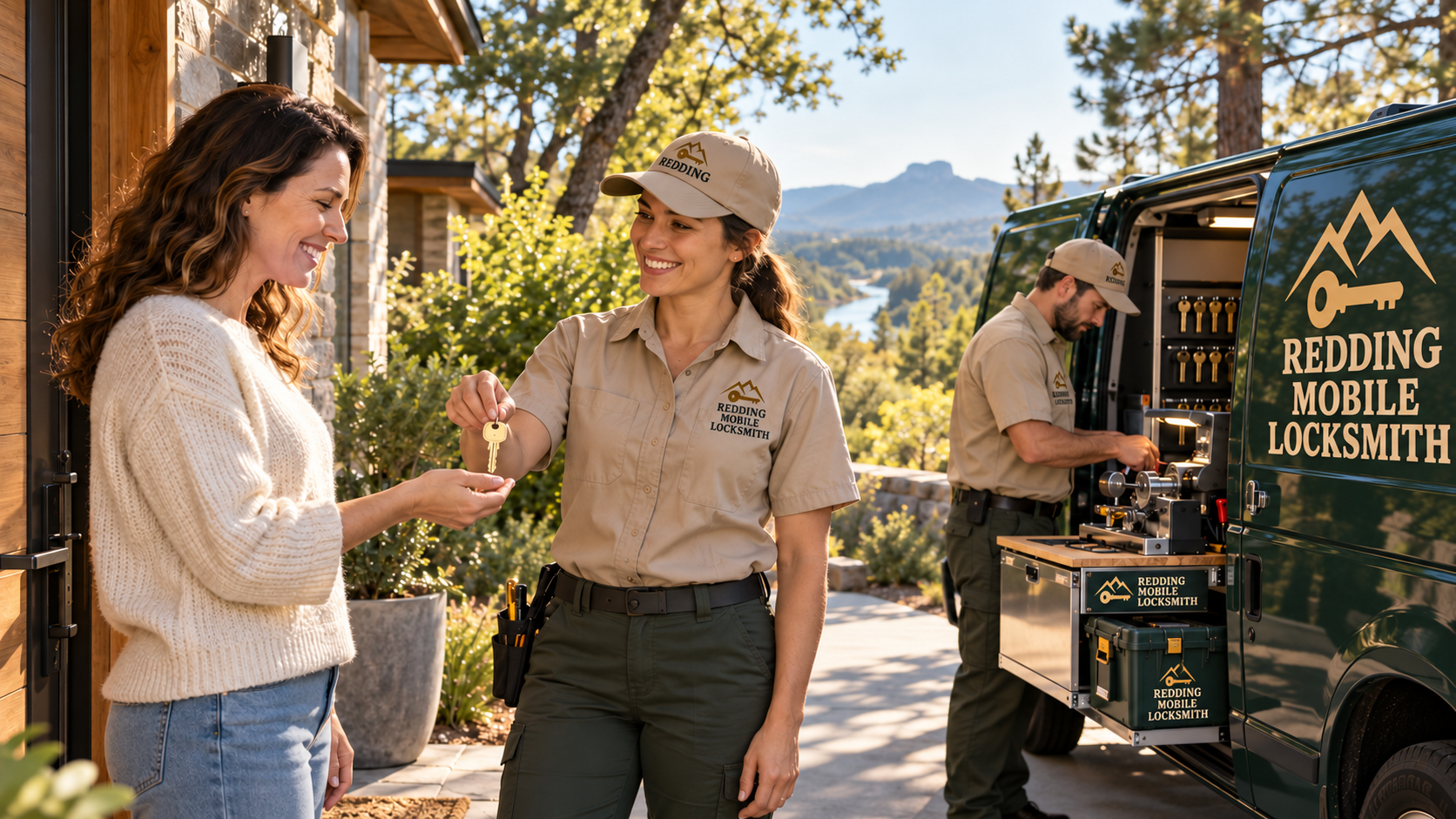
If something cannot wait, emergency help any hour in Millville explains how urgent requests work. We are a 24 hour service, and our branded van carries tools, key cutting and programming equipment and common hardware, which matters a great deal on a rural call.
Helping us find you on a private road
Addresses can be unreliable on private roads, so the details you add in the request form do real work. Say which road you turn from, whether there is a gate, and what you can see at the turn. A distinctive feature such as a large tree, a mailbox cluster or a color of gate helps more than a number.
Tell us about the surface too. Gravel in dry weather is one thing, mud in a wet spell another. If the last stretch is steep or narrow, say so. And let us know if someone will meet the van at the gate or if it must be left open.
We do not promise arrival times, because roads and weather differ, and an honest answer is better than a hopeful one. What we offer is clear communication. Our page on emergency help at any hour explains how that works.
Close neighbors
Millville lies east of Redding, not far from Palo Cedro, and shares many concerns with Cottonwood and other rural parts of the county.
For a full picture of what we do, browse our full list of help. If a question is nagging you, the guides in Neighbors Ask are a good place to start.
Good to know
Common questions
Do you serve Millville and the roads around it?
Yes. Millville, ZIP 96062, is one of seventeen communities we serve in Shasta and Siskiyou counties. Describe your road, any gates and the condition of the last stretch in the request form, and we will plan the visit with that in mind.
Should I lock my well house or pump enclosure?
A simple lock is a sensible precaution, because losing a pump can leave a household without water. Choose a weather tolerant padlock with a closed shackle, and check it every season. Corrosion can seize a lock that has not been touched in a year, which is its own kind of problem.
How do I deal with a lock that freezes on a cold morning?
Do not force the key, since a stiff key can snap in the lock. Warm the lock gently and try again. Afterward, clean it and apply a lubricant suited to key cylinders. If it keeps freezing, the lock may be worn or damp inside and may need repair or replacement.
Can a lost truck key be replaced without towing?
Often yes. A mobile technician with key cutting and programming equipment can make a new key at the vehicle's location, including the chip that the engine needs to recognize. Tell us the make, approximate year and the type of key, and we will arrive with the right tools.
Is it worth rekeying a country house I inherited?
Usually it is. An inherited property may have keys held by relatives, workers and earlier occupants, and nobody may know how many. Rekeying makes every old key useless and gives you a clean set, without replacing all the hardware. It also gives you a chance to check each door.
Can I phone for service in Millville?
Not yet. The call line is coming soon, so the request form on our contact page is the way to reach us for now. It handles urgent and planned work alike. Tell us where you are, what has happened, and whether it cannot wait.