
Home / Cottonwood / New Lock Installation in Cottonwood
Installation, Cottonwood
New Lock Installation in Cottonwood: Door Prep, Strikes and Alignment
A lock is only as good as the door it is fitted to. This page follows an installation from bare door to final test, so you know what good work looks like on your Cottonwood property.
Installation, Cottonwood
The lock is the easy part
Picture a small shop owner in Cottonwood closing up for the evening, pulling the door shut, and turning a key that takes three tries to catch. The owner decides it is time for a new lock. It sounds simple: buy one, screw it in. But anyone who has done this knows the surprise. The new lock does not quite fit the old holes, the bolt hits the frame at a slight angle, and the door that closed smoothly yesterday now needs a shoulder.
The truth is that a lock is a small mechanism in a large system. The door, the frame, the hinges, the strike plate and the floor all take part. A new lock placed into a door that has shifted will perform no better than the old one. That is why a careful installation spends more time on the door than on the lock, and why a locksmith asks to see the door closing before suggesting a thing.
In a rural community with acreage, ranch properties, farm and shop buildings, long driveways and gates, doors often live hard lives. They face dust, sun and cold, they carry weight from heavy use, and some are decades old. Installing a lock on such a door means respecting what it has become, not what the drawing says it should be. This page explains the steps so you can follow along, ask questions and judge the result.
Step one: reading the door
Before touching a screwdriver, the installer looks at the door in its frame. Is it solid wood, hollow core, metal or fiberglass over a foam core? How thick is it? Is it square? Does it swing freely, or does it drag at the top or the bottom? Does the gap along the latch side look even from top to bottom? Each answer decides what hardware will work and what preparation is needed first.
Door materials matter more than most people think. A solid wood door accepts a standard bore and holds screws well. A hollow door needs reinforcement around the lock, or the lock can crush the skin when tightened. A metal door has a specific hole pattern, and drilling it wrongly can bend the skin. A fiberglass door may have a wood block inside to hold the lock. Our page on how locks fit different doors explains these differences.
The installer also looks at the frame. Is the wood sound, or is it cracked near the old strike? Are there signs of past forced entry, such as splits, pry marks or patched screw holes? A frame that has been damaged needs repair or reinforcement before a new lock can do its job. It is better to hear this at the start than to discover it when a deadbolt is mounted into weak wood. A good installer will tell you plainly what they see. If a repair is needed, ask what it involves and whether it can be done during the same visit, since a lock mounted into a damaged frame is only a cosmetic improvement.
Step two: door prep and the bore holes
Most residential and light commercial locks use two holes in the door: a large one on the face, usually about two and an eighth inches across, and a smaller one drilled into the edge of the door for the latch. The distance from the edge of the door to the center of the large hole is called the backset. Common backsets are two and three eighths inches or two and three quarters inches. Matching the lock to the existing backset saves a great deal of work.
If the new lock needs different holes, the installer uses a hole saw and a drill guide, often a jig that clamps to the door so the cuts stay square. Cutting freehand is how doors end up with ragged holes and loose locks. Drilling is done from both sides when needed, to avoid splintering the face. A clean hole lets the lock sit snug, and a lock that sits snug lasts longer than one that rattles in a loose bore.
On the edge, the latch hole must run straight into the face hole. A slight angle makes the bolt bind. The edge of the door also gets a shallow mortise, a rectangular recess cut so the latch plate sits flush with the surface. If this recess is too deep or too shallow, the plate will stand proud or sink in, and the bolt will not line up with the strike. These details sound dull, but they decide whether the lock feels crisp or sloppy.
- Check the existing bore size and backset before choosing a lock.
- Use a jig and hole saw so the cuts stay square and clean.
- Cut the edge mortise to the exact depth of the latch plate.
- Reinforce hollow or worn areas before mounting the hardware.
Step three: the strike plate and why it matters so much
The strike plate is the metal piece on the door frame that receives the bolt. It looks like a minor part, but it does a great deal of work. When someone pushes or kicks the door, the force travels through the bolt into the strike and into the frame. If the strike is thin, attached with short screws, or set in soft wood, the frame can split. Many break ins succeed not by defeating the lock but by splitting the frame around a weak strike.
A good installation uses a strike plate that fits the frame's profile, with a recess cut to the proper depth, and screws long enough to reach the solid framing behind the trim. Three inch screws are commonly used on the hinge side and strike side for this reason, though the right length depends on the building. Some installers add a reinforcing plate or a longer strike box. Our page on what makes a good strike plate goes through the features.
Alignment is the other half. The bolt must enter the strike hole squarely, with a little room to spare. If it rubs on one side, the lock will feel stiff and the door will not latch consistently. The installer holds the door closed, marks where the bolt lands, and adjusts the strike position accordingly. Sometimes a small file adjustment widens the hole by a hair. It is meticulous work, and the reward is a door that closes and locks without a thought.
Step four: mounting, tightening and testing
With the holes cut and the strike set, the lock itself goes in. The latch slides into the edge, the outer and inner halves of the lock join through the door, and long screws pull them together. These screws should be snug, not crushed. Overtightening can bind the mechanism or distort a thin door skin. The installer then fits the trim and the handle or knob, checking that nothing rubs against the door surface.
Testing comes next. With the door open, the installer turns the key and the thumb turn to make sure the bolt extends and retracts fully. Then they close the door and repeat the process. The bolt should slide into the strike without the door being lifted, pushed or pulled. The latch should click into place and hold. The key should turn in a smooth motion. Any binding is investigated and fixed on the spot, not left for later.
A final check is to open and close the door several times from both sides, with and without the key. For a shop, test it as the owner would at closing: pull the door shut, lock it from the outside, and try the handle. Our page on new lock installation describes the usual steps in more general terms, and our guide on changing a door handle helps decide what you can do yourself.
When the problem is the door, not the lock
Sometimes the real reason a lock fails to catch is that the door no longer hangs true. Doors sag over time as hinge screws loosen, as the wood swells in damp weather, or as the building settles. When a door sags, the latch drops below the strike, and the owner blames the lock. Replacing the lock will not fix that. The hinges need tightening or shimming, or the door needs planing, before anything else.
Our page on why doors sag and what it does to locks explains the usual causes. For a shop with a heavy door that swings all day, hinges can wear out. In a dry Cottonwood summer, wood shrinks and leaves gaps. In wetter months, it swells and can bind. A locksmith will check for these conditions and either correct them or suggest who can.
If the door itself is beyond saving, it may be wiser to replace it than to keep patching. A new door with a prepared frame and quality hardware can be a better investment than a fresh lock on an old slab. That is a bigger project, but a locksmith can advise on what is reasonable, and on what the door needs to carry the hardware you want. Ask to be told honestly, and expect a plain answer.
Choosing the lock to install
Once the door is understood, the lock choice is easier. For an exterior house door, a deadbolt paired with a latch set is the standard. For a shop or outbuilding, a keyed deadbolt, a hasp with a padlock, or a lever lock may be better. For a gate or a shed, a padlock designed for outdoors fits. The key is to match the lock to the use, the door and the level of security you want.
Grade matters here. Locks are graded by how well they resist wear and force, and a heavier grade costs more but lasts longer and resists more abuse. Our page on what lock grade means explains the idea. A busy shop door that opens a hundred times a day deserves a sturdier lock than a guest bedroom. A rarely used shed may not need the most robust option.
Think also about keying. Do you want the new lock to match your existing keys, so one key runs several doors? Or to be a new, separate key? A locksmith can key the new lock to match, rekey old locks to fit, or set up a fresh system. If several people use the building, plan who gets keys. And decide up front whether a keypad or smart lock suits you, since these change how the door is prepared.
What to prepare before the visit
A little preparation makes the visit go smoothly. Clear the space around the door so the installer can work. Know which locks you want installed and on which doors. If you have the lock already, have it at hand with its box and instructions. Note the thickness of the door if you can, and any problems you have noticed, such as sticking, rubbing or drafts. A photo of each door from inside and outside is useful.
If the door is part of a rental or a shared property, check with the owner or manager before work starts. Rules about changing locks vary, and some require approval or specific hardware. If you are unsure, ask. Also think about security during the work: when the old lock comes out, the door is briefly unsecured, so plan to be present, or to have someone there you trust, until the new lock is tested.
Make a list of who needs keys and how many. Decide whether any older keys should stop working. If this is a new building, note whether doors will be keyed alike. Our page for home lock service in Cottonwood walks through every lock on a typical property, and door hardware for business in Cottonwood covers busy doors in more depth.
How Redding Mobile Locksmith handles an installation
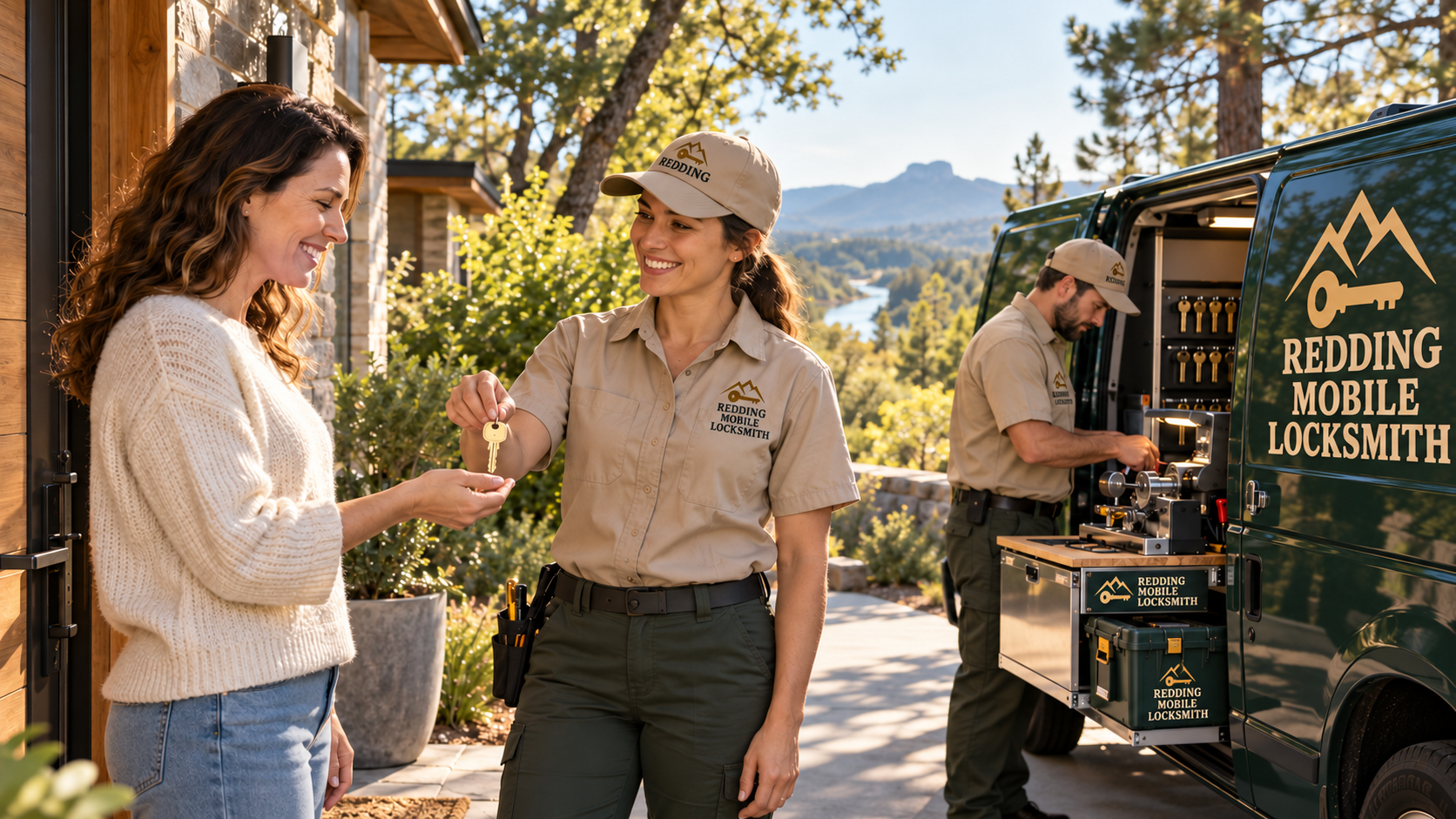
Redding Mobile Locksmith comes as a branded team in uniforms, working from a branded service van that carries professional tools, key cutting and programming equipment, and common hardware. For an installation, that means the right drills, jigs and strike plates are on hand, and keys can be cut on site. The team will walk the door with you, explain what they see, and agree on a plan before they start.
During the work, expect the steps described above: reading the door, preparing the bore and edge, setting the strike, mounting the lock and testing. At the end, you should receive working keys, a lock that turns smoothly, and a door that closes and latches without effort. Ask the installer to show you how to use any feature that is new, such as a thumb turn, a keypad or a locking lever. Keep the paperwork or any small spare parts that come with the lock in a labeled envelope, because they are surprisingly hard to find later when a screw goes missing.
For more detail on related work, see home lock service and business lock service. For the local picture, visit the Cottonwood page and the Anderson page. When you are ready to schedule, use the request form, since the phone line is coming soon, and describe the door and the lock you have in mind.
Good to know
Common questions
Why does a new lock sometimes not fit the old holes?
Locks are made to standard bore sizes and backsets, but older doors may have different or enlarged holes. A locksmith measures the existing holes and either picks a matching lock or adjusts the door. Bringing a photo and the door thickness to your request helps the team prepare.
What is a strike plate and why does it matter?
The strike plate is the metal piece on the door frame that receives the bolt. When the door is pushed hard, the force goes through it into the frame. A solid strike with long screws into the framing makes the door much harder to force open.
Can I install a lock myself?
Some people do, especially for simple replacements on a door that is already prepared. Problems arise when the door is damaged, the holes do not match, or alignment is off. A locksmith can fix those details and test the result, which is why many owners prefer to hire help.
Why does my door still not latch after a new lock?
The cause is often the door, not the lock. Loose hinges, a sagging door, swollen wood or a misaligned strike can all keep the bolt from entering the frame. An installer checks the door and frame and corrects the alignment as part of the job.
Should my shop and my shed use the same key?
It can be convenient, since locks and padlocks can be keyed alike. The trade off is that a lost key opens everything. Many owners use one key for general areas and a separate key for the office or cash area, and keep a clear list of who holds what.
How do I ask for a new lock installation in Cottonwood?
Use the request form on our contact page, because the phone line is coming soon. Describe the door, the type of lock you want, any problems you have noticed, and where on the property the door is. Photos help the team arrive with the right parts.