
Home / Shasta Lake / Home Lock Service in Shasta Lake
Shasta Lake home locks
Home Lock Service in Shasta Lake: Keeping a Household Secure
A home is only as secure as its keys are accounted for. Here is how a Shasta Lake household can keep its locks working and its keys under control through moves, repairs and years of ordinary wear.
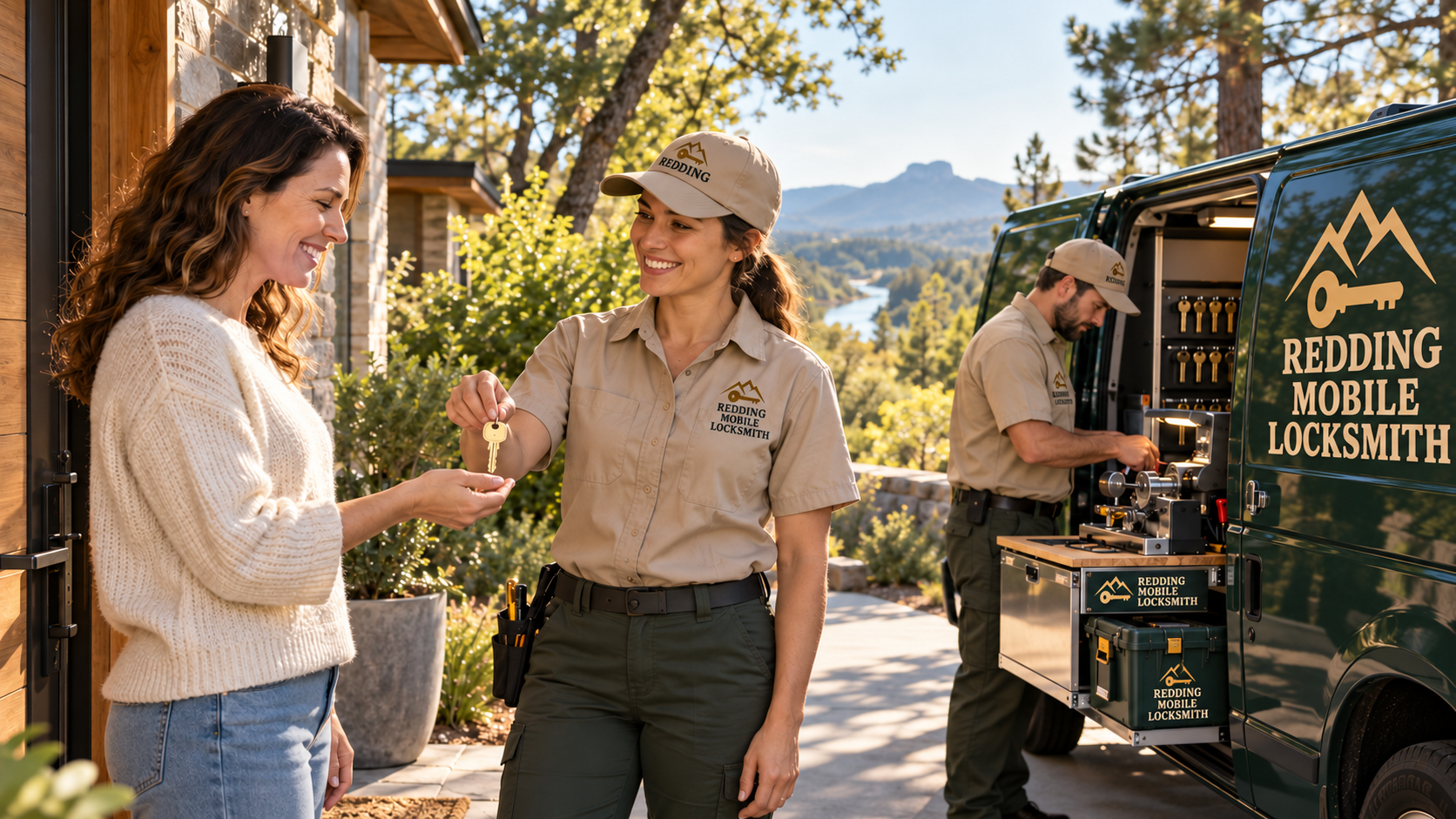
Shasta Lake home locks
The person who holds the only key
Most communities have a volunteer like this one. Imagine a member of a church or a club in Shasta Lake who, years ago, was handed the key to the hall because they lived close and were reliable. Nobody made a copy. Nobody wrote down who else might have one. The key lives on a hook by their kitchen door, and everyone assumes that arrangement will last forever.
It will not, of course. The volunteer moves, falls ill, or loses the ring on a fishing trip, and suddenly a whole group is standing outside a locked door with no one who can open it. The same pattern shows up inside ordinary households, just with smaller stakes: one person holds the key to the side door, the garage entry or the shed, and the others have never thought about it.
This page uses that scene as a reminder. Home lock service is not mainly about dramatic emergencies. It is about the quiet job of knowing who has which key, which locks are wearing out, and what to do when circumstances change. A household that handles those things calmly seldom needs the dramatic kind of help.
What home lock service covers
A mobile locksmith's work on a home falls into a handful of groups. There is getting in when you are locked out, making or replacing keys, changing who can use the existing locks, repairing the locks that are failing, and installing new ones where they are needed. Each of those has its own page on this site, and this page ties them together for a household.
The point of having one team for all of it is continuity. When the same service looks after your front door, your back door and your garage entry, they build a picture of how your home is protected. They can tell you when a lock is nearing the end of its life, and suggest a rekey when keys have scattered, without selling you a larger job than you need.
Our broader page on home lock service describes the full range. Here we focus on the situations that come up most often for families in a place like Shasta Lake, where people move in and out, rent and own, and keep one eye on the lake and the other on the commute.
A short conversation at the start of a visit usually settles what is needed. Tell the technician about the household: how many adults, whether children use the doors, whether anyone has trouble with stiff locks, and whether a spare key is already out in the world. Those details shape the advice much more than the make of the lock does.
- Opening a door when you are locked out of your own home.
- Rekeying locks so old keys stop working.
- Repairing or adjusting locks that stick, spin or rattle.
- Replacing worn hardware with something sound.
- Making spare keys and organizing who holds them.
Shasta Lake homes and the way people live in them
Shasta Lake sits near the dam and the lake along Interstate 5, with family homes, rental housing, seasonal visitors and many people who commute to Redding for work. That mix means keys travel. A key might be held by a landlord, a tenant, a relative who helps with the kids, a neighbor who waters the plants, and a contractor who came by in spring.
Rentals add another layer. Tenants come and go, and each turnover is a chance for a key to wander. Homeowners who rent out a room, a unit or a cabin have the same problem. If you do not know how many copies of a key are in circulation, then you do not truly know who can open your door.
The people most often caught out are those who assume the previous occupants handed back every key. That is a generous assumption, and not one a careful household can afford to rely on. We return to the question in a later section and in our guide on whether to rekey after buying a house.
Rekeying after a move or a scare
A pin tumbler lock, the common kind in homes, contains a row of small pins of different heights. The correct key lifts each pin to exactly the right level, so the cylinder can turn. Rekeying replaces those pins with a new set cut for a new key. The lock stays in your door, but every old key becomes useless.
It is one of the most sensible things a household can do after moving into a new home, after a roommate leaves, after a key is lost, or after any event that leaves you unsure who holds a copy. It is typically less work than replacing locks, and the new key can be made to open several doors at once if you wish.
Our service page on rekeying your home describes the process in detail. A related guide, is it better to rekey or replace, helps you choose. The short version: if the lock is in decent shape and the only worry is keys, rekeying fits. If the lock itself is worn, replacement is wiser.
After a rekey, test every new key in its lock yourself, and keep the old keys until you have confirmed nothing was missed. Then retire them properly. Old keys have a way of ending up in a junk drawer, and a junk drawer full of keys that no longer work can be mistaken for keys that do.
Signs that a lock is wearing out
Locks give notice before they fail. A key that sticks, needs a jiggle, or grinds as it turns is telling you something. A deadbolt that does not extend all the way, a handle that wobbles, or a latch that catches only if you lift the door are all small warnings. The time to act is when the warnings start, not when the key breaks off in the lock.
Several things cause the wear. Years of use rub the pins and the key. Dust and grit find their way into the cylinder. Moisture corrodes the metal. And the door itself shifts with the seasons, so the bolt starts to bind against the strike plate. Each of these is worth recognizing, because the fix differs.
Our guide on how to tell if your locks are worn out goes through a simple checklist you can run through at home. And if you find a lock that turns hard, why a lock turns so hard explains the usual causes and what you can safely try before calling anyone.
Repairs, adjustments and when to replace
Many lock problems are not lock problems at all. A bolt that binds is often a door that has sagged a fraction of an inch. A key that sticks may be a cylinder full of grit. A handle that spins loosely may need a screw tightened. A technician who looks at the whole assembly can often solve the issue with an adjustment, a cleaning or a small part.
Other times the lock has reached the end of its useful life. Worn internal parts do not heal, and a lock that has been repaired repeatedly is a lock that is telling you to replace it. A careful technician explains the difference honestly, and does not suggest a replacement when an adjustment would do.
If you want more detail, our page on lock repair and adjustment covers what can be fixed and how. One practical tip: use only dry lubricant intended for locks, as heavy oils attract dust and gum up the pins over time.
If a deadbolt is stiff only in winter or only in summer, the cause is often the door moving with temperature and humidity, not the lock. Pay attention to whether the trouble tracks the weather. A technician who hears that pattern knows to look at the hinges and the strike before blaming the cylinder.
Spare keys, and who should have one
Every household needs a plan for spare keys. The usual advice is to keep at least one extra key somewhere other than the main ring, in a place that is secure and that you will remember. Avoid hiding keys outside in obvious spots, since those are the first places anyone looks.
How many keys is enough? That depends on the number of people and doors. Too few and you risk lockouts. Too many and you lose track of who holds what. Our guide to how many keys a household should keep offers a way to think about it.
The volunteer from the beginning of this page is a reminder of what a plan looks like. Written down, it says who holds a key, what it opens, and where the spare lives. Nothing about that is complicated. It just takes a little honesty and a pencil, and it spares a household a great deal of trouble later.
Teenagers and older relatives deserve a place in the plan too. A teenager who keeps losing keys might do better with a keypad code on one door. A relative who has trouble with small keys might prefer a lever handle and a larger key head. These are ordinary adjustments, and they keep people from being locked out of their own lives.
When you are locked out
Lockouts happen to careful people. A door swings shut behind a child. A key stays on the kitchen counter. A lock sticks in the cold and you step away to find a tool. If it happens to you, check the other doors and windows only if that is safe, and avoid forcing anything. Forcing a door can damage the frame and cost far more than the lockout itself.
A mobile locksmith opens a door using methods designed to protect the lock and the door where possible. The technician will ask for identification that connects you to the home, because careful professionals confirm that before opening anything. Have it ready, and the process goes smoothly.
Our page on being locked out of your home describes what to expect. And if a lockout happens at night, what is the safe thing to do when locked out at night gives practical, calm advice.
Moving in, moving out, and the keys that stay behind
Moves are when keys scatter. The seller hands over a set, but the agent, the cleaner, the neighbor and the earlier tenant may all have kept copies. A rekey on the first day in a new home closes that door for good, and it makes sense even if everyone involved is trustworthy.
Moving out has its own checklist. Collect every key from every person. Count them. If you are a landlord, change the locks between tenants, or at least rekey them. If you are a tenant, ask your landlord what is expected, because the rules about lock changes vary and depend on your lease. We do not give legal advice, but the question is always worth asking early.
Our guide on handling keys when a tenant moves out goes through the steps. If you are on the buying side, remember that a rekey is one of the simplest improvements to a new home's security.
Lake visitors, seasonal use and a home that sits empty
Near a lake, many homes sit empty for part of the year, or are used by family members who come and go with the seasons. A home that is closed up for weeks needs a plan: who has keys, who checks on the place, and how the locks are tested before the busy season.
Check the locks when you open up the house. Turn every key. Operate every deadbolt. If one sticks, address it before you need it urgently. Dust and damp can slow a lock that sat unused for months, and a little attention at the start of the season can prevent a lockout at the worst time.
If you rent your home to visitors, think about how keys or codes are handed over. Keypad locks allow you to change a code between guests without cutting keys. Our guide on managing keys at a rental with many guests is a good starting point.
Next steps and nearby help
If you are ready to talk, send a request through the form on our contact page. Describe the doors, the problem and any history of lost keys. The phone line is coming soon, and the team answers requests at every hour. If you are not sure which of the services you need, say so in the request and describe what is happening instead. A clear description is more useful to the technician than a guess at the correct name for the job.
Related pages close to home include new lock installation in Shasta Lake, key programming and fobs in Shasta Lake and cars and trucks in Shasta Lake. For the whole picture of the area, visit our Shasta Lake overview.
The same team also serves Redding and Anderson, which helps if your commute or your family spans more than one town. A household that keeps its keys counted and its locks maintained is, we think, a household that sleeps well.
Good to know
Common questions
How do I know if I should rekey or replace my locks?
If the locks work smoothly and your worry is who holds keys, rekeying is usually enough. If locks stick, rattle or look worn, replacement may be wiser. A technician can look at the condition of each lock and suggest the right approach without pushing a bigger job.
Should I rekey my home right after moving in?
It is a sensible habit. Previous owners, tenants and visitors may all have kept copies. Rekeying makes every old key useless while keeping the locks you have. It also lets you set up a clean key plan from the start.
Can one key open all the doors of my house?
Yes. Locks can be rekeyed or ordered so that several doors share one key. This is convenient for households that dislike carrying many keys. Some people prefer a separate key for outbuildings, which can also be arranged.
What should I do if my key breaks off in the lock?
Stop using that lock and do not try to dig the piece out with glue or pliers, which usually makes things worse. Mention it when you call. A technician has thin extraction tools and can usually remove the broken piece without damaging the cylinder.
My home sits empty part of the year. Any advice for the locks?
Test every lock when you open the home for the season, and treat any that stick before you need them. Decide who holds keys while you are away. Dust and damp can slow lock parts that sat unused, so a gentle check helps.
Is the service available at night for a home lockout?
The team answers requests around the clock, so a night lockout is handled like any other. You will be asked to show identification that connects you to the home. Send details through the request form on the contact page, as the phone line is coming soon.