
Home / Granada / Emergency Help Any Hour in Granada
Granada emergency help
Emergency Help Any Hour in Granada, California
Needing a locksmith in the middle of the night is stressful enough without not knowing what the call will be like. Here is how an around the clock conversation goes, and what helps most when you live alone in Granada.
Granada emergency help
A call at an odd hour
Imagine a retiree who lives alone on a quiet road outside Granada. She steps out onto the porch late one evening to bring in the cat, the wind pulls the door shut behind her, and the deadbolt she always remembers to throw has clicked into place. Her keys are on the kitchen table. Her phone is inside. The nearest neighbor is a field away.
Situations like this are the reason a 24 hour service exists. Most lockouts and lock failures do not happen at convenient times, and a person who is cold, tired or worried needs somewhere to turn without waiting for business hours. The aim of this page is to take some of the mystery out of that turn, so the call itself feels familiar before you ever have to make it.
We will describe the conversation step by step, say what a dispatcher and a technician will ask, and explain what you can do while you wait. Nothing here replaces emergency services. If anyone is hurt, trapped, ill or in danger, call emergency services first and everything else second.
Living alone adds a layer to every one of these decisions. There may be nobody nearby to ask, nobody to hold a spare, and nobody who will notice if a call goes unanswered. That is not a reason to be anxious. It is a reason to make a couple of small arrangements while things are calm, which the later sections of this page describe.
When to call emergency services instead
A locksmith is the right call for a locked door, a broken key, a failed lock or a car you cannot enter. A locksmith is not the right call when a life is at risk. If a child or a pet is locked inside a vehicle, call emergency services right away and follow their directions. If someone inside a home may be unwell and cannot answer the door, call emergency services as well.
If you believe an intruder is inside your home, or you see signs of a break in, step away to a safe place and call the authorities before anything else. Do not go in to look around. A locksmith can help later, once the situation is safe and the people responsible for your safety have done their work.
That ordering keeps you safe, and it also keeps the later conversation with us simple. After a break in, for example, the lock repair and the question of whether to change the keys can wait until you and the authorities are done. Our guide on what to do about locks after a break in covers that part.
It is perfectly fine to ask the dispatcher to slow down or repeat a question. People calling at night are often rattled, and a good dispatcher expects that. You might also be asked for a callback arrangement so that the technician can reach you if the road is hard to find or the plan changes.
What the dispatch conversation sounds like
When you reach an around the clock dispatcher, the tone should be calm and unhurried. The first questions are usually simple. Where are you, and are you safe right now? What has happened? Is it a home, a car, a shop or a gate? Is anyone with you?
After that comes detail. For a house, the dispatcher wants to know what kind of door it is, whether the lock is a deadbolt or a handle, and whether there is a side door, a window or a spare key somewhere. For a vehicle, the questions turn to make, model and year, and whether the keys are inside. For a lock that has failed, the dispatcher asks what it was doing before it quit.
You do not have to answer perfectly. Plain descriptions are fine. Saying that the big brass lock above the handle will not turn tells the technician nearly as much as any technical term. Our emergency help page outlines the service in general, and this page adds what matters for Granada.
Think, too, about who else might be involved. If a family member holds the deed, a landlord owns the building, or a caregiver is helping you, tell the dispatcher at the start. The person who authorizes the work should be someone entitled to do so, and a clear picture of that early on avoids delays at the door.
What the technician needs from you
Two things come before any work. The technician needs to confirm that you are entitled to the access you are asking for, and needs a safe way to do the job. Expect to be asked for identification and for something that links you to the home or vehicle, such as mail with your name or a registration. This protects you, because a service that opened doors for anyone who asked would be dangerous for everybody.
If you are locked out and your identification is inside, say so. There are sensible ways around that, which a dispatcher can describe: perhaps a neighbor who knows you, or a document on your phone. Do not worry about being turned away for being honest. Tell the dispatcher the situation, and the technician will tell you what is workable.
Once identity is settled, the work itself is mostly a matter of choosing the gentlest method for the lock in front of them. A professional would rather open a door without damage than drill it, and will explain when damage is unavoidable.
If you have no shelter and the night is bitterly cold, which is common in this part of Siskiyou County in winter, treat warmth as the first concern. Sit in a vehicle you can open, step into a lit building if one is reachable, or ask a neighbor for a little time. A technician would much rather arrive to find you warm than waiting stubbornly in the cold.
Staying safe while you wait
Waiting is the hard part. The most important rule is to stay somewhere safe. If it is cold, find shelter, such as a porch, a car you can get into or a neighbor's home. If you are in the dark on a rural road, keep your phone charged and your location clear. Share exactly where you are, including any gate, driveway or landmark a driver would need.
If you are alone, consider letting a friend or relative know what is happening. A short message that says where you are and that help is on the way is reassuring to both of you. Do not try to climb through windows, force doors or use tools to open a lock, because injuries and damage are more likely than success.
If the situation changes, call again. Tell the dispatcher if you have found a way in, if you feel unsafe, or if the weather is turning against you. They can update the plan. Our guide on being locked out at night has more on keeping yourself safe.
Many properties here have gates that are kept closed to stock and to the wind. If you cannot open the gate from where you are, say so, and describe how it latches. A technician who knows to expect a chain, a wire loop or a padlock can come prepared. It is a small point that can save a lot of fumbling in the dark.
Rural roads, gates and finding the house
Granada sits in the Shasta Valley of Siskiyou County near Montague, among rural homes, open ranch country, outbuildings and gates. For a technician arriving in the dark, the biggest challenge is often finding the right driveway. Rural addresses can be hard to read at night and gates may be closed.
Help the dispatcher by describing the approach. Which road do you turn onto? Is there a mailbox, a gate, a cattle guard or a distinctive tree? Is the driveway long, and does it fork? If you can, switch on an outside light and open the gate before the technician arrives. These small kindnesses can make the difference between a smooth arrival and a lost half hour.
Remember to mention if there are animals loose on the property. A dog that is friendly to you may not be friendly to a stranger in the dark, and a technician needs to know before getting out of the van. A brief word to the dispatcher keeps everyone safe.
Seasons shape the answer too. A broken lock in a heat wave is a nuisance, while a front door that will not latch during a winter storm is a problem the household wants dealt with that night. Tell the dispatcher about the weather, because it changes how soon the work matters to you.
What counts as an emergency
The word emergency means different things to different people, and the dispatcher will help you sort it out. Lockouts at night, a door that will not lock when you need to leave the house, a key broken off in a lock, a break in that left a door insecure, and a car you cannot enter in a lonely spot all count. So does a business door that will not close when staff are leaving for the evening.
Other jobs are important but can wait for the next day, such as a stiff lock that still works, a spare key you would like to have, or a rekey after a purchase. If your situation is on the edge, say so and ask for advice. The dispatcher may suggest a plan that deals with the immediate risk and schedules the rest.
Our pages on locked out of your home and locked out of your car describe those two common emergencies in detail, and the guide on what a lockout is and what to try first lists safe first steps before you call.
A written list is worth the five minutes it takes. Put the make, model and year of your vehicles, the type of lock on each exterior door, and the name of a trusted neighbor on a single card. Keep it somewhere you can reach if you are standing outside, such as a wallet or a glove compartment, so it does not end up locked in the house.
Preparing for a call you hope never to make
Much of the useful emergency preparation is done on a quiet afternoon. Put a spare house key with a trusted neighbor or relative, or in a secure place that only you know. Keep a card in your wallet with the details of your vehicle. Save the number of the service in your phone once it is available.
For an older person living alone, a spare key with a trusted person is a particularly good habit. Our guide on lock choices for an older relative living alone explains options such as keypad locks, which remove the need to carry a key at all.
- Know the make, model and year of every vehicle in your household.
- Keep proof of address, such as a utility bill, where you can reach it from outside.
- Tell one person where your spare keys are kept.
- Check that your outside light works and your address is clear from the road.
- Keep a small flashlight in the car and on the porch.
Where the contact line stands today
The phone line for Redding Mobile Locksmith is not yet published, and it is described on the site as coming soon. Until then, the place to start a request is the form on the contact page, and you can find it through our request form. Please do not use the form for a danger to life, because it is not a substitute for emergency services.
When the line goes live, the same questions covered above will apply, and being ready will make the call shorter and calmer. In the meantime, reading these pages is a reasonable way to prepare, and you can bookmark the Granada overview so the information is at hand.
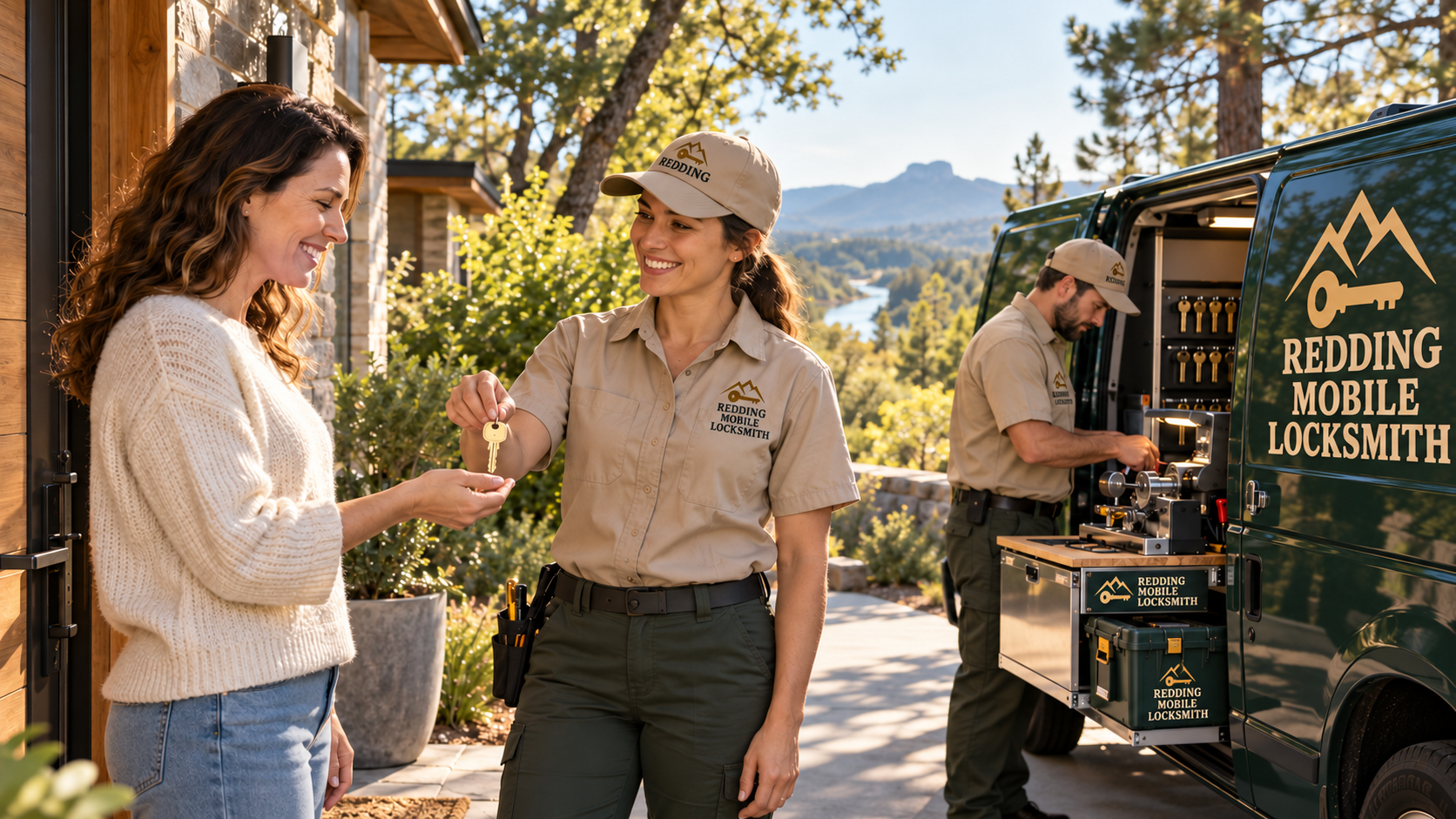
It also helps to know what kind of service you are asking for. Redding Mobile Locksmith is a 24 hour mobile locksmith, and the team works in uniforms and a branded service van carrying professional tools, key cutting and programming equipment, and common hardware. That means many jobs can be completed where you are, without a trip to a shop.
Other pages for Granada and the neighbors
If your emergency involves a car, the page on cars and trucks in Granada explains the kinds of vehicle work handled on site. If it involves a home, home lock service in Granada covers lockouts, repairs and rekeying. The Granada overview lists every local page.
Granada neighbors Montague, and some people on the edge of the valley use both communities. Our page on emergency help any hour in Montague offers a different angle on the same service.
Whatever the hour, the goal is the same. A calm voice, clear questions, a safe wait and a technician who opens the door with as little fuss as possible. That is the standard we aim to meet, and it is what you should expect from anyone you call.
Good to know
Common questions
What should I say first when I call about a lockout?
Tell the dispatcher where you are and whether you are safe. Then describe the problem in plain words, such as a locked front door or keys inside a car. Mention the weather, any animals, and anyone who needs help. Clear, simple answers matter more than technical terms, and the dispatcher will ask for anything missing.
Do I need to prove the home is mine?
Yes, a responsible technician will ask for identification and something linking you to the property or vehicle. This protects you from anyone else gaining access. If your documents are locked inside, tell the dispatcher, who can suggest sensible alternatives. Accepted proof can vary, so ask what to have ready when you call.
What if a child or pet is locked in a car?
Call emergency services immediately and follow their instructions. Do not wait for a locksmith. Once emergency services are on the way, you can also contact a locksmith if the car still needs to be opened. A life at risk always comes before the lock, and responders are trained to act at once.
Can the technician find a rural address in the dark?
Usually, with help from you. Describe the road, the mailbox, any gate or landmark, and switch on an outside light if you can. Open any gate beforehand and mention loose animals. Rural driveways can be hard to read at night, and clear directions make the arrival smooth for everyone.
Will the lock be damaged when the door is opened?
A professional aims to open the door without damage and will tell you if that is unlikely. Most standard locks can be opened by a skilled technician without drilling. If a lock is broken or has an unusual design, the technician will explain the options and agree on the plan with you before continuing.
What if I cannot use the phone at night?
Until the phone line is published, use the request form on the contact page when you have a safe connection, and describe your situation fully. If you cannot reach anyone and feel unsafe, contact emergency services. A neighbor or relative can also place a request on your behalf if you are unable to.