
Home / Neighbors ask / What is a lockout and what should I try first?
Lockout Basics
What Is a Lockout, and What Should I Try First?
A lockout is any moment when the door is shut, the key is not working or not with you, and you cannot get in. Before anything else, make sure everyone is safe, then try the gentle, obvious things in a sensible order.
Lockout Basics
A lockout, defined without the drama
A lockout is simply a situation where you are on the wrong side of a locked door. The key may be inside the house or car. It may be lost. It may be broken off in the cylinder. It may be in your hand but refusing to turn because the lock has frozen or worn out. The word covers a surprisingly wide range of trouble, from a thirty second embarrassment to a real emergency.
What they share is a feeling: the sudden drop in the stomach when you hear the door click and know what that click means. Almost everybody has had it, and almost everybody has said some version of how could I be so silly. You weren't silly. Doors are built to close and lock with very little effort, and human attention is not built to track a key every moment of the day.
This guide is a calm order of operations. It starts with safety, moves through the simple checks that solve a surprising number of lockouts, and ends with how to ask for help without making the problem worse. If you're reading it while locked out right now, skip ahead to the next section and come back to the rest later.
It helps to sort lockouts into three families. In the first, the key exists but is out of reach, inside the car or house. In the second, the key is gone, lost or stolen. In the third, the key is present but the lock will not respond, which can mean a worn cylinder, a frozen mechanism or a door that has shifted. Each family has a different sensible next step, and naming yours gets you halfway there.
First, check that everyone is safe
Nothing else on this page matters as much as this. If a child or a pet is locked inside a vehicle, call emergency services first, before any other step. Heat, cold and time all work against a small person or an animal, and emergency responders can act in ways a locksmith's schedule cannot. Please do not wait to see if you can solve it yourself.
If someone inside a building needs help, such as an older relative who cannot reach the door or a person who is unwell, treat it as an emergency in the same way. A locked door is an inconvenience. A person in trouble behind it is a different order of problem.
If everyone is safe, take a breath. You have time to think. The goal for the next few minutes is not to win a contest against the door. It is to reach the other side without breaking anything you will have to pay to fix later.
Look for the obvious before the clever
Walk around and check every door and every window that you are legitimately allowed to open. In a house, that might mean the back door, a side door, the garage entry or a patio slider. In a car, that might mean all four doors and the trunk or hatch. Sometimes a door you forgot about is simply unlocked.
Check your pockets, your bag, your coat, the car seat, the bottom of the bag again. People find keys in the first place they look more often than they admit, because stress makes us look and not see. Ask whoever is with you to check as well, since fresh eyes help.
If you have a spare key, think about where it is. A trusted neighbor, a relative, a partner at work or a person who keeps a key for you is the gentlest solution of all. Keep in mind that a spare hidden outside under a mat or in a planter is easy for others to find, and you may want to rethink that habit afterwards.
Try to resist the urge to try the same thing ten times. If a door did not open the first three times you pulled it, it will not open the fourth time out of hope. Change the approach instead, and move on to the next idea in the list.
Try phone based options, if they fit
Modern vehicles and some home locks can be opened from an app, a connected service or a keypad code. If your car came with an app or a roadside service, try it. If your door has a keypad or smart lock, check whether a code, a phone credential or a fingerprint will open it.
These routes are worth a minute of attention because they are the cleanest. No tools touch the lock, nothing needs repairing, and you can be on your way. They do depend on battery, signal and account details, so do not be discouraged if one fails.
If you do not know whether your car has such a feature, the manual or the manufacturer's site will say, once you can get to them. Our pages on locked out of your car and locked out of your home describe the professional routes that follow when these do not work.
What not to try
There's a long list of ideas that look clever and end badly. Forcing a key that won't turn can snap it in the lock and turn a simple problem into a stuck key problem. Prying at a door or frame with a screwdriver can bend the door, split the frame or damage weatherstripping. Pouring oil, soap or other liquids into a cylinder can gum up the pins.
In a car, jamming a tool between the window and the seal can damage the weatherstrip, scratch glass or knock a sensor or wire inside the door. Modern doors have airbags, wiring and electronics packed inside, and a coat hanger is a poor match for them. Breaking a window may feel decisive, but it creates a new problem, with glass, weather exposure and a replacement cost.
You also should not borrow tips from videos that show someone bypassing a lock in a few seconds. Those demonstrations usually involve a specific old lock, practice and the right tool. Applied to your own door, the same trick tends to produce damage and no entry.
A good rule of thumb is that anything you would not be willing to explain to the owner of the door afterward is something you should not do to it. That rule alone rules out most of the creative ideas that cause damage. Patience costs nothing, and a damaged door costs a good deal.
The gentle things worth a try on a stubborn key
Sometimes the problem isn't a lockout in the strict sense but a key that will not turn. Try wiggling the key slightly while applying light turning pressure, and check that you have the right key. Many people carry several that look alike. Try pulling the key out a hair and turning again, since some keys are cut slightly off, and a tiny change in depth can let the pins line up.
If the door has swollen or shifted, pushing or pulling the door toward the frame while turning the key can relieve pressure on the bolt. Lift the handle or press the door in a bit and try again. A bolt that is binding on its strike plate may release.
If a lock is frozen in winter, think gently. A small amount of lock specific lubricant or a warmed key can help, but avoid hot water, which can refreeze and make things worse. Our guide on weather and seasons and locks covers more of this, and the note on dealing with a stuck key covers keys that will not come out.
Cars: what is different
Vehicles have their own wrinkles. Many modern cars lock automatically when you walk away with the fob, or when the engine is off and a door closes. Some have a smart entry system where the car senses the fob nearby, and a dead fob battery can make it feel like the car has abandoned you. Try holding the fob against a spot on the steering column or door handle, as some are designed to be read at close range with a weak battery. Your manual will say where.
If the key is inside the car, a technician can usually open the vehicle without damaging it, using tools made for the purpose. The method depends on the vehicle, and the details are not something we publish for obvious reasons. Our guide on how a car is opened without the key explains in general terms what a professional does.
If the key is lost, the story is longer. A replacement may need to be cut and programmed so that the car's immobilizer accepts it, and that is the work described on our replacement car keys page.
Think, too, about what the lockout says about your system. If your fob battery is the reason the car locked you out, replace it before the next trip. If a spare key is hidden somewhere unsafe, move it to a person you trust. A lockout is irritating, but it is also an inexpensive lesson in where your arrangements are thin.
Homes: what is different
Houses present different problems. An exterior door may have a deadbolt, a knob lock and sometimes a security chain or latch. A lockout might involve any one of them, and what matters is which one is actually engaged. A door that is only latched and not dead bolted is a simpler problem than a door that is fully locked.
Remember that other people may be able to help. A person living in the house, a landlord, a property manager or a trusted neighbor with a key may all be easier routes than any tool. If you rent, ask before you do anything that changes the lock, since rules vary and a landlord may have views.
If you must call for help, a technician can often open a residential door without damage, then check the lock and offer to repair, rekey or replace it if needed. The page on home lock service describes what that looks like in more detail.
Staying comfortable and safe while you wait
While you wait for help, think about comfort. In summer, find shade and water. In winter, in the mountain towns, find shelter or a warm layer. If you are in a vehicle on a roadside, stay well away from traffic. If you are alone at night, stay where there are lights and people.
A neighbor's porch, an open business or a friend's car is often a better waiting spot than your own doorstep. Be careful about telling strangers that you are locked out and alone. Tell people you trust, and keep your phone charged and visible.
Our guide on staying safe when locked out at night goes further into this. The short advice is that you can always wait a little longer for a lock, and you should never take risks to avoid it.
If you are waiting in a vehicle in a mountain town in winter, keep the engine's exhaust clear of snow if the engine is running, and keep a blanket or coat on hand. These are small things that a person thinking calmly would do, and a locked door is a good reason to think calmly.
When it is time to ask for help
Once you have checked for safety, tried the obvious, and avoided the temptations above, it is time to ask a professional. Describe your situation plainly and give your location in words someone can follow. Our guide on what to have ready lists the details that help the most.
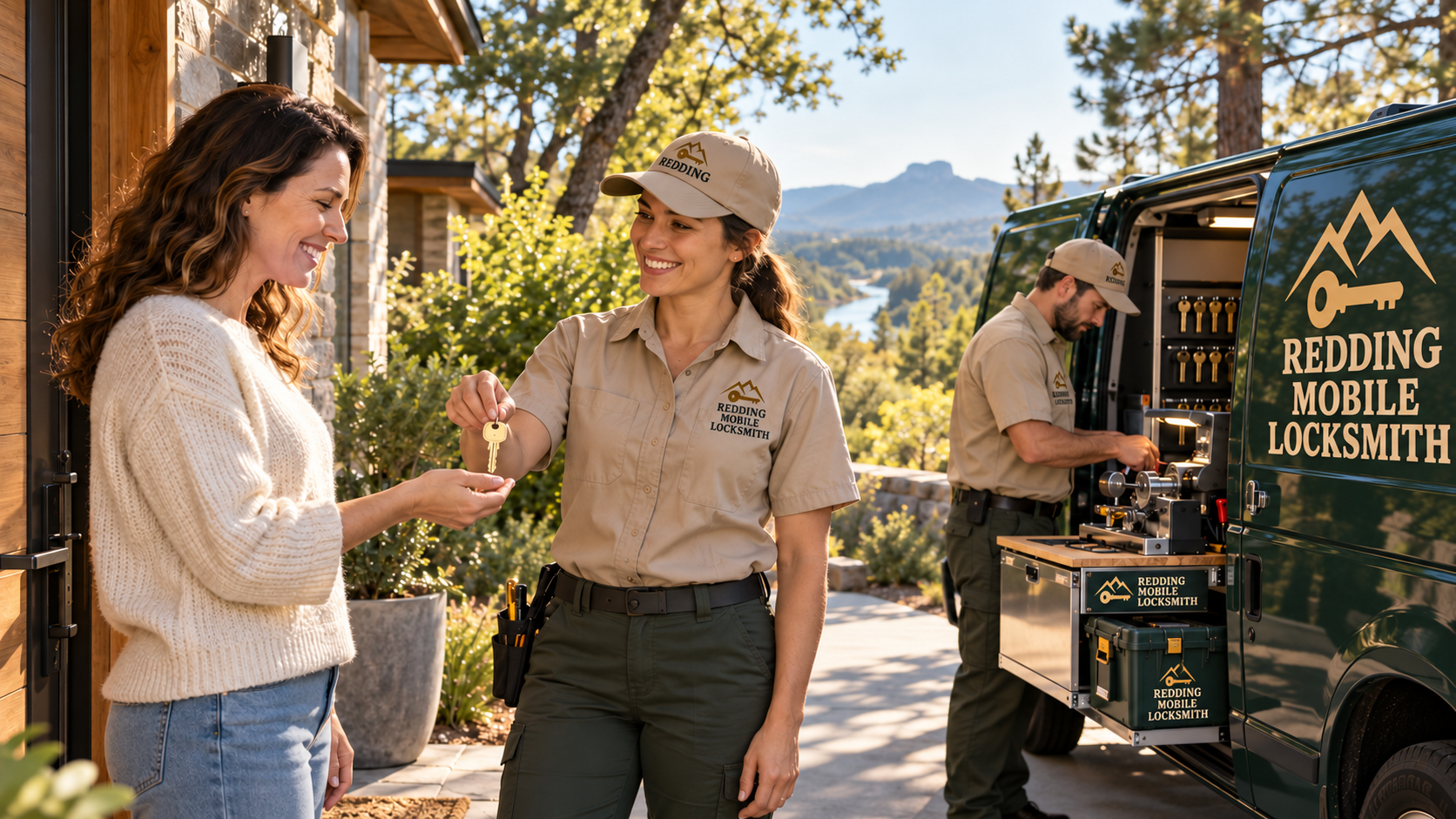
A phone line for Redding Mobile Locksmith is coming soon, so for now the request form is the way to describe what happened. The team works around the clock, and a branded service van carries tools for opening, key cutting and programming, and common hardware.
Afterward, take a few minutes to make sure it does not happen again. Think about a spare key with someone you trust, a keypad or a keyless entry upgrade, or a habit of checking your pockets before you shut a door. Small habits prevent a great many lockouts.
Lockouts at businesses, sheds and gates
Not every lockout happens at a front door. A shop owner might arrive to find a back door lock jammed, a gate padlock refusing to open, or a key to a cash drawer missing. Picture a small shop opening on a cold morning with a stuck rear door. The first steps are the same: make sure no one is at risk, check any other legitimate entrance, and look for a person who holds a spare.
Commercial doors often have heavier hardware, closers and panic bars, so the problem can be a closer holding the door too tightly, a strike misaligned, or a keyed cylinder that wore out. Those are repair questions as much as lockout questions, and our pages on business lock service and door hardware for business describe them.
For sheds, gates and outbuildings, a padlock is often the culprit. Rust, dirt and frozen water can all stop a padlock from turning. Do not hammer at it. Let a professional look, because a gentle approach may save the padlock and the hasp it hangs on, while force usually destroys both. The note on shed and garage padlock questions covers more.
Good to know
Common questions
Is a lockout always an emergency?
No. Many lockouts are simply inconvenient, and you can handle them calmly. They become emergencies when a child, pet or vulnerable person is involved, when you are in dangerous weather or an unsafe place, or when you need to reach something urgent. In those cases, contact emergency services if anyone is at risk.
Can I open my own car with a wire or a tool?
It is not wise. Modern car doors are crowded with wiring, sensors and airbag parts, and a tool pushed into the wrong place can cause costly damage. Trained technicians use tools designed for each type of vehicle. If you are unsure, it is better to wait and ask for help.
Should I break a window if I am locked out?
Almost never. It creates glass, exposure to weather and a repair bill, and it may not even solve the problem if you need a key to start the car. The exception is a true emergency involving a child or animal, and then emergency services should be called first.
What if my key is inside but I can see it?
Seeing the key does not make the lock easy to open from outside. A technician can open most doors and vehicles without damage, using methods made for the purpose. Describe exactly where the key is and what type of door or vehicle you have, and let a professional handle it.
Will a lockout damage my lock?
Not if it is handled properly. Problems arise when people force a lock or pry a door. A careful professional chooses the gentlest method that works and checks the lock afterward. If any damage already exists, they can tell you whether to repair, rekey or replace.
How can I avoid being locked out again?
Build small habits. Check pockets before closing doors, keep a spare with a trusted person, and consider hardware that doesn't rely on a single key, such as a keypad. For vehicles, keep fob batteries fresh. Avoid hiding a key outside, because hiding places are easy for others to guess.