
Home / Neighbors ask / Gate lock questions for country driveways
Rural gates
Gate lock questions for country driveways
A driveway gate out in the country has to survive weather, sagging posts, delivery drivers and the occasional neighbor in a hurry. These are the lock questions people ask us most, answered over the fence.
Rural gates
Why a country gate is its own kind of lock problem
A gate at the end of a long driveway is not like a front door. It stands in the open, miles from anyone who might notice trouble. It swings on posts set in ground that heaves with frost or bakes hard in summer. It has to be opened many times a week, often from a truck window, often in the rain or the dark. And whoever is at the gate may be a friend, a delivery driver, a firefighter or a stranger.
So a gate lock has several jobs. It has to keep livestock in and strangers out. It has to be easy enough for family to use half asleep. It has to let in people you invite, including emergency crews, who need a way through when seconds matter. And it has to keep working through heat, mud, ice and years of neglect. That is a lot to ask of a lock and a hinge.
Picture a family on a long gravel lane east of town. The gate is a steel pipe affair with a chain, and every evening someone climbs down from the truck, unwraps the chain in the dark, drags the gate through a rut it has worn in the dirt, drives through, and climbs down again to close it. Nobody complains because it has always been that way. Yet a better latch, a post reset and a keypad could turn that nightly chore into a nonevent.
The questions we hear tend to circle around the same few topics. Which latch holds up outdoors? Chain and padlock, or something better? How do I share access without handing out keys to everyone? What about electric gates and keypads? And what do I do when the gate sags and the lock no longer lines up? Let us take them one at a time.
Latches, chains and the humble padlock
The simplest gate lock is a chain wrapped around the post and gate, held by a padlock. It is flexible, tolerates bad alignment and costs little. It also looks like what it is. A chain can be cut, the padlock can be attacked, and a gate that drags on the ground makes wrapping the chain a daily chore. In a rural area where you open the gate often, that gets tiresome in a hurry.
A gate latch with a built in lock improves matters. The latch holds the gate closed on its own, and a padlock or built in cylinder adds security. Look for heavy gauge steel, a design that shields the shackle, and a latch that still works if the gate has shifted a little. Latches with a long catch tolerate drift better than ones that need perfect alignment.
On pipe gates and metal farm gates, a common arrangement is a hasp or a slide bolt with a padlock tucked inside a protective shroud. The shroud keeps bolt cutters away from the shackle. On wood or ranch style gates, wooden posts and soft wood make fastening the hardware a bigger concern than the lock itself. Our guide on shed and garage padlock questions goes deeper on padlocks and hasps.
- A chain and padlock is flexible but easy to cut and tiresome to use daily.
- A gate latch with a built in lock holds itself closed.
- A shrouded padlock protects the shackle from bolt cutters.
- Heavy gauge steel and a long catch tolerate a gate that has drifted.
Gates sag, posts lean, and locks stop lining up
Almost every gate sags eventually. The weight pulls on the hinge post, the post leans, and the far end of the gate drops. The latch, which used to meet its catch perfectly, now misses by an inch or two. You may find yourself lifting the gate to close it, or kicking it to make the latch drop. That is the sign something has moved.
In the valley around Redding, clay soils swell when wet and shrink when dry, and posts can shift with the seasons. In mountain places like Mount Shasta, McCloud or Etna, frost can push posts up and out of the ground over winter. A wooden post can rot at ground level. Each of these changes the geometry of the gate, and locks pay the price.
Fixing the lock without fixing the post is a short lived cure. The better approach is to address the hinge post first, by resetting it in concrete with proper depth or bracing it with a diagonal strut, and then to adjust the latch. The principle is the same as with a house door, which we talk about in why doors sag and what it does to locks. A sound structure makes any lock work better.
Keypads, codes and sharing access
Keypad locks are popular on country gates because they remove the need for keys. A code lets family, farm hands, delivery drivers and neighbors in without a ring of keys changing hands. Mechanical keypad locks need no power and use buttons to set the combination. Electronic ones use batteries and sometimes a solar panel.
The upside of codes is flexibility. The downside is that codes spread. A code shared with a contractor six months ago may still be in use by someone who no longer works for you. Choose a lock that lets you change the code easily, and make it a habit to update it at least when someone leaves or when you suspect it has been shared too widely. Do not use obvious codes like a birth year.
Think also about who needs access. A family with a shared drive may agree on a single code. A property with a tenant, a caretaker and a propane delivery needs a plan. Some people keep separate locks, one for the owner and one for guests. Others rely on a lockbox for keys. It helps to write down who has access and when it was last changed.
Electric gates, openers and what happens when power fails
Electric gate openers run on household power or on solar panels with a battery. They are convenient, but they bring new questions. What happens when the power goes out? Most openers have a manual release, which lets you open the gate by hand, but the release itself is a weak point. If it sits where anyone can reach it, it defeats the lock.
A reliable setup has a way to open the gate without power, a secure place for the release, and a lock or keypad that works even when the batteries are low. Test the system after a storm. Replace batteries on a schedule. Keep a physical key somewhere safe for emergencies, and make sure everyone who might need it knows where it lives. A gate that traps a guest or a delivery inside, or leaves a family locked out after a power failure, is a problem that a few minutes of planning would have prevented. And make sure the keypad or remote does not depend on a signal that fails at the edge of range.
Many rural properties also need to think about emergency access. Fire crews, ambulances and law enforcement need to be able to get through your gate in a hurry. Rules and expectations vary by area, so ask your local fire district what they prefer, such as a keyed lock box or a specific type of lock. We are not the authority on that, but we can help you install what they request. Our emergency help any hour page explains what we do when a lock fails at an awkward time.
Weather, dust and moving parts
Gate hardware lives outdoors without shelter. In summer, sun heats steel and dries out lubricant. Dust and pollen collect in every opening. In winter, rain and snow bring rust and ice. A lock that worked fine in September may stick in January, and a keyway full of grit can refuse a key in July.
Choose hardware built for outdoor use, with a weather resistant finish and sealed or covered keyways. Pay attention to the finish. Galvanized or powder coated steel stands up well. Plain steel will rust within a season or two of hard weather, especially where paint has chipped and water can sit in a seam or under a washer. Brass and stainless resist corrosion but differ in strength. Whichever you pick, make sure fasteners match, since mixing metals can speed corrosion.
Maintenance is simple and often skipped, mostly because the gate is far from the house and out of sight. Twice a year, spray a dry lubricant in the keyway, oil the hinges, tighten bolts, and check the post. Wipe off dirt. Replace worn parts before they fail. Our note on what lubricant belongs in a lock explains the choices, and weather and seasons covers why locks sulk in certain months.
Keeping livestock in and strangers out
For many country properties, the gate is a fence for animals as much as a guard against people. Horses, cattle and goats can lean on latches, lift them with their noses or learn to work simple bolts. A gate that works for people may not work for livestock. A latch that needs two motions, like lifting and sliding, is harder for animals to open.
Dogs and children can be inventive, too. A latch placed higher than a small child can reach is one more layer. A self closing gate with a spring can prevent accidents. Keep in mind that a latch designed for livestock may not suit someone with limited hand strength. Choose something that works for everyone who has to use it.
If you have a pool or other hazard near the drive, think about whether a lock is needed on that gate, too. Rules about fences and barriers vary, so ask the local authority what applies. We cannot tell you the rules, but we can help you match hardware to what is required. Our guide on childproofing exterior doors offers ideas that carry over.
Sharing a gate with neighbors
Many country roads end at a shared gate, with several families using the same entrance. That raises questions of fairness, responsibility and security. Who pays for repairs? Who gets keys? What happens when a new family moves in? Without a plan, a shared gate becomes a source of friction.
A workable arrangement starts with clear agreements. Put it in writing. List who has keys or codes and who is responsible for maintenance. Choose a lock that can be rekeyed or reprogrammed when ownership changes. A keyed alike set of padlocks or a shared combination are common options. Keep one spare set with a trusted person.
When a household leaves, change the key or the code. When a new one arrives, welcome them and share the system. It is the same logic as for any rental or shared property, which our guide on how keys should be handled when a tenant moves out describes. Shared gates work out well when everyone understands the rules and has a stake in keeping the lock working.
When something goes wrong at the gate
Gate trouble tends to arrive at inconvenient times. The key breaks off in a frozen padlock. The keypad dies in the middle of a storm. A truck bumps the post and the latch no longer catches. Someone has locked the gate and left with the only key. These are the moments when a locksmith earns a place in your contacts.
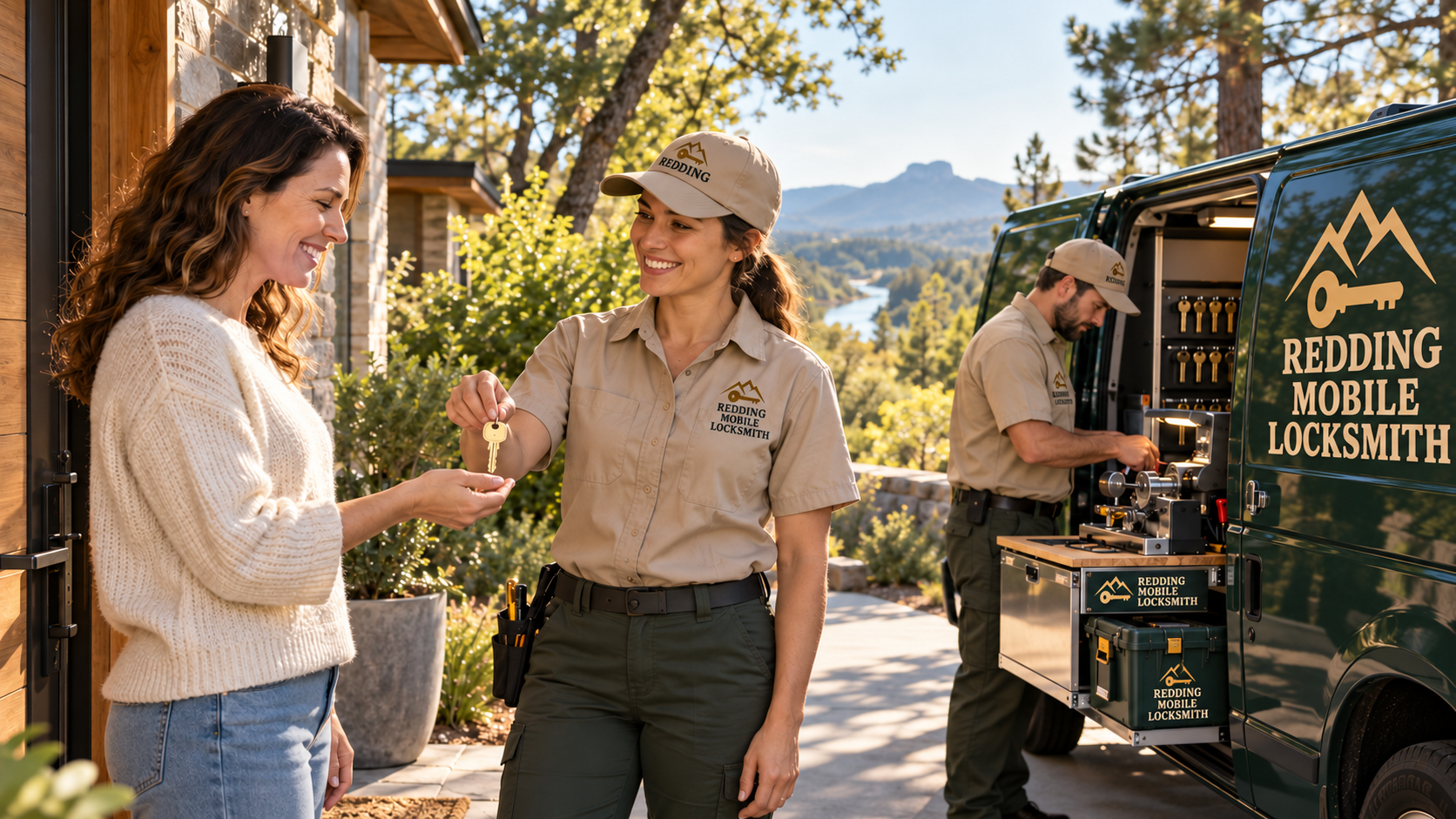
A technician from Redding Mobile Locksmith can come to a rural property with a service van that carries professional tools, key cutting equipment and common hardware. Typical work includes opening or cutting a stuck padlock, replacing a latch, installing a keypad lock, rekeying a set of padlocks, or adjusting hardware after a post has been reset. Because we serve both Shasta and Siskiyou counties, we know how different the conditions can be from valley to mountain.
If your gate is part of a larger lock problem, mention it. Tell us what kind of gate it is, how far it stands from the house, and what has gone wrong. A photo helps. You can send details through the request form. Our lock repair and adjustment and new lock installation pages describe the sort of work we do.
Local notes for the north state
Out in the Shasta County countryside, longer driveways are common around Palo Cedro, Millville, Cottonwood and Lakehead. Up in Siskiyou County, towns like Fort Jones, Etna, Montague and Granada have ranches, farms and homes at the end of long lanes. Each setting brings its own weather, from hot dry summer dust to winter snow and cold, and each affects gate hardware differently.
Wide open land also means longer waits for help, so a lock that fails can leave you stuck. Plan ahead. Keep a spare key in a safe place, test your gate before storm season, and keep contact details for your locksmith, your neighbors and your local fire district handy. Check your gate after strong winds, which can shift a hinge or bend a latch.
You can find notes for your community on our pages for Palo Cedro, Fort Jones and Etna. If you also keep a cabin or seasonal property, our guide on seasonal closing and reopening of a cabin pairs well with this one.
Good to know
Common questions
What is the most reliable lock for a country gate?
There is no single winner, but a heavy duty latch with a shrouded padlock or a weather resistant keypad lock usually does well. Reliability depends on a solid post, good hinges and a latch that tolerates some drift. Choose hardware made for outdoor use and maintain it twice a year.
Why does my gate latch keep missing?
The gate or post has most likely shifted. Hinge posts lean, soil moves with the seasons, and gates sag under their own weight. Fixing the post and hinges first, then adjusting the latch, gives a lasting result. Moving only the latch may help for a while but the problem tends to return.
Are keypad gate locks a good idea?
They can be, especially for shared driveways, because they avoid handing out keys. The trade off is that codes spread, so change them when people leave and avoid obvious numbers. Pick a model made for outdoor weather, and think about battery life, backup access and emergency crews.
How do I make sure emergency crews can get in?
Ask your local fire district what they prefer, since expectations vary. Some areas favor a specific lock box or key arrangement. Once you know, a locksmith can install what they ask for. Make sure the gate can also be opened by hand if power fails.
Can one key open the gate and other locks on my property?
Yes, with keyed alike padlocks or rekeyed locks, which let one key work several locks. It is convenient on a rural property with many outbuildings. The trade off is that losing the key affects every lock, so plan for secure spares.
What if my gate lock freezes in winter?
Warm it gently and use a de icer made for locks, then apply a dry lubricant. Avoid hot water, which can refreeze and make things worse. If it keeps happening, choose hardware with a covered keyway or a design less prone to icing.