
Home / Neighbors ask / How is a car opened without the key?
Car Lockouts Explained
How Is a Car Opened Without the Key?
A trained technician opens a locked car with purpose built tools that work through the door gap or the lock itself, aiming to move the lock mechanism without harming paint, glass or wiring. Here is the general idea, minus anything a thief could use.
Car Lockouts Explained
The honest, general answer
Cars are opened without the key by people who know how a car door is built and who carry tools made for exactly that job. Every door has a latch, a lock mechanism and some way for the inside handle and the outside handle to act on them. A professional finds the least intrusive path to that mechanism, applies gentle, controlled movement, and the lock releases the way it would if you had pressed the button yourself.
We'll keep this explanation general on purpose. A locksmith's day is spent helping people who belong to the cars they own, and a tutorial for getting into someone else's vehicle would help the wrong people. What you need as a car owner is an understanding of the principles, a sense of what is reasonable to expect, and the confidence to tell careful work from clumsy work.
If you're locked out right now and everyone is safe, you can read on in comfort. If a child or a pet is inside, stop reading and call emergency services first, before you do anything else. Responders can act in ways a locksmith's schedule cannot, and nothing about a lock is more important than the life behind the glass.
Why cars are harder to open than they look
A car door is a crowded little room. Inside the door skin you'll find the latch, the lock actuator, window regulators, wiring for speakers and mirrors, side impact beams, and often an airbag or sensors. Everything is tucked close, and the parts that matter are not where a casual guess would put them.
Modern cars also add electronics. Central locking links every door to a control module, and many vehicles will react if the wrong signal reaches the wrong place. An improvised tool can pinch a wire, bend a rod or trigger an alarm. The old image of a bent wire and a hard shove belongs to simpler decades, and it does not describe what happens to a modern car when someone tries it.
That is why a practiced technician moves slowly and deliberately. Slowness here is skill, not hesitation. The aim is to leave the car in exactly the condition you found it, only unlocked, and anything that risks scratching paint or flexing a door frame gets avoided.
Think of it as the difference between a watchmaker and a hammer. Both can open a case, but only one leaves the watch running afterward. The tools a locksmith carries are slim, padded and shaped for particular doors, and they work because the technician knows where they are going before they go there.
The families of methods, in general terms
Without going into the particulars, professional car opening falls into a few families. One uses a thin, protective wedge to create a tiny working gap at the door and then reaches a long, soft tipped tool through it to act on a lock control. Another works through the lock cylinder itself with tools designed to move the lock's internal parts. A third relies on specialized equipment and knowledge of a given model's design.
Which family is chosen depends on the car. Some vehicles have door designs that make the gap method straightforward. Others have tight seals, frameless windows or electronics that call for another approach. A technician decides after looking at the vehicle, not before. They may also use more than one approach in turn.
In every case, protection matters. Soft wedges, padded tools and careful placement keep paint and trim safe. If something is not going to be possible without damage, a professional will tell you so rather than forcing the issue, and will discuss alternatives with you.
What the technician checks before touching the car
Before any tool comes out, a careful professional asks questions and looks around. They'll confirm you have the right to open the vehicle, usually by asking for identification and something that ties you to the car. They'll ask where the keys are and whether anything is running. They'll check the make, model and year, because those facts decide the method.
They also look at the condition of the car. A door that has been damaged before, a window that is cracked, or a seal that is brittle with age affects the choice. In hot weather, glass and plastic can behave differently from cold weather, and in the mountain towns a frozen seal may need patience.
This stage is part of why a good visit starts with a conversation. It's also why a request that includes the vehicle details helps. Our guide on what to have ready lists the facts worth gathering, and our locked out of your car page describes the service as a whole.
Does it damage the car?
When done by a trained person, opening a car should not damage it. That's the point of the tools and the training. Slight marks can occasionally occur, especially on older vehicles with worn seals, and a professional will mention any risk beforehand. A technician who says there's no chance of any problem on a fragile old door is overpromising, and one who explains the risks honestly is being careful.
Compare that with the do it yourself routes people often try. A coat hanger can scratch the inside of the window channel, tear the weatherstrip, or snag a wire. A prying tool can dent the door skin or crack the paint. A broken window means new glass, glass fragments inside the door and exposure to weather. The cost of those mistakes often exceeds the cost of calling for help.
If damage does occur, speak up at once. Photograph it, ask the technician to explain what happened, and keep any paperwork. A professional who takes the matter seriously will discuss it openly. The note on knowing a locksmith is the real thing describes how to recognize that kind of conduct.
A fair question to ask beforehand is what the plan is if the first approach does not work. A confident professional has an answer, such as trying another method or explaining that the lock cylinder may need attention. That kind of forethought separates careful work from improvisation.
Keys inside the car versus keys that are gone
There are two different situations hiding under the heading of a locked out car. In one, the key is inside the vehicle or in your possession but out of reach. Opening the car solves everything, and you can drive away. In the other, the key is lost or stolen, and opening the car is only the first step.
In that second case, the car may need a new key cut and programmed so the immobilizer accepts it. The immobilizer is the anti theft system that checks a code from a tiny chip in the key before the engine will run. Without the right code, the car may turn over and refuse to start. We explain the chip in our guide on what a transponder chip is.
If your key is lost, a technician may be able to open the car and then make a key on site using the equipment in the service van. Details depend on the car, and our page on replacement car keys covers the options.
There's one more wrinkle worth knowing. Some cars have a deadlock feature that disables the inside handles once the doors are locked with the key or fob, intended to stop a thief from reaching in. It can make a lockout feel stranger, because even a visible lock button inside no longer helps. A technician accounts for it when choosing a method.
Smart keys, fobs and push button starts
Cars with push button start and keyless entry complicate the story. The car senses a fob nearby and unlocks when you touch the handle. If the fob is lost, left inside or has a dead battery, the car may behave stubbornly. Many fobs contain a hidden mechanical key that can open the driver's door, usually released by a small catch.
Check your fob and your manual. Often there is a small button or latch that frees the hidden blade, and a spot on the door handle that hides the keyhole under a cap. Know where yours is before you need it, since it can save a call entirely. If the battery is dead, many cars also have a place to hold the fob so it can be read at close range.
If none of that works, a technician can help, and our guide on what to do when a key fob stops working covers the usual reasons a fob goes quiet.
Weather, terrain and where you are parked
Where the car sits matters. On a flat, well lit parking area, a technician has easy access. On a narrow shoulder or a snowy mountain road, safety comes first. Tell whoever you contact about the surroundings, such as whether the car is on a slope, beside traffic, or in a place with poor footing.
Weather changes the work. Cold can stiffen seals and make plastics brittle, and ice can bind a door in its frame. Summer heat can make a closed car dangerous in a short time, and is a reason to be honest about urgency if a person or animal is inside. Our Mount Shasta and Redding pages talk about how local conditions shape these calls.
When in doubt, say what you see. A technician plans better with real information, and the clearer the picture, the smoother the visit tends to go.
Trucks, work vehicles and older cars
Not every vehicle is a modern sedan. Pickups, vans and work trucks have their own door designs, and older vehicles may have simple linkages that behave very differently from newer ones. A professional adjusts to each. Sometimes older cars are easier, because there is less electronics to worry about, and sometimes they are harder, because aged parts are fragile.
Work vehicles often involve other people. If a company truck is locked, the person on site may not be the one who can authorize opening it. Our guide on work vehicle lockouts and who to tell covers that situation. Our page on cars and trucks describes the full range of vehicle work.
Whatever you drive, the same principles hold: gentle tools, careful checks, honest explanations and a fair result.
Ask your technician afterward what to watch for. A freshly opened door sometimes needs a day of normal use before you know the seal is sitting as it should, and a mention of anything odd, such as a window that now closes slowly, is better made early than late.
What you can do to make the visit smoother
Prepare a few facts: the vehicle make, model and year; where it is; whether the key is inside; and whether anyone or anything is inside. Have identification ready and something that ties you to the car, such as registration. If you can reach a second key, mention it.
Keep your distance while the work is done, and let the technician work without hovering. Ask questions afterward. Try the door, the lock and the car in both directions. Check that windows and electronics behave as before. Raise any concern before the technician leaves.
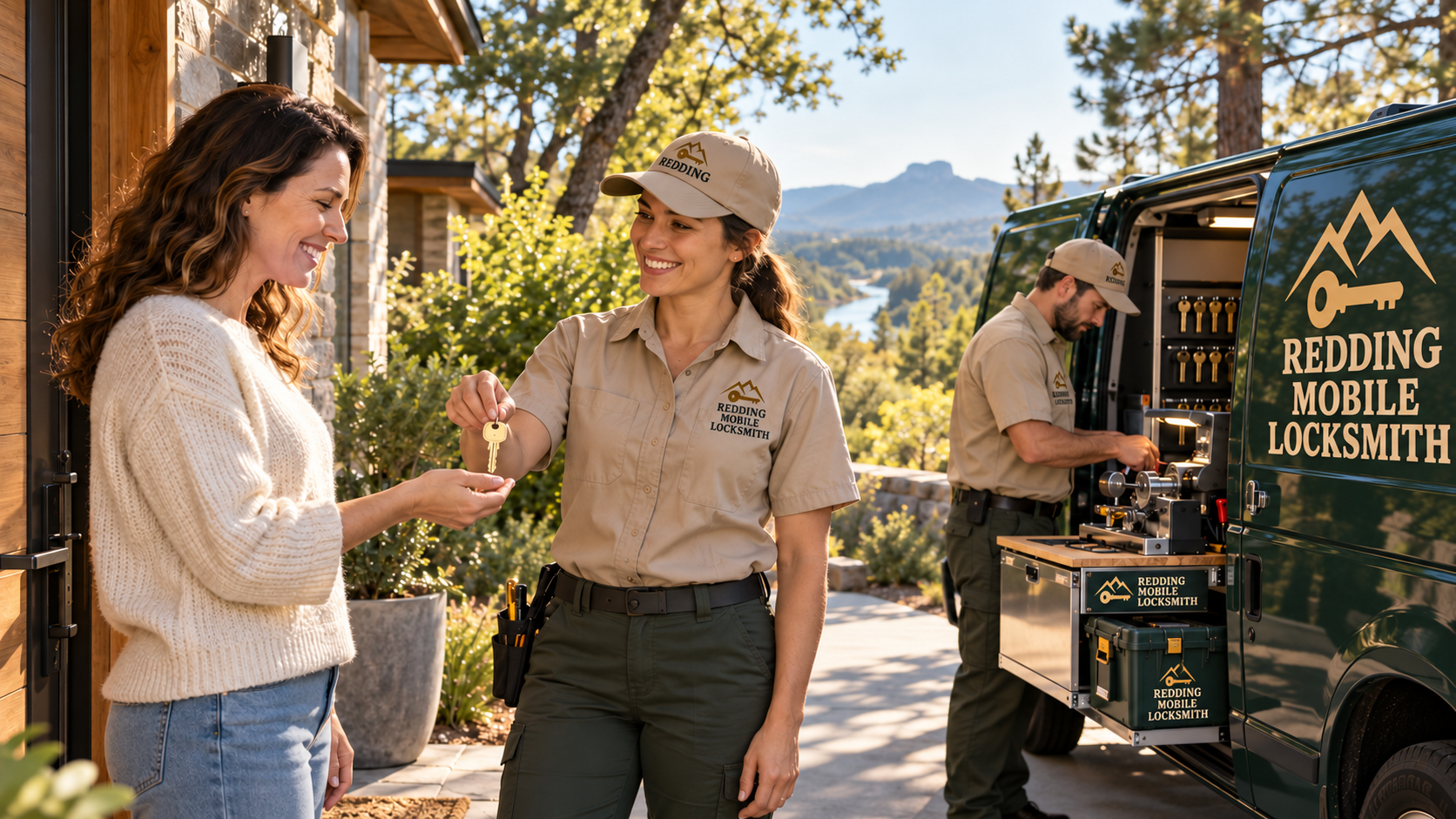
When you are ready to ask for help, use the request form. A phone line for Redding Mobile Locksmith is coming soon, and the team's service van carries opening tools, key cutting and programming equipment, and common hardware. Afterward, consider a spare key and a fresh fob battery so that you do not repeat the day.
A picture to hold in your mind
Imagine a driver who parks at a trailhead on a cold morning, shuts the door with the key on the seat, and walks back to find the car locked. There is no one around, the phone has a little signal, and nothing urgent is happening inside the car. This is the ordinary version of the problem, and it is solved by a calm request, a technician who arrives in a marked van, and a door that opens with no mark on it.
Now imagine the same driver tries a coat hanger first. Twenty minutes later the weatherstrip is torn, a wire in the door is pinched, and the lock still has not moved. The call for help happens anyway, only now there is a repair to add. The difference between those two mornings is not luck. It is a decision to wait and ask.
Neither picture is dramatic, and that is rather the point. Most car lockouts are small events handled well by people who do them often. If you would like to see how lockouts of every kind are approached, our guide on what a lockout is is the place to begin.
Afterward, a little housekeeping makes the next time easier. Learn where the hidden key in your fob lives, put a spare with someone you trust, and keep your fob battery fresh. If you have only one key for the car, consider a second one made while nothing is going wrong, since a spare cut calmly is simpler than a first key made in a hurry.
Good to know
Common questions
Can any locksmith open any car?
Not necessarily. Vehicles vary, and some need specific tools or knowledge. A professional should be honest about what they can do with your car and explain the method in general terms. If the job is beyond them, a straightforward answer is better than an attempt that risks damage.
Will opening my car trigger the alarm?
It can, depending on the vehicle. Some cars sound an alarm when a door opens without the key. A technician may warn you, and the alarm usually stops once the car is unlocked and started or once the owner uses the key or fob. Mention any alarm behavior you know about.
Is it safe to let someone open my car in the dark?
With care, yes. Choose a lit, visible spot, ask for the business name and check the vehicle markings, and keep a friend or neighbor nearby if you can. Expect to be asked for identification. If anything feels wrong, you can decline the work.
What if my car has no keyhole on the outside?
Many modern cars hide the keyhole under a cap or have none, relying on a fob instead. A hidden mechanical key usually lives inside the fob. A technician can work with those designs, and your manual may show where the hidden keyhole is located.
Can a locksmith make me a new key after opening the car?
Often yes, using key cutting and programming equipment. The details depend on the vehicle and the key type. You will need to show you own the car. Ask what the process involves before work begins, so you understand what is being done and why.
Should I tell my insurer or roadside service first?
It can help to check whether you have a roadside plan that includes lockouts. Some plans do, and the process may be simple. If not, or if you need a key made, a locksmith can help directly. Rules vary, so check your own policy or plan.