
Home / Neighbors ask / Lockboxes and showings, general questions
Neighbors Ask
Lockboxes and Showings: Your General Questions
A lockbox lets people with permission reach a key without anyone meeting at the door. Here is how the common types work, what to watch for when your house is on the market, and when a rekey makes sense.
Neighbors Ask
What a lockbox really is
A lockbox is a small, sturdy container that holds a house key and opens only with a code or a special credential. It usually hangs from a door handle, a gate or a railing, or bolts to a wall near the entry. The idea is old and sensible: someone needs a key, you cannot be there, so the key waits in a box that only the right people can open.
There are two broad families. A simple combination lockbox opens with a code you set, usually a few digits turned on dials or pressed on buttons. Anyone who knows the code can open it, which makes it easy to share and easy to lose control of. A more elaborate electronic lockbox opens with a credential tied to a person, and it can keep a record of who opened it and when.
Some boxes also include a shackle that loops over a handle, while others fasten flat to a wall, and the choice affects how easily the box can be removed. Neither type is a vault. Both are built to resist casual tampering, not a determined attack, and both depend on the mounting. A box hung loosely on a handle can be carried off whole. A box fastened to something solid is a very different object. Keep that in mind as you read on, because most lockbox trouble comes from where it hangs and who knows the code.
It helps to remember what the box protects. It does not protect the house from a person with a crowbar, and it does not stop someone from walking in through a door that was left unlatched. What it does is replace an older, riskier habit: leaving a key under a doormat, in a flowerpot or above a ledge. Compared with those hiding places, a mounted box with a changeable code is a clear step up, because the secret can be changed without cutting a single new key.
Why lockboxes show up during a sale
When a house is on the market, many people need to see it. Agents bring buyers, inspectors look at the structure, appraisers measure rooms, and sometimes a stager or photographer needs a morning inside. It would be impractical for the owner to be present for every visit, so a lockbox stands in.
Picture a family that has already moved to a new place across the county while their old house sits for sale. They still care about it, but they cannot meet every visitor. A lockbox lets the people involved in the sale get in on their own schedule, while the owners keep one key in a box they control and a short list of those who may use it.
Rental homes use the same tools for a different reason. A property manager with several units may need a contractor to reach one door on Tuesday and a cleaner to reach another on Thursday, and a box at each entry keeps the manager from driving across the county with a ring of keys. The same cautions apply: control the code, keep a list, and reset it when the job is done. The convenience is real, and so are the questions it raises. Who has the code? How many people saw it? Did anyone leave a door unlocked after a showing? Those are ordinary worries and have ordinary answers, but they are easier to manage with a plan than with luck. The rest of this column walks through the plan.
Choosing where the box goes
Location is half of lockbox security. A box on a front door handle in plain view of the street announces that the house is empty and that a key is inside. A box tucked at the side of the entry, out of the line of sight from the road, is a calmer choice. The key is still reachable by people who know where to look.
Mount the box to something that cannot be easily carried away. A fixed railing, a sturdy post or a wall bracket is better than a loose knob. If you are renting out a place, a box attached to the property with a screw mount is harder to remove than one that dangles. Ask the person who supplied the box how it is meant to be mounted, since models differ.
Weather matters in this region. Hot dry summers can bake plastic parts, and cold mountain winters can freeze moisture inside a mechanism. A box that sticks in January is a nuisance for anyone trying to enter. If you live in a snowy community like Mount Shasta or McCloud, test the box on a cold morning, and keep it clear of drifting snow.
Codes, credentials and who holds them
With a combination box, the code is the key, so treat it like one. Pick digits that do not match your address or phone number. Share the code only with people who truly need it, and keep a list of who knows it. Change it whenever the list changes or a showing period ends.
With an electronic box, the system usually ties access to individual credentials, and the person managing it can add or remove people. That is useful, because you can end someone's access without changing hardware. Ask whoever supplies the box how credentials are issued, who can see the access record, and how an old credential is canceled.
In both cases, the habit that matters most is closing the loop at the end. When the house sells or is taken off the market, remove the key from the box, reset the code, and take the box down. A lockbox left hanging on a handle for months after the need ends is an open question mark. If you are not sure how a particular box is managed, ask the person who put it there before you assume the answer.
- Choose a code that is not your address, birthday or phone number.
- Keep a written list of everyone who knows the code or has a credential.
- Change the code when the list changes or showings pause.
- Take the box down and reset it when the sale ends.
- Do not leave the only copy of your house key in the box permanently.
Keys you put inside the box
What goes in the box matters. Many owners put in a spare key they already use, and it is tempting. A better habit is to put in a key whose only job is the showing, so that you can retire it afterward without disturbing your own set.
If you are not sure a key is clean, a technician can cut a fresh one. If the front door lock is old and worn, a showing key may stick and cause visitors trouble. A lock that works only with jiggling is a poor match for a stream of people who have never touched it before.
That is a good moment to consider the lock's condition more broadly. Does the key slide in smoothly? Does the deadbolt throw all the way? A technician can adjust or replace what is tired. Our page on lock repair and adjustment outlines the checks, and the column on why a lock turns so hard explains common causes.
Securing the house between showings
The lockbox only handles the front door. Everything else is up to the household. Before showings begin, walk through the house and lock windows, garage entry doors, sliding doors and any side gates. Put valuables, medications, personal papers and small electronics where they cannot be spotted or pocketed. Visitors are mostly honest, but a house full of strangers is a house where a little care goes a long way.
Ask the people running showings to lock up after each one, and consider a short check yourself at the end of the day if you can. A door left unlatched is the single most common problem with showings, and it is almost never done on purpose. A friendly reminder tends to solve it.
If a door does not latch easily, fix it before showings start. A sticking strike plate or a sagging door makes a hard lock to close under pressure. Our guide on doors that will not close goes through what to try, and sliding door security covers a common weak point.
Think about pets and children as well, if the household has them. A cat that slips out through a door left open after a showing is a bigger loss than any missing lamp. If animals live in the house, arrange to have them elsewhere during visits, and post a clear note at the door asking visitors to close it behind them. Small courtesies like these protect the people and animals who live in the house, not just its contents.
Rekeying when the sale is done
Even with careful control, a house that has been shown many times has had many hands near its key. For the buyers, the sensible step after closing is to rekey. For the sellers who stay on the property during a long listing, a rekey after the sale also makes sense when they move out, because they may keep copies without thinking.
Rekeying changes the pin arrangement inside a cylinder so that old keys no longer work. The lock stays on the door, and a new key is cut for the new arrangement. It is an inexpensive way to turn a doubtful key count into a known one. Our page on rekeying your home explains the steps, and the column on whether to rekey after buying a house speaks to buyers directly.
If you are the seller, hand over the keys you have, say plainly how many exist, and leave the details to the new owner. If you are the buyer, assume the count is unknown and plan on a rekey. Either way, writing down the date of the change gives everyone a clear starting point.
Smart lockboxes and keypad doors
A growing number of owners skip the lockbox entirely and install a keypad deadbolt on the front door. A temporary code is then issued for each showing or each service person, and deleted afterward. There is no key to copy, no box to hang, and the log can show who came and went on some models.
The tradeoff is dependence on batteries and sometimes on a connected app. Cold mountain nights shorten battery life, and a lock that fails at the wrong moment leaves a visitor on the porch. Keep a mechanical key backup, replace batteries on a schedule, and test the lock with the door open before you rely on it.
If you like the idea but are unsure it suits your house, read who needs a smart lock and whether smart locks can be rekeyed. Installing or swapping hardware is also covered on our new lock installation page.
Questions to ask whoever supplies the box
Most lockboxes come from a real estate agent, a property manager or an association, and the rules about their use are theirs to explain. This page cannot state what any local board or office requires. Instead of guessing, ask them directly and write down the answers.
Good questions are practical ones. Who can open the box? How is access added or removed? Is there a record of openings? What happens if a code is shared with someone who should not have it? How soon is the box taken down after the sale? Their replies tell you whether the system will serve you or whether you need a stronger plan of your own.
If something does go wrong, such as a lost code or a key you cannot account for, do not wait to see what happens. Change the code, rekey if needed, and make a note. A hardware change costs less than months of worry, and it leaves you with a clear record of exactly when access was reset. Keep a simple note with the date, what you changed and who was told, since that note answers most later questions before anyone has to ask them. For businesses or shops, see business lock service, which covers the commercial side of key control.
When you need help with a stuck box or a lost key
Sometimes a lockbox jams, a code is forgotten, or a key goes missing during a sale. These are annoying but solvable. First, check with whoever supplied the box, because they may be able to reset it themselves. Second, if a key is lost, plan on a rekey instead of hoping it turns up.
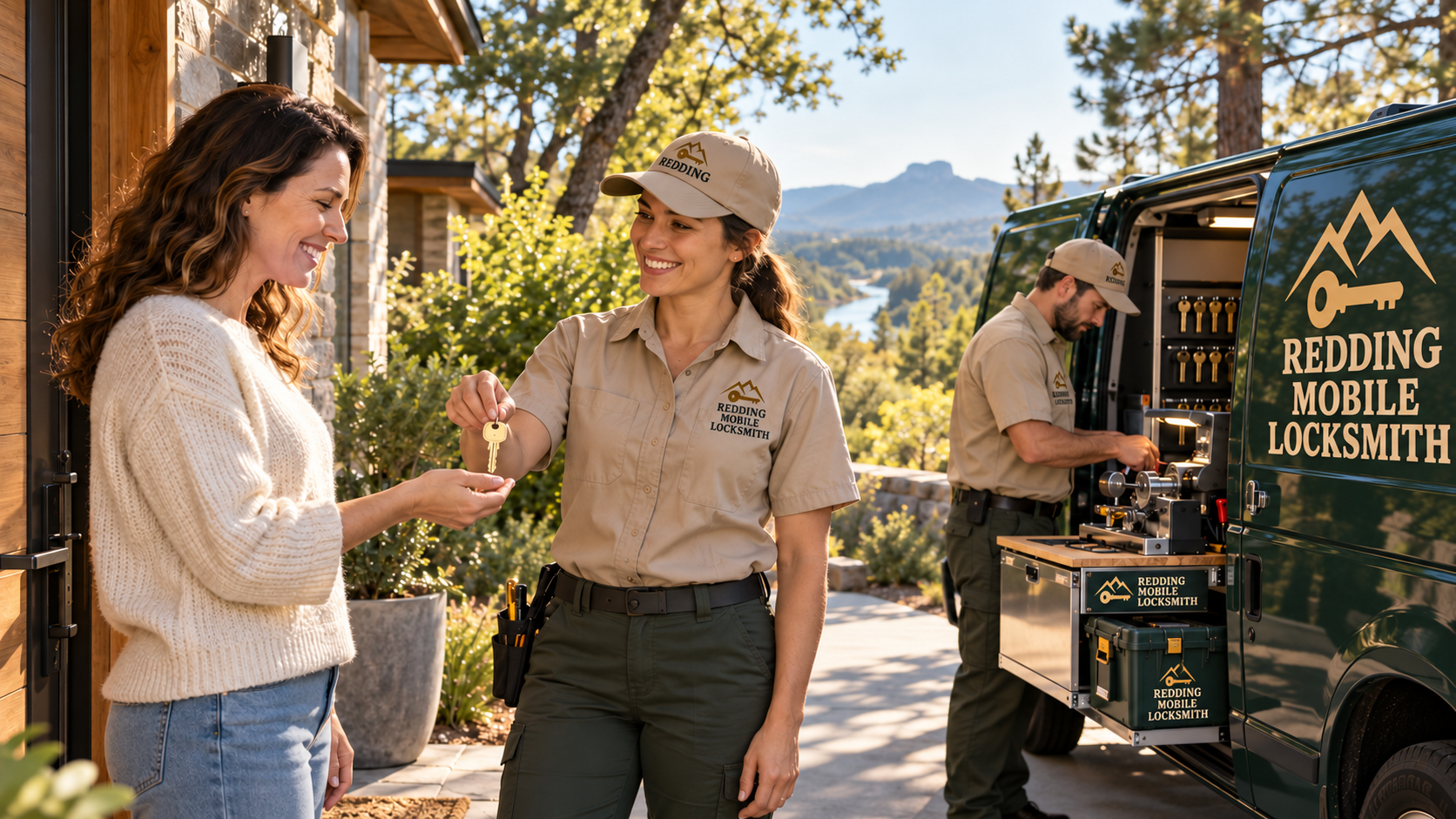
Redding Mobile Locksmith serves seventeen communities across Shasta County and Siskiyou County and works around the clock. The branded service van carries key cutting equipment and common hardware, so a new key or a rekey can often be handled at the property. You can describe what you need on the request form while the phone line is coming soon.
If you find yourself locked out of a house you are trying to show or sell, our page on locked out of your home explains what to expect. For late hours, emergency help any hour has more. If the property is in Redding or Anderson, those local pages describe the area.
Good to know
Common questions
Is a lockbox safe to leave on my front door?
It depends on how it is mounted and who knows the code. A box fastened to something solid, in a spot not easily seen from the street, with a code you control, is a reasonable choice for a short period. Take it down when the need ends and reset the code.
How often should I change a lockbox code?
Change it whenever the group of people who know it changes, whenever showings pause, and when the sale ends. If you are unsure who has seen the code, change it now. There is little reason to keep a code in use longer than necessary, and a new one costs nothing but a moment of attention. Tell the people who still need access, and let everyone else lapse.
Should I rekey before or after selling?
Most sellers wait. After closing, the new owner usually rekeys to cut off every earlier key, including the ones used for showings. If you have lost track of key copies during the listing, you can rekey earlier, but check what your sale agreement expects first.
Can a lockbox be broken into?
Any lockbox can be attacked with enough effort, particularly if it is loosely mounted. They are meant to stop casual tampering, not a determined thief. Good mounting, a sensible spot, a code you control and prompt removal afterward are your strongest tools.
What if I lose the key that was in the box?
Treat it as a missing key and plan on a rekey, because you cannot tell who might have it. A technician can change the cylinders so the lost key stops working, and cut new keys for the new arrangement. Describe the doors on the request form.
Do smart locks replace lockboxes?
For some owners, yes. A keypad deadbolt can issue temporary codes and remove the need for a box entirely. They depend on batteries and sometimes on a connection, so keep a mechanical backup and test them often, especially before cold weather in mountain towns.