
Home / Anderson / Emergency Help Any Hour in Anderson
Anderson after hours help
Emergency Help Any Hour: What the Call Sounds Like in Anderson
Most people have never called a locksmith in the middle of the night, so they do not know what to expect. This page walks through the conversation, step by step, and what to have in your hands when you make it.
Anderson after hours help
The end of a very long shift
Picture someone in Anderson finishing a long work shift, the kind that ran well past the scheduled hour. Their feet hurt, their head is somewhere else, and the drive home along Interstate 5 felt automatic. They pull into the driveway, reach into a pocket for the keys, and find only a phone and a pen. The keys are in a locker, or on a counter, or on the seat of a different vehicle entirely.
Nobody is at home to open the door. The street is quiet, the porch light is the only light in sight, and it is much too late or much too early to knock on a neighbor's door. This is the moment when most people discover that they have no idea whom to call, or what the call will involve. They also discover that panic is a poor assistant.
We wrote this page because that moment is easier with a little preparation. An emergency locksmith call has a shape, and once you know the shape, you can get through it with your head clear. Below we describe it in order, from the first ring of a request to the moment you are back inside, with the practical details that matter along the way.
First, make sure you are safe
Before anything else, take a breath and look at where you are. Is the area lit? Are you alone? Is anyone nearby who makes you uneasy? A locksmith can help with a locked door, but your own safety comes first. If something about the situation feels wrong, move to a place with lights and people, and call emergency services if you feel threatened.
If you are locked out of a car with a child or a pet inside, the rule is different and firm: call emergency services first. Do not wait for a locksmith to arrive when a life may be at risk. The locksmith can help afterward, but the emergency line is the right call to place first, every time.
For the more ordinary case, a locked door and a tired person, the main thing is to find a comfortable, safe place to wait. If you can sit in your car with the doors locked, do so. If you can wait in a lit entrance of a nearby place that is open, that works too. Keep your phone charged enough to take the technician's call.
If you have to leave the property to find a safe place, tell the dispatcher where you will be, so the technician is not looking for someone who has wandered off. A short message in the request form that says where you are waiting can spare everyone a confusing hour of back and forth.
What the dispatcher will ask you
A dispatch conversation is short and practical. The person on the other end wants to understand what kind of problem you have and where you are. Expect questions about whether it is a car, a home or a business, what happened, and whether anyone is in danger. They will ask for your location in a way that lets the technician find you without confusion.
They will also ask about the lock or vehicle. For a house, that means the type of door and whether it is a deadbolt, a handle lock, or both. For a car, that means the year, make and model, and whether the key is lost, locked inside, or broken. These answers let the technician bring the right tools and, with a vehicle, the right key blanks.
Finally, expect a conversation about confirming that you are entitled to open the door or vehicle. That is not a hurdle for the sake of a hurdle. It is how a careful locksmith protects both you and the people who live next door. You can make this easy by having identification and anything that connects you to the property ready before you call.
- Where you are, described clearly enough for a stranger to find.
- What kind of lock or vehicle is involved and what went wrong.
- Whether anyone is inside, hurt, or in danger.
- A number where the technician can reach you.
- Identification and something that connects you to the property.
Describing where you are in a rural stretch or a town street
Anderson is a small city on the valley floor, and the area around it includes rural parcels with long driveways, gates and unmarked turns. A technician arriving in the dark benefits from clear directions that do not depend on landmarks they cannot see. Mention gates, the side of the road the driveway is on, and how to recognize your place.
If you cannot give a clear description, share your location using your phone if the request process allows it, or describe the nearest major road. Highway names such as Interstate 5 help orient someone, but they are only part of the answer. A last detail, such as a porch light left on, makes the difference at night.
Rural addresses around Anderson sometimes confuse navigation apps, which may drop a pin at the road rather than the house. If your place is set back from the road, say so. Describe the first thing a driver would see, such as a mailbox, a gate or a fence line, and then the thing after it.
Turn on an outside light if you can. Open a gate, if it is safe to do so, and leave it open so the van does not have to stop and wait. If you are in a parking lot, tell the dispatcher where in the lot you are, and what your vehicle looks like. These small kindnesses save everyone time and frustration.
What the technician needs from you at the door
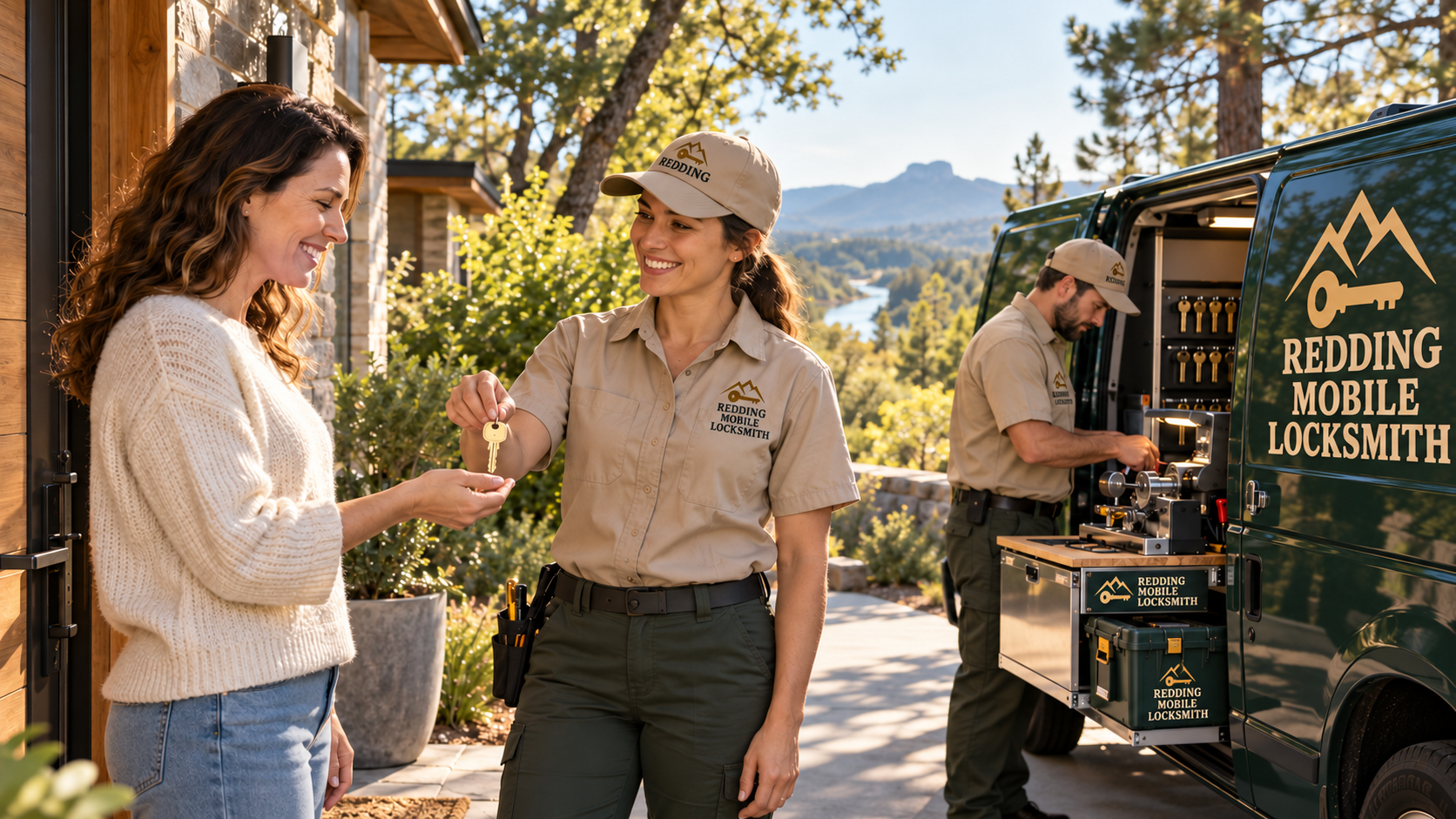
When the technician arrives, the van is marked and the team wears uniforms, so you can recognize who they are. Expect a short greeting and a request to see identification that matches the property or vehicle. Have it in your hand. If you do not have your wallet, explain that, and let the technician tell you what other proof might do.
They will ask a few questions about the lock or the car, look at the situation, and tell you what they plan to do. Good technicians explain before they act. If a price is part of the conversation, you should hear it before work begins, and you are entitled to ask what it covers. You do not have to agree to anything you do not understand.
Our guide on how to tell a real locksmith describes what to look for in a technician, and what to have ready when you call walks through the checklist in more detail.
How different emergencies are handled
A house lockout is usually the simplest case. The technician looks at the door, decides on a method that will not damage it where possible, and opens it. Sometimes the lock must be drilled or replaced, but that is a last resort and not the first choice. The aim is to get you in with the door and lock intact. Our page on being locked out of your home covers this in detail.
A car lockout is its own craft. Modern vehicles have doors full of wiring, sensors and airbags, so the technician uses tools made for the purpose and works around them with care. The aim is to open the door without scratching paint or disturbing the electronics. If you also need a key made, the technician can discuss that, and our car lockout page covers the process.
A broken key in a lock is a particular kind of problem. The snapped piece has to be removed without harming the cylinder, which takes thin tools and patience. Many people try to pull it out with pliers or glue and make it worse, so leave it alone and mention it when you call. Lost keys, broken keys and failed locks each have their own approach, but they share the same shape: assess, explain, act, test. When the work is done, you should be able to operate the lock or start the car normally. If the situation involves a failed lock that cannot be repaired that night, the technician can often secure the door temporarily and arrange a proper fix.
Why speaking up about damage and limits is smart
Sometimes the honest answer is that the door will take some damage to open. A deadbolt with a snapped key stuck inside, or a lock that has seized, may need to be drilled. You should hear this before it happens. A good technician explains what will be done, why, and what it means for repair.
Sometimes the answer is that the technician cannot do what you ask on the spot, because the vehicle needs equipment they do not carry, or because they cannot confirm that you have a right to open the property. That is not a failure; it is a limit, honestly stated. Ask what the next step is, and whether there is a safe place for you to wait.
If something does not feel right, you are always allowed to stop. Say you would like to pause and think. A technician who respects you will not pressure you. They will wait while you gather yourself, call a family member, or ask a question.
It also helps to know what you will not be asked to do. You will not be asked to hand over your keys, your passwords or anything unrelated to the lock in front of you. The conversation stays on the door, the car, and proof that you belong there. If it drifts elsewhere, that is a reason to slow down.
Things you can do while you wait
Waiting is the part nobody enjoys. A few simple tasks can help. Check the other doors and windows of your home, only if it is safe and you are not forcing anything. Look for a spare key that you may have left with a trusted neighbor or family member. Call them, if the hour allows.
If your phone battery is low, plug it into the car if you have access to it, or move somewhere you can charge it. If it is cold or hot, find shelter. In Anderson, summer evenings can stay warm and winter nights bring chill and sometimes rain, so a jacket or water in the car is a good idea to keep on hand.
Avoid the temptation to try something risky. Climbing through a window, forcing a lock or prying at a door can injure you and cause costly damage. A short wait for a professional is almost always the better trade. Think of a broken window or a bent door frame as a second emergency created to solve the first one, and one that stays with you long after the original lockout is forgotten. Our overview of emergency help at any hour adds more on what to expect.
After the door is open
Once you are back inside, take a moment before you head to bed. Ask yourself how the lockout happened. Was the only key on a ring that went to work? Did a lock fail? Is a spare key worth making and keeping somewhere dependable? These questions are worth answering while the memory is fresh.
A common follow up is to make a spare. Another is to repair or replace a lock that nearly failed. Our local pages on key programming and fobs in Anderson and new lock installation in Anderson describe those jobs, and cars and trucks in Anderson covers the vehicle side.
None of this has to be done tonight. A tired person makes poor decisions, and an emergency visit is about getting you safely in. The longer conversation about spares and upgrades can happen in daylight, when you are rested and can think about what fits your life.
One habit is worth starting right away: give a spare key to someone you trust who lives nearby, and tell them where it is kept. It is the oldest solution to the oldest problem, and it works as well in Anderson as anywhere. Just be sure the person understands that the key is for emergencies only.
The wider area around Anderson
Anderson is one of seventeen communities in Shasta and Siskiyou counties that the team serves. A late shift can take you toward Redding, Cottonwood or Shasta Lake, and the same team covers each of them. Our pages for Redding, Cottonwood and Shasta Lake describe what is available in each.
This matters if your day includes more than one town. A lockout might happen at work in one community while your home is in another. Telling the dispatcher both locations helps them understand the situation and plan accordingly. It also helps if you can say which place is the real emergency. A person stranded at a workplace with the house keys inside needs different help from a person standing at their own front door, and the dispatcher can sort the order of things out once they hear the whole picture. Never assume the dispatcher knows the area as you do; name the town, the road and the type of place plainly.
Whatever town you are in, the principle is the same: stay calm, stay safe, describe the situation clearly, and let a professional do the opening. The next step is as simple as sending a request through the form on our contact page, where you can leave details at any hour.
Good to know
Common questions
Do you really answer at every hour of the night?
Yes, the service is built around the clock. Requests can be made through the form on the contact page at any hour, and the phone line is coming soon. When you reach the team, describe your location and problem, and the dispatcher will take it from there.
What should I do first if I am locked out late at night?
Make sure you are safe and in a lit place. If a child or pet is locked inside a vehicle, call emergency services first. Otherwise, gather your identification, think about where you are, and contact the locksmith with clear details about the lock and your location.
Will the technician ask for identification?
Yes. A careful locksmith wants to confirm you are entitled to open the door or vehicle. Having identification and something that connects you to the property helps the process go smoothly. If you do not have your wallet, explain, and ask what else might be accepted.
Can my door be opened without damaging it?
Often it can, depending on the lock and the door. Technicians use methods intended to protect the hardware. Sometimes a lock is damaged or seized and must be drilled or replaced. A good technician explains that before acting, so you know what to expect.
What if I cannot describe my address clearly?
Share whatever you can: the road, the direction, any gates and landmarks, and an outside light you can turn on. If your phone can share a location, that helps too. A technician arriving in the dark benefits from every clear detail you can provide.
Do I need to be present when the work is done?
Yes, someone with authority over the property should be there. The technician needs to confirm who you are, explain the work and test the result with you. If you cannot be there, a trusted person can stand in, but tell the dispatcher in advance.