
Home / Palo Cedro / Emergency Help Any Hour in Palo Cedro
Around the clock
Emergency Help Any Hour for Palo Cedro Residents
Lockouts and broken locks do not keep office hours. This is what an around the clock dispatch conversation sounds like, what we need to know from you, and how to stay safe while you wait.
Around the clock
The newcomer on the porch at midnight
Imagine someone who closed on a house in Palo Cedro a few weeks ago. The boxes are mostly unpacked, the new keys are on a ring with a tag from the previous owner's realtor, and tonight, after a late errand, the key will not turn. It is dark, the porch light is off because the switch is inside, and the nearest neighbor is a field away.
That is a moment when the idea of an emergency locksmith stops being abstract. You want to hear a calm voice, answer a few sensible questions, and know that someone is coming. You also want to feel that the person on the other end understands the place you live: a rural community east of Redding with larger lots, oak and pine country, long driveways and few street lights.
This page describes how that conversation goes and what happens afterward. Our aim is to take the mystery out of it. If you know what to expect, you can handle a stressful night with less worry, and you can help the technician arrive with exactly what is needed.
A word on tone before we start. Nobody calls a locksmith on a good day, and nobody needs to apologize for the situation. Dropped keys, stubborn deadbolts and doors that swing shut behind us are part of ordinary life. What we offer is calm, practical help from people who do this work all the time and who would like you to feel better by the end of the visit than you did at the start.
What around the clock really means
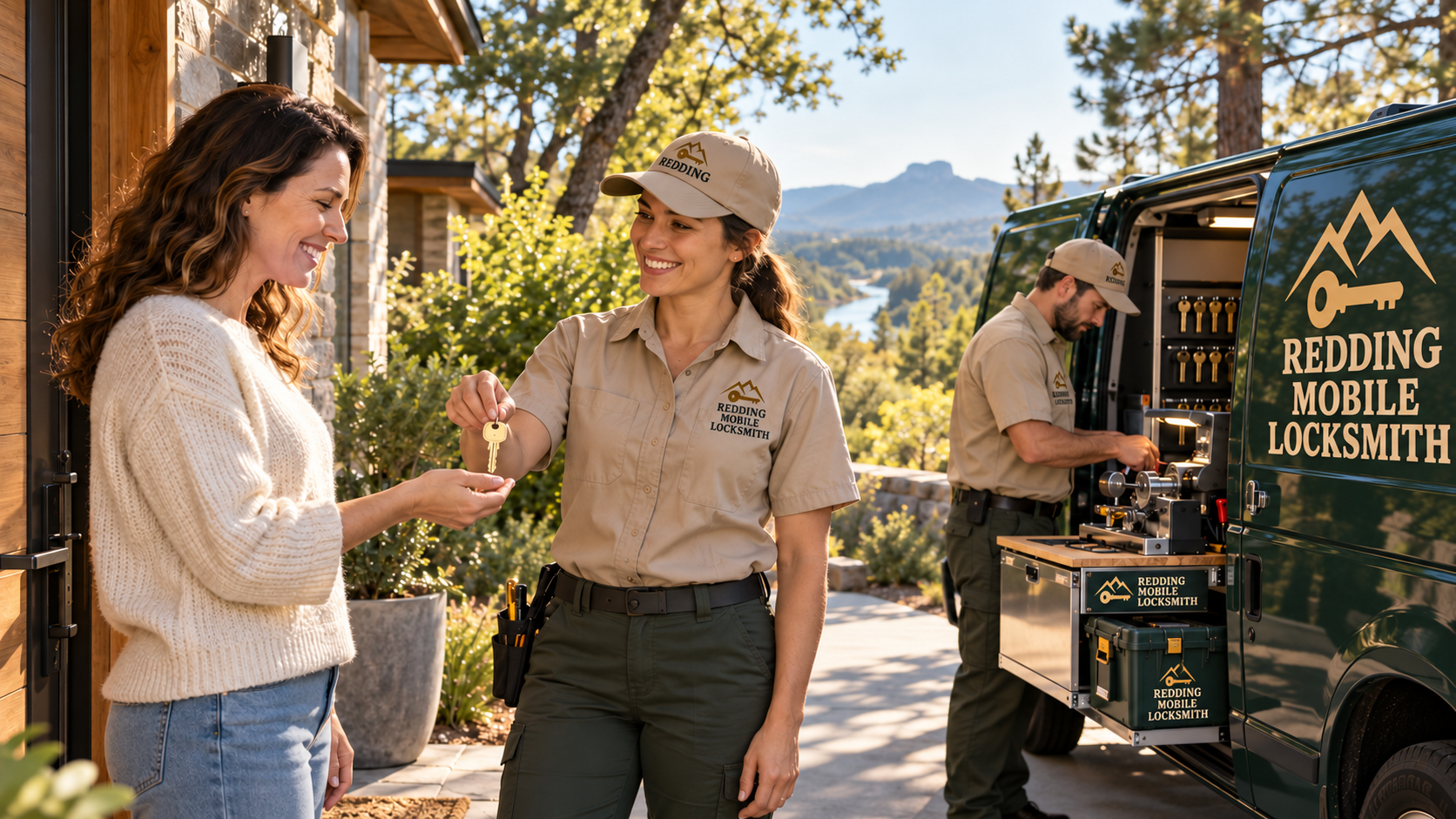
Our service is a 24 hour mobile locksmith service. That means someone is available to take your request at any hour, including nights, weekends and holidays, and a technician can be sent out in a branded van when the situation calls for it. The van is stocked with professional tools, key cutting and programming equipment and common hardware, so many jobs are finished on the spot.
We do not promise an arrival time on this page, because distances, weather, road conditions and the number of calls vary. What we promise is honesty. When your request is received, we tell you what we can do and what we need, and we are plain about anything that will take longer than you hoped.
For now, the way to reach us is the request form on our contact page, since our phone line is coming soon. Use it as you would a phone call: describe the problem, the place and what is urgent. The more detail you give, the better prepared the technician will be.
The questions you will be asked, and why
A dispatch conversation follows a pattern, and each question has a reason. First, where are you? A clear location, including the nearest main road, gate details and any landmarks on the property, lets the technician find you without wandering down the wrong lane. On country roads, the difference between two driveways can matter.
Second, what is the problem? Say whether you are locked out of a house, a car or a building, whether a key broke, whether a lock is jammed, or whether a door will not close. Third, is anyone in danger? If someone is trapped, hurt or in distress, tell us right away, and call emergency services if the situation is urgent.
Fourth, can you prove it is yours? We will ask you to show identification and something that connects you to the property or vehicle. For a new homeowner, closing documents, a utility bill or a lease can serve. This is not suspicion. It is the same step a careful professional takes with everyone, and it protects you.
Fifth, what do you see? Describe the door: its material, its handle, whether there is a deadbolt, a keypad or a second lock. For a vehicle, give the make, model, year and whether it uses a push button start. These details let the technician choose tools in the van before the engine is even started, and they prevent the awkward moment of discovering on your doorstep that a part is missing.
- Give the exact location, including gates, long driveways and nearby main roads.
- Describe the lock or door and what happened when you tried the key.
- Say whether anyone is inside, hurt or in distress.
- Have identification and something that links you to the property ready.
What the technician needs from you
Once the plan is set, a few simple things make the visit smoother. Turn on every light you can reach. Make sure the driveway or the spot where a vehicle is parked can be seen from the road. If you have a dog, secure it or tell us about it. If there is a gate, say how it opens, or arrange for someone to let the van in.
Stay in a safe place while you wait. If you are in a car, keep the doors locked and the engine off unless you need warmth or air conditioning. If you are at a house and it is cold, wait in the vehicle or in the home of a neighbor, rather than standing on a dark porch. Safety comes before speed.
Keep your phone charged and nearby so we can reach you if we have a question. If the weather turns, let us know, since rain, snow in the higher country and even heavy fog can change how a technician approaches a job. We are used to the conditions that come with life in Shasta County, and it helps to share what you are seeing.
How a night call differs from a daytime one
Darkness changes almost everything about a lock job. Small screws are harder to find, house numbers are harder to read, and a stranger arriving at your door can understandably feel unsettling. That is why we put so much weight on being recognizable, with a uniform and a clearly branded van, and on explaining each step before it happens.
It also changes what we ask of you. In daylight, a gate that sticks or a driveway that forks is a small puzzle. At night it can cost real time. If you can, switch on an outdoor light, leave a gate open ahead of time or send a short description of landmarks, such as a mailbox shape or a particular tree. Rural roads have few signs, and good directions are a gift.
Fatigue is a factor for everyone involved. A person who has been up for hours may hand over the wrong key or forget where they left a spare. A technician who has been on the road may need a moment to read the situation. We keep things calm and simple, double check the details and avoid rushing through the steps that matter, like confirming whose property it is.
What happens when the technician arrives
The technician arrives in a branded service van, wearing a uniform. You can ask for identification and for the name of the company, and we expect that. Before any work begins, the technician confirms who you are, looks at the lock or vehicle, and explains what they plan to do.
If the job is a house lockout, the technician examines the door and chooses a method that avoids damage when possible. In many cases, a skilled professional can open a lock without harming it. If a lock must be drilled or replaced, the technician says so and explains why. You are in charge of the decision.
Afterward, the lock is tested. If a new key was cut, it is tried in the lock from outside. If hardware was replaced, you can try the door yourself. If the situation allows, you also get tips for avoiding a repeat, such as hiding a spare in a sensible place, rekeying a house you just bought, or labeling keys.
You will also be told, in plain language, what was done and why. If the job reveals another problem, such as a loose strike, a worn cylinder or a door that sags, we mention it without pressure. You decide whether to deal with it now or later. A responsible technician describes the options and leaves the choice with the person who lives there.
Common midnight problems at a Palo Cedro home
A few situations come up again and again. Keys left inside when a door latches behind you. A deadbolt that has swollen or shifted until the key will not turn. A key snapped off in a cylinder. A garage entry door that will not unlock. A lock that someone forced open, leaving the door unsecured.
The last one is serious. If you come home to find a door forced open, do not go inside. Step away, call emergency services and wait for the authorities. Once the scene is cleared, we can secure the door, repair damage and help you decide what else needs attention. Our guide on what to do about locks after a break in offers a calm checklist.
If you have just moved in, one of the wisest things you can do is arrange for rekeying before an emergency happens. Previous owners, agents, contractors and former neighbors may all have held copies. Our page on rekeying your home and the guide about whether to rekey after buying a house explain the process.
Vehicles at the roadside or in the drive
Emergencies also happen with cars and trucks. Keys locked inside, a fob that dies far from home, a key that breaks in the ignition on a country road after dark. A mobile locksmith comes to the vehicle, so you do not need to arrange a tow for a key problem.
If the vehicle is on a road, move it to a safe spot if you can. Wide shoulders on Highway 44 and quiet turnouts offer more room than a narrow bend. Turn on your hazard lights, stay out of traffic and stay with your phone. If there is a child or pet locked inside a vehicle, call emergency services first, before anything else.
Our page on cars and trucks in Palo Cedro describes how vehicle work proceeds, and the one on getting back into a locked car goes through the steps. For lost keys, replacement car keys explains the process.
What you can try before you call
Some lockouts have gentler solutions. Check every door and window you own for one you forgot to lock, though never climb or force anything that risks injury. Think about whether a family member, housemate or neighbor has a spare. Look at your phone for a message from a landlord or agent who may hold a key.
Do not try to force a door, break a window or remove hinge pins unless there is a genuine emergency, because repairs to damaged frames and glass tend to take more effort than the original lockout. A door that was opened gently can usually be locked again at once. A door that was forced often cannot, and then you have a security problem on top of a lockout.
If you have a smart lock or a keypad, check whether a code or an app can open it. If the battery is weak, a backup method may exist. Our guide on what a lockout is and what to try first goes deeper, though remember never to force a lock in a way that damages your door.
If none of that works, make the call. There is nothing embarrassing about it. Lockouts are one of the oldest reasons for locksmith visits, and a calm request with good details is the surest way to get help. Give the facts plainly, keep the details in order and trust the process. A technician who hears a clear description can bring the right cylinder, the right blank or the right tool the first time, and that saves a second visit on a cold night.
Planning so the next night is calmer
The newcomer on the porch has a few lessons to take away. Make a spare key and put it somewhere reliable. Keep one on a hook inside the house for anyone who lives there. Put the porch light on a timer or a sensor so you are never working in the dark.
Learn how your locks feel on a good day. When a key starts to stick or a deadbolt starts to drag, schedule a look before it becomes a midnight problem. Our guide on what to do when locked out at night pairs well with this page.
Neighbors in Palo Cedro, Millville and Anderson know that help is only as useful as the preparation behind it. Our full page on emergency help at any hour covers the service across every community we serve.
One last habit is worth building: keep a short card in your wallet or phone with your address as a stranger would describe it, the make and year of your vehicles and the location of a spare key. When you are tired and stressed, reading from a card is easier than remembering. It turns a frightening night into a short, orderly conversation, and it is exactly the kind of preparation a newcomer is glad to have made.
Good to know
Common questions
Is someone really available in the middle of the night?
Yes. We are a 24 hour mobile locksmith service, with a team that works around the clock, including nights, weekends and holidays. Our phone line is coming soon, so for now, send your request through the form on the contact page and describe the urgency.
What information should I give when I ask for emergency help?
Give your exact location, including gate details and the nearest main road, describe the lock or vehicle and what happened, say whether anyone is in danger, and be ready to show identification. Photos of the door or key can help if you can send them.
Will you tell me how long it will take to arrive?
We do not promise arrival times on this website because distance, weather and road conditions vary. We tell you plainly what to expect once we know your location and the situation, and we update you if anything changes.
What should I do if I find my door forced open?
Do not go inside. Step away, call emergency services and wait for the authorities. After the scene is cleared, we can secure the door, repair damage and help you decide what else needs attention, such as rekeying or new hardware.
Do I need to be at the property for the work to start?
Usually yes, or someone with authority must be. We confirm identity and a connection to the property or vehicle before opening anything. If you cannot be there, explain who can approve the work and what documents they can show.
Can you help if a child or pet is locked in a car?
Call emergency services first, without waiting. Warm weather can make a closed vehicle dangerous. Once responders have handled the situation, we can help with the lock or repair any damage to the door.