
Home / Anderson / New Lock Installation in Anderson
Anderson lock installation
Installing New Locks on Anderson Doors That Need Them
Sometimes a door has no lock worth the name, or a lock that has quit trying. This page explains how new locks are chosen and fitted, written the way one neighbor would walk another through it.
Anderson lock installation
The favor that turns into a lock project
Here is a scene that plays out all over Anderson. One neighbor comes by to help another with something small, say carrying a couch or fixing a gate latch, and while standing at the back door notices that the lock is loose, the deadbolt is missing, or the whole thing has been held together with a screw from a different project. Nothing is said at first. Then, over coffee, somebody asks the question: when did you last change that?
It is worth imagining that moment, because it is how most lock installations start. Almost nobody wakes up wanting new locks. They notice a problem, usually while doing something else, and the notice turns into a to do item that sits on the fridge for months. This page is for that to do item.
New lock installation covers a surprisingly broad range of work: adding a deadbolt where there was none, replacing a worn handle set, fitting a keypad lock on a side door, or outfitting a freshly built structure from scratch. What follows explains how those jobs work, how to choose, and what to expect from the visit.
Start by walking around the property
Before anyone picks a product, take a slow lap around the place and look at every door you can open from the outside. Count them. Include the one nobody uses, the one that leads from the garage into the house, the one to the shed, and the sliding door that has a broom handle in the track. Each door is its own decision, and the easiest mistake to make is to treat them all as the same.
Anderson has a mix of older houses, newer builds, rural parcels and small businesses, and the doors reflect that. An older home may have a door that has been painted a dozen times and a lock set from several owners ago. A newer build may have decent hardware that is simply untouched by anyone who knew how it worked. A parcel outside town may have outbuildings that never had a lock at all.
Write the doors down with a note on how each is used. Front door, daily. Back door, sometimes. Shop, every morning and every night. That list is the most useful thing you can hand a technician, because it lets them recommend based on how the doors really live rather than guessing.
It also helps you. Once the list is on paper, patterns jump out: three doors that all open onto the same dark corner of the yard, or a door that everyone uses but nobody has ever locked. Those patterns tell you where to spend attention first, and they make it easier to decide whether you need one new lock this month or a gradual plan across a year.
Deadbolts, handles and what each one is for
People use the word lock for two different jobs. The handle or knob that you turn is usually a latch that keeps the door shut against wind and casual pushing. The deadbolt is the heavier bolt that slides into the frame and resists force. Many exterior doors benefit from having both, and each should be chosen on its own merits.
A deadbolt is only as strong as the way it is installed. The bolt must be long enough to reach well into the frame, the strike plate must be fixed with screws that reach the structural wood and not just the thin trim, and the door itself must be solid enough to hold the lock. A strong deadbolt in a hollow, worn door is a handsome decoration.
We have a related read asking whether every exterior door needs a deadbolt. The short version is that it depends on the door, the frame and how exposed the door is, which is why a short walk and a few honest answers beat a blanket rule.
- A latch handle keeps a door closed but is not meant to resist force.
- A deadbolt adds a solid bolt that locks the door to its frame.
- A strike plate is the metal piece in the frame that receives the bolt.
- A keypad lock replaces or supplements a key with a code.
- A smart lock adds wireless features and often a phone app.
Keypads, smart locks and the honest tradeoffs
Keypad locks are a good fit for doors that many people use, such as a side entrance for a household with teenagers, a rental unit, or a workshop with a few trusted helpers. You can change a code without cutting a new key, and you can give someone temporary access and take it away later. The tradeoff is batteries and the need to remember a code, and on a hot or cold day the keypad faces the weather like the rest of the door.
Smart locks add wireless features on top, such as checking whether a door is locked from your phone. They suit some households well and others not at all. If you travel a lot or manage a rental, they can save a great deal of key juggling. If you dislike apps or have poor signal at your house, a simple mechanical deadbolt may serve you better for years.
Our guide on what a smart lock is and who needs one goes into more detail. The most useful test is simple: would you rather carry a key, remember a code, or use a phone? Whichever answer is true for you is the right starting point.
Doors are not all the same, and the lock has to fit
A lock does not install itself into just any door. Standard residential deadbolts expect a door of a particular thickness, with a bored hole of a standard size and a standard spacing from the edge. Many older doors deviate, and many doors have been planed, painted or patched in ways that matter. A technician checks the door first, and sometimes the plan changes because the door tells them to.
Material matters as well. Wood doors take screws well and can be reinforced. Metal doors need careful drilling to avoid denting. Fiberglass doors can be fitted with the right lock but demand clean cuts. We cover this in our piece on metal, wood or fiberglass doors.
If the door sags, the lock will fight it every day, no matter how good the hardware is. A bolt that has to be lifted into place with a shoulder is a bolt that will be left unlocked. This is why installation sometimes includes small adjustments to hinges and strikes, so that the door closes cleanly and the lock engages without effort.
What happens during the installation visit
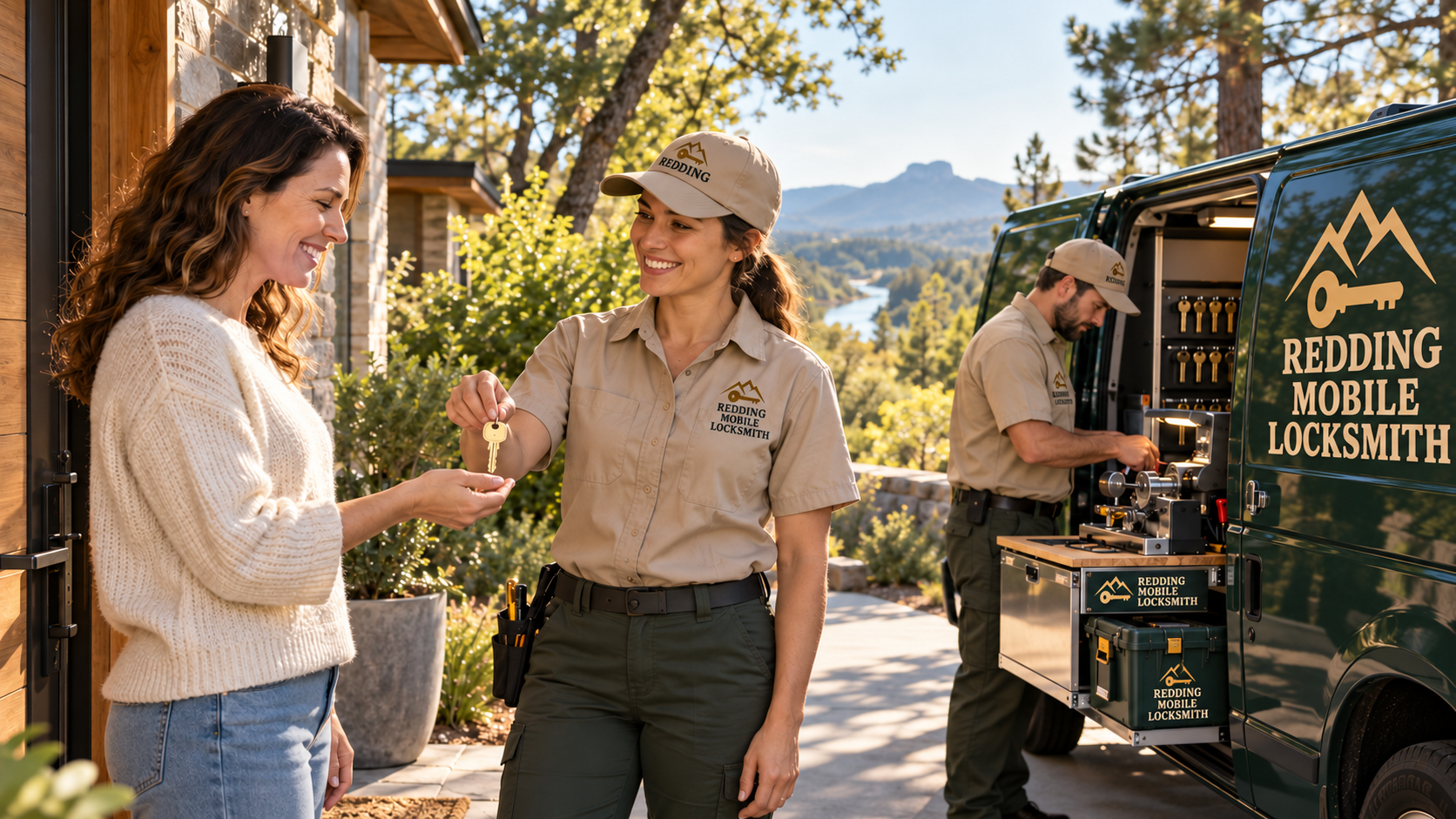
A mobile locksmith arrives in a marked van with the tools and a selection of common hardware aboard. The visit begins with a look at the door and a conversation about how it is used. If you already bought a lock, the technician checks that it fits the door and is suitable for the job. If you did not, they can suggest options from what they carry or help you pick something that fits.
Next comes the work itself. Old hardware is removed, the holes are checked and adjusted if needed, the new lock is fitted, and the strike plate is positioned so the bolt lines up with the opening in the frame. The technician then tests the lock from both sides several times with the door open and closed, because most installation problems show up when the door is shut and the bolt meets a misaligned strike.
At the end you should get working keys, a clear explanation of how the lock operates, and, with keypad or smart locks, help setting a code or pairing a phone. Ask for a final walk through. Operate the lock yourself with the technician watching, and if anything feels stiff or awkward, say so then, not three weeks later.
Keying several locks alike, or not
If you are replacing locks on more than one door, you have a choice. Keyed alike locks all open with the same key, which is convenient for a household that does not want a ring of six keys. Keyed differently locks give you separate keys per door, which suits places where different people should have access to different doors.
Most households prefer alike on the doors they use daily, and perhaps a different key for a shed or a garage workshop. Small businesses often prefer a system where the owner has everything and the staff have only what they need. That can be arranged at installation, and it is a lot easier to arrange then than to untangle afterward.
Whichever route you take, keep a record of who has which key. A simple note in a drawer works. When the next person moves in, the next employee leaves, or a spare goes missing, you will be glad you did. Our overview page for new lock installation adds some thoughts on planning key systems for larger properties.
New lock or rekey: choosing the right fix
Not every lock problem calls for new hardware. If the lock itself is sound, but you worry about who has keys, rekeying changes the internal pins so old keys no longer work, while the lock stays in place. That is often the right answer after a move or a lost key, and it can cost less than replacing hardware.
New installation makes more sense when the lock is worn, damaged, badly matched to the door, or simply not the level of protection you want. A loose, rattling handle set that has been repaired twice is a good candidate. So is a deadbolt that shares a door with a flimsy latch that anyone could force.
Our guide, is it better to rekey or replace, walks through how to decide. If you are unsure, tell the dispatcher what you see and let the technician make a recommendation after looking at the door. A good one will not push you toward the bigger job.
Rules, landlords and shared walls
Before changing hardware, ask who has a say. A homeowner generally decides for their own house, though some neighborhoods have associations with expectations about exterior appearance. Renters usually need to talk to a landlord before changing anything, and rules about this vary, so we do not offer legal guidance here. We simply say that a short conversation first saves arguments later.
If you manage a small rental in Anderson, ask what your lease and local expectations say about who provides keys and who pays for lock changes. Put the answer in writing. The point is not to be formal, but to avoid a disagreement months later when someone moves out and the keys do not come back.
Businesses have their own considerations, since a door that must stay open to the public during hours may need hardware that can be opened from inside at any time. Our local page on door hardware for business in Anderson covers what that looks like in practice.
Living with the new lock afterward
Once the work is done, a few habits make it last. Use the key straight, without wiggling. Keep the strike area clear of paint drips. Lubricate with a dry product intended for locks, not a heavy oil that gathers grit. In Anderson, summer dust and winter damp both find their way into locks, so a gentle yearly check is a decent plan.
If you installed a keypad or smart lock, mark a day on the calendar to check the batteries. Many of these locks warn you when power is low, but it is easy to ignore a chirp for a week. Keep a regular key hidden somewhere safe for the day the batteries die anyway, and do not hide it in the obvious places.
Finally, tell the people who need to know. If a teenager or a relative has been using a back door, make sure they know how the new lock works before they stand outside in the dark trying to figure it out. A good lock that locks out your own family is not doing anyone a favor.
Where to go next
If you are still deciding, the most useful next step is to write down your doors and send the list through the request form on the contact page. Include which doors are used daily, which are rarely opened, and anything about their condition that worries you. That gives the technician a head start.
For related reading close to home, see key programming and fobs in Anderson if cars are part of your key tangle, or emergency help in Anderson if a door has already failed and you need something sooner. Our Anderson overview gathers everything else in one place.
Neighbors in Redding and Cottonwood are also covered by the same team, which is useful to know if you have family or property in both towns. Sharing a plan with relatives who live elsewhere is easy when the same team can serve every address. Wherever you live, a decent lock fitted properly is one of the quieter pleasures of home ownership.
Good to know
Common questions
Can I buy a lock myself and have you install it?
Yes, many customers do. The technician checks that the lock suits the door, the thickness and the bored holes before installing. If it does not fit, they can explain why and suggest an alternative. Bringing the box with the model information on it helps the conversation.
How do I know whether I need a deadbolt on a certain door?
Consider how exposed the door is, how solid the door and frame are, and how much you rely on it for protection. Back doors and doors from an attached garage often deserve one. A technician can look at the frame and tell you whether a deadbolt would hold.
Do keypad locks work in hot Anderson summers?
Most are designed for ordinary outdoor conditions, but heat, direct sun and dust can shorten the life of lower grade electronics and batteries. Pick a unit suited to your door's exposure, and check the batteries on a regular schedule rather than waiting for a warning.
Will new locks match the key I already carry?
They can. Locks can be keyed to a key you already use, or to a fresh one. Tell the technician which doors should share a key and which should not. Planning this before installation is much simpler than changing it afterward.
What if my door is old and does not hold a lock well?
A tired door can often be improved with reinforcement around the lock area and a better strike plate, or the door itself may need attention. The technician looks at the wood and frame first and tells you honestly whether the door can support a new lock.
How do I request an installation visit?
Use the request form on our contact page and describe your doors, what you want and any problems you have noticed. The phone line is coming soon. The team serves Anderson and the surrounding Shasta County communities around the clock, so a request can be made at any hour.