
Home / Lakehead / Home Lock Service in Lakehead
Lakehead home locks
Home Lock Service in Lakehead: A Walk Around the House
Most people can name the lock on their front door and little else. Here is a room by room, door by door tour of the locks and latches on a typical Lakehead property, with what each one does.
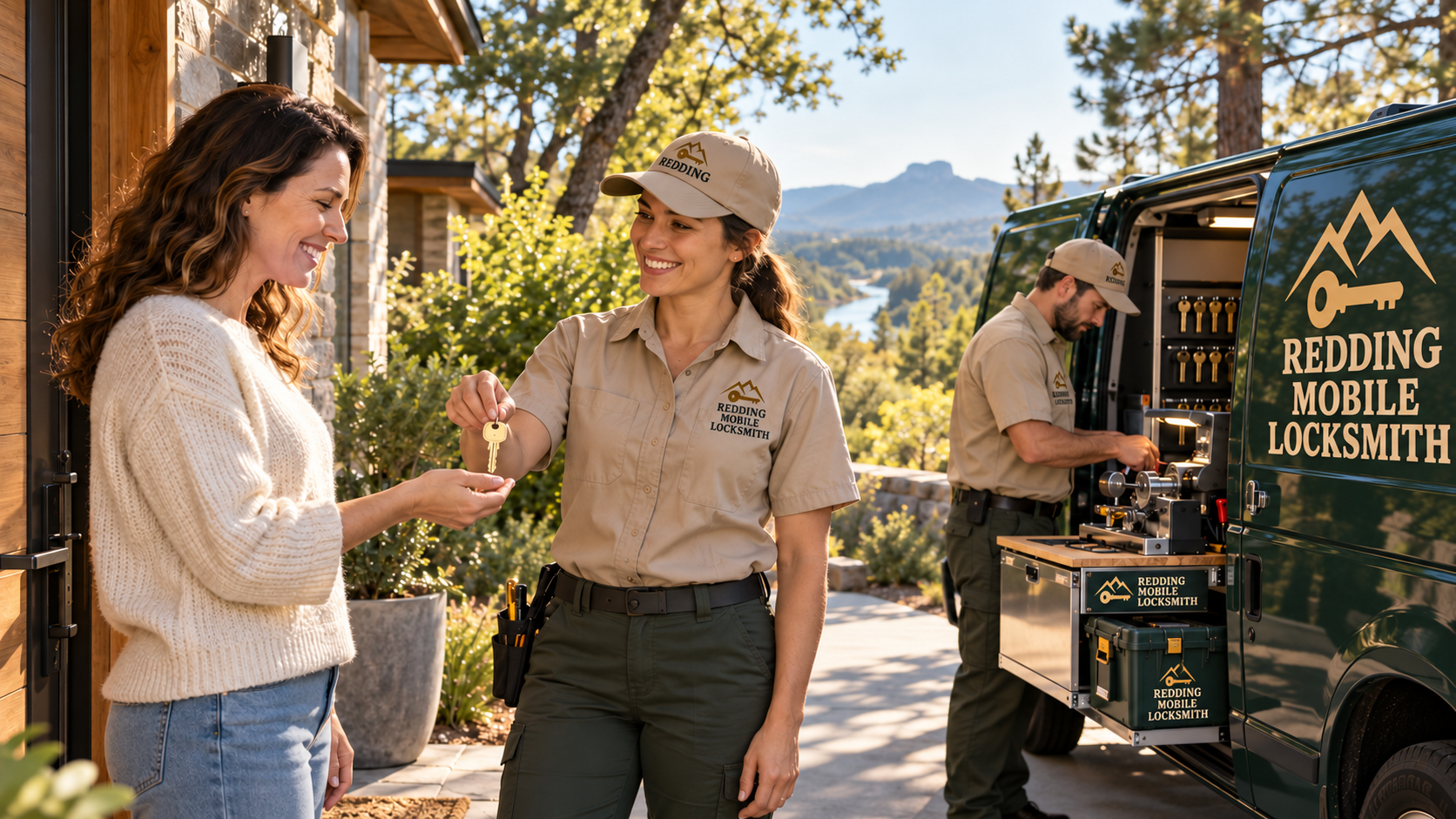
Lakehead home locks
Start at the gate with an owner who has a lot of ground
Imagine an owner of several acres near the north end of Lake Shasta, with a gated driveway, a main house, a guest cabin, a boat shed and a workshop. Each building has its own door, each door has its own lock, and none of them were bought in the same year. Ask that owner how many keys are in the drawer and how many locks they open, and the honest answer is a shrug.
That is the normal state of a property that has grown over time. Locks pile up, keys multiply, and nobody ever sits down and lists them. A walkthrough turns that vague picture into a tidy one. You do not need tools or special skill, only a notebook, a few minutes at each door and a willingness to notice what feels wrong.
This page leads you around the property in a sensible order, from the gate to the front door and on through every latch you are likely to meet. If you would like the big picture of the service first, our home lock service page sets it out, and this page is the Lakehead version, written for lake country homes, cabins and acreage.
Gates and driveways
The gate is usually the first lock anyone meets. Some are chain and padlock arrangements, some are swing gates with a latch and a lock box, and some are electric gates with a keypad or remote. The gate matters because it decides who even reaches the house, but it is also the lock most exposed to rain, dust, sun and frost.
Check that the padlock turns freely, that the chain is not rusted through, and that the latch lines up when the gate closes. A stiff gate lock is a warning, since it will be worse in winter. Use a lubricant made for locks and not a general oil that attracts dirt. Our guide on what lubricant belongs in a lock explains the choices.
Think about who needs the gate open, and when. Delivery drivers, guests and caretakers may all have a key or a code, and over the years the list can grow unmanageable. For more on this subject, see our guide on gate lock questions for country driveways.
If your gate has a keypad or remote, ask what happens when the power fails or the battery dies, and whether there is a manual override. A gate that cannot be opened by anyone during a storm is more than an inconvenience, so it is worth knowing the backup before you need it.
The front door
The front door usually carries the most thought and the most hardware. Look first at the deadbolt, since that is the lock that matters most. A deadbolt should turn smoothly and throw the bolt fully into the frame. Close the door and turn the bolt while watching the edge: it should slide out cleanly, without scraping, and sink into the strike plate with a small amount of play.
Next check the handle or knob set. It should hold the door shut but release when you turn it, with a latch that springs back crisply. A wobbly handle, a sticky latch or a key that must be jiggled are all small signals. They rarely mean disaster, but they do mean wear, and they are simpler to deal with before they fail.
Finally look at the strike plate and the screws holding it. The strike is the metal plate in the frame that the bolt enters. If the screws are short, the plate is only attached to thin trim. A longer set of screws that reach the solid framing behind the trim is a small change with real benefit. Our guide on what makes a good strike plate explains it further.
While you are at the front door, look at the hinges as well. Hinge screws that have worked loose let the door sag, and a sagging door drags the bolt out of line with the strike. Tightening a loose hinge screw is a two minute job that can bring a stubborn lock back to life, and if the screw hole is stripped, a longer screw or a wooden filler peg usually restores the grip.
Back doors, side doors and the door to the garage
People tend to protect the front and forget everything else. But every exterior door is an entrance, and the weakest one decides how secure the house is. On a lake property, patio doors, deck doors and side entrances to the garage are common, and each deserves the same attention.
The garage entry door is worth special mention. It usually opens into the house, so a lock failing there is a serious matter. Our guide on what to do if the garage entry lock fails covers it. Sliding doors are a category of their own, and we discuss them in sliding door security questions.
Whenever you are not sure whether a lock is adequate, ask. A technician can look over a door and say whether the lock, the frame or the door is the weak link.
Remember the small details, too. A door viewer, a chain, a latch guard or a longer screw in the hinge side can each add strength at little effort. They are the quiet upgrades that rarely get noticed until the day a door is tested, and then they matter a great deal. Add them to your list as you walk, since it is easier to remember them at the door than at the kitchen table.
- Confirm each exterior door has its own working deadbolt, not only a handle lock.
- Check that the door between the house and the garage closes and latches on its own.
- Look at sliding glass doors for a working latch and a secondary bar or pin.
- Make sure the screen door latch is not the only thing you rely on at night.
- Test any keypad or smart lock, and note where its backup key is kept.
Windows and the older latches
Windows rarely get the credit they deserve as entry points. A window latch is a small cam that pulls the sash tight, and in older houses it can be loose, painted over or missing. A window that can be lifted from outside with the latch undone is an open invitation, particularly on the ground floor or near a deck.
Check each latch to see that it turns and holds. Some windows can be fitted with a secondary stop, a pin or a lock that limits how far the window opens. These are inexpensive to add and easy to use. Think about ventilation, though, since lake country summers are hot and dry, and a window locked partly open can be a good compromise.
Older homes have their own quirks, and we have written about them in our guide on window lock questions for older houses. If you are not sure what a particular latch is, take a photo and ask.
Outbuildings, sheds and the boat shed
On a lake property the list of buildings can be long: a boat shed, a tool shed, a workshop, perhaps a guest cabin. These often carry the most valuable items, such as tools, equipment and watercraft gear, and the least secure locks. A padlock on a hasp is a common arrangement, and it is only as strong as the hasp, the screws and the door.
Look at the hasp. If the screws are visible and short, or the hasp is attached to a thin board, it can be pried loose. Consider hardware where the fasteners are hidden when the door is closed and where the lock is shielded. Also check the hinges: hinge pins that can be lifted out make the lock irrelevant.
Moisture and damp near the water take their toll on metal parts. Rust and corrosion can freeze a lock or weaken a hasp. Choose hardware suited to outdoor use and keep it lubricated. Brass and stainless parts tend to resist corrosion better than plain steel, and a cover or small overhang above the lock keeps rain and spray off the keyway. Our guide on shed and garage padlock questions gives the key points.
Keys: how many, who has them, and what they open
A property with many locks ends up with many keys. Sort them. Take every key you can find, and label them. Try each in its lock to see what it opens. Keys that open nothing can be set aside, and keys that nobody can identify are worth thinking about, since they could belong to a lock you forgot or a lock on someone else's property.
Then ask who has copies. Caretakers, relatives, former tenants, contractors and previous owners can all hold keys. If you do not know, or you bought the property recently, consider changing the locks. Our guide on whether you need to rekey after buying a house discusses the question.
There is a middle road between living with unknown keys and replacing everything. Rekeying changes the inside of the lock so the old keys no longer work, and it can be done so that several locks share one new key. That is especially handy for a property with many doors.
Signs a lock is wearing out
Locks give warnings before they fail. A key that is harder to turn than it was, a bolt that does not fully extend, a handle that sags, a latch that sticks, a cylinder that spins loosely in the door: each tells you something. Catching them early turns an emergency into a scheduled job.
Weather accelerates wear. In the hot dry months, dust and heat can stiffen mechanisms. In the cold, moisture can freeze inside a lock, and a forced key can snap. Locks near water or on exposed doors show age sooner than ones inside the house. Check them seasonally, perhaps when you change your smoke alarm batteries.
Our guide on how to tell if your locks are worn out has a fuller checklist, and the page on lock repair and adjustment explains what can be fixed without replacing the lock.
One more habit helps: listen. A healthy deadbolt makes a clean, solid sound as it extends, and a tired one scrapes, clicks twice or drags. You may not be able to name the problem, but if a lock sounds different from last year, that is worth a note on your list.
Seasonal visitors, rentals and shared access
Lakehead is a lake community, and many homes see a changing cast: owners who come on weekends, relatives who stay for summer, guests who rent for a week. Every one of them needs access, and every one of them is a potential key to lose.
If you share a property, think about how access is handled. A keypad lets you give each guest a code and change it afterward. A lockbox gives access without handing over a key. A smart lock can let you manage entry remotely. Each has tradeoffs, and a technician can explain which fits your door. Our guide on managing locks for vacation homes has more.
Whatever you choose, change codes or rekey between long stays, and keep a record of who has what. Rules about shared properties and rentals vary, so ask about any that apply to yours.
If you hand out physical keys, put a tag on each one that does not say what it opens or where, only a number you can look up. A lost key with an address attached is an invitation. A lost key with a number on it is just a piece of metal to anyone who finds it.
Putting your list together
After the walkthrough, you should have a page of notes. Door by door, write what lock it has, how it feels, who holds keys, and what you would change. Prioritize. A front door with a worn deadbolt matters more than a shed latch. A garage entry with no deadbolt matters more than a bedroom window latch.
Then decide which jobs to do yourself and which to hand over. Cleaning and lubricating a lock is simple. Replacing a handle set can be done by a handy owner. But fitting a deadbolt into a new door, rekeying several locks or fixing a lock that has failed is work for a technician. Our guide on whether you need a locksmith to change a door handle will help you decide.
If you have a list, you can send it with your request. The technician can then plan the visit and bring the right parts. The request form accepts as much detail as you like, and the phone line is coming soon.
Next steps and nearby pages
If you decide to add or upgrade hardware, new lock installation in Lakehead explains how that goes. If the door is the problem, check the related guidance. If everything seems fine, a walkthrough once a year keeps it that way.
For other communities with their own settings, the page for home lock service in Millville looks at a foothill setting, and the Lakehead page collects every local service in one place.
Keep the list somewhere you will find it next year, and add the date of each repair or change. A lock history of that kind takes little effort and pays off when you sell the property, hand it to a caretaker or try to remember whether a particular door was rekeyed. A house is a collection of small decisions made over many years. A walkthrough like this one is a chance to make a few of them again, on purpose, with a clear view of what you own.
Good to know
Common questions
How often should I check the locks on my property?
Once or twice a year is a sensible habit, and it fits well with seasonal chores. Check that each lock turns smoothly, each bolt fully extends, and each latch catches. In lake country it helps to look after the damp season and again before summer, when dust and heat can stiffen mechanisms.
Is rekeying better than replacing locks?
Often it is the simpler step. Rekeying changes the inside of the lock so old keys stop working, and the hardware stays. Replacement makes sense when a lock is worn, damaged or the wrong type for the door. A technician can look at your locks and say which route suits.
Do I need a deadbolt on every exterior door?
It is a common and sensible choice, since a deadbolt resists force far better than a spring latch alone. The right setup depends on the door and its use, and some doors, such as sliding doors, need a different kind of lock. Ask a technician to look at each entrance.
What can I do about locks that stick in cold or damp weather?
Do not force the key. Use a lubricant made for locks, and check whether the door itself has swollen or shifted. Moisture can freeze in a lock, and a forced key may snap. If it stays stiff, a technician can clean or repair the lock or adjust the door.
How do I keep track of keys on a large property?
Collect and label them, test each against its lock, and keep a simple log of who has copies. Setting aside unknown keys and rekeying where you cannot account for them reduces risk. Many owners also like to key several locks alike so fewer keys are needed.
Can a rental or vacation home use codes instead of keys?
Yes. A keypad or smart lock lets you give each guest a code and change it between stays. Each type has tradeoffs for power, backup access and how it behaves in cold weather. A technician can explain which suits your doors and your guests.