
Home / Millville / Cars and Trucks in Millville
Millville vehicles
Cars and Trucks: What a Mobile Locksmith Handles in Millville
After a long shift, the last thing anyone wants is a car that will not open or start. This page lays out the full mix of vehicle key problems we handle, so you know which one you have and what comes next.
Millville vehicles
The end of a long shift
Imagine someone finishing a long work shift, walking out to the vehicle in the dark with a head full of the day. The keys are in a jacket pocket, or on the seat, or in the ignition with the doors shut. Whichever it is, the moment the problem reveals itself is a deflating one. All you want is to go home, and the vehicle is declining to cooperate.
Fatigue makes everything feel bigger. A dead fob feels like a disaster. A key that will not turn feels like a conspiracy. A calm look at the facts usually shrinks the problem to a manageable size. Almost every vehicle key problem falls into a handful of categories, and each category has a known path to a solution.
This page walks through those categories one by one. We describe them as a patient neighbor would, with no jargon we do not explain. If you live in Millville or the surrounding foothill country, you will recognize the setting: long private roads, few street lights and neighbors who are not close enough to lend a coat hanger, which is a good thing, since a coat hanger rarely helps and often damages the door.
If you are reading this in the parking lot, with a nearly empty phone and a long drive ahead, skip down to the section on what to tell us. If you are reading it at home, as preparation, take your time. Knowing the vocabulary now will make the next awkward moment shorter and less stressful.
Group one: the vehicle will not open
The simplest category is the one everyone knows. The keys are inside and the doors are locked, or the key is lost and the door will not unlock. A locksmith opens the vehicle using purpose made tools that work without harming paint, glass or weatherstripping. The aim is to leave the car as it was, only with an open door.
The process starts with a question about who you are and whether the vehicle is yours. We ask for identification and something connecting you to the vehicle, such as registration. Then the technician examines the door and chooses a method suited to that model. Once the door is open, you can retrieve your keys and carry on.
It is worth checking the obvious first. Try every door, including the rear and the tailgate, since a lock sometimes gets missed. Look at whether a window is down, and whether a spare key is with a family member who could bring it. Those simple checks cost nothing and occasionally end the problem before it starts. When they do not, a professional opening is the gentlest route.
Our page on getting back into a locked car describes the service, and the guide on how a car is opened without the key gives a general explanation without exposing methods that would help a thief. If a child or pet is inside a locked vehicle, call emergency services first.
Group two: every key is gone
The next category is harder. There is no key to copy, and the vehicle must be introduced to a new one. This is the situation when keys are lost on a hike, dropped into water, taken by accident or simply vanished. A modern vehicle will not accept a plain metal blade. It needs a key with the right chip or the right fob, cut and programmed to match.
The process is methodical. The technician confirms ownership, identifies the key type from the vehicle, prepares a matching blank, cuts it to fit the locks and programs it so the car accepts it. In many cases the entire sequence is completed at the vehicle, in the driveway or by the road, with no towing required.
If any old key is still missing, it is wise to ask that it be removed from the vehicle's memory when new keys are programmed. That prevents a lost key from being used by anyone who might find it. Our page on replacement car keys covers this in detail, and the guide on making a key when you have none answers the usual worries.
Expect the visit to take some patience. Cutting, programming and testing each key is careful work, and a technician will not hurry through it. The result should be a key that opens every door, starts the engine and operates every remote button you expect. If anything is off, say so before the technician leaves, because adjusting a fresh key is easy while the equipment is still out.
- Confirm that you own the vehicle and can show identification.
- Tell us the make, model and year so the right blank is ready.
- Say whether the vehicle has a push button start or a regular ignition.
- Ask about removing lost keys from the vehicle's memory.
Group three: the key works the doors but the engine will not start
This is the problem that surprises people most. The key goes in, the doors lock and unlock, and then the engine refuses to cooperate. The cause is usually the chip inside the key. Most vehicles since the late 1990s check a coded transponder before allowing the engine to run. If the chip is missing, damaged or unrecognized, the car simply will not start.
A copy of a key from a counter often has the right blade and the wrong chip, or no chip at all. Sometimes a good key has been dropped, soaked or cracked, and the chip inside has failed. Sometimes the vehicle's own system has lost track of a key after a battery change or repair. The fix depends on which of these applies.
Programming is the usual answer. A technician connects a tool to the vehicle, puts it into learning mode and teaches it the key. Our page on key programming and fobs and the guide on what a transponder chip is describe the idea. Our local page on key programming in Millville gives the neighborhood version.
Group four: the fob is tired or broken
Remote fobs and smart keys fail in several ways. The battery runs down, so buttons respond weakly or only when you stand beside the car. The case cracks. The buttons wear through. The fob loses its connection to the vehicle after a battery replacement. Some of these are easy fixes and some need a new fob.
Start with the battery. Most fobs open with a small coin or a thin tool, and the battery type is printed on the cell. If a fresh one does not help, look for visible damage. A fob that has been dropped, soaked or left on a hot dashboard through summer may have internal damage.
If you have a smart key, learn where the emergency blade is hidden and how to use it. Many people do not know their fob contains one until the day the battery dies in a parking lot. Our guide on what to do when your key fob stops working walks through the steps you can try.
Group five: the ignition or the steering lock
Sometimes the key is fine and the vehicle is the problem. A key that will not turn may be caught by the steering lock, which engages when the steering wheel has been turned against a stop while parked. Gently wiggling the wheel while turning the key often releases it. A key that turns stiffly may be dealing with a worn ignition cylinder.
A key that will not come out is another variant. It may be stuck because the vehicle is not in park, because the ignition is worn, or because the key itself is damaged. Do not force it. A forced key can snap, and a broken key in an ignition is a bigger job than a stuck one. Our guide on a key stuck in the ignition explains what to check.
A technician can repair or replace an ignition cylinder, cut a key to match it and program the key if needed. In many cases the vehicle's steering column does not need to be replaced. Worn keys and heavy key rings are common causes of ignition wear, so lightening the load on your ring is a small habit with real benefits.
If the steering lock is the culprit and the wiggle does not help, do not apply force with a tool. The lock pin is hardened steel, and bending a key or cracking its head turns a nuisance into a repair. Let a technician look at it. Sometimes a worn key is the real reason the lock will not release, and a fresh key cut from the code does the trick without touching the ignition.
Why a mobile visit suits Millville
Millville is a small rural community in the Shasta County foothills, where country properties, wells, barns and long private roads set the rhythm of life. Getting a vehicle to a shop can be an undertaking, particularly when it will not start or cannot be driven safely. A mobile locksmith brings the shop to you.
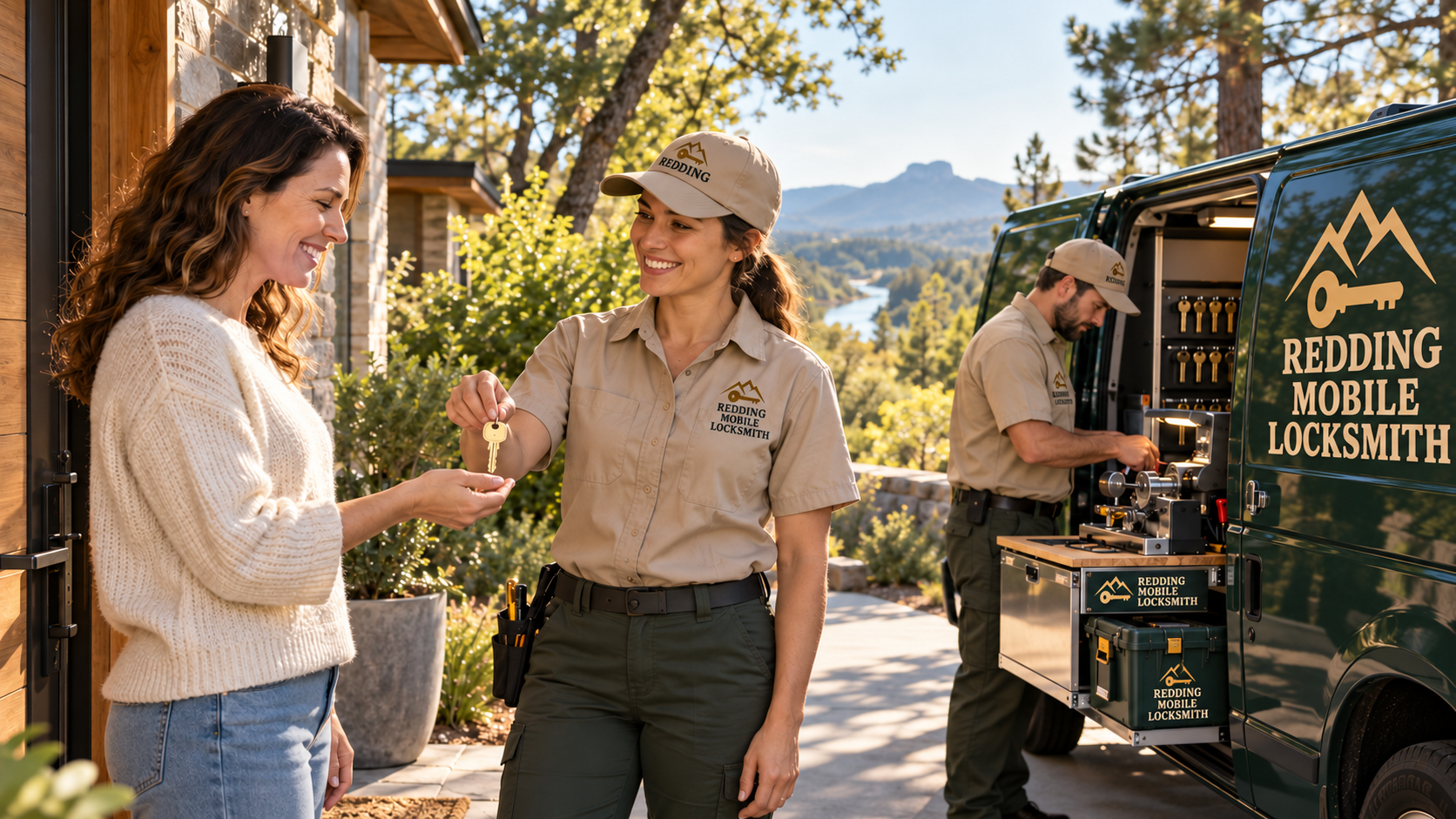
Our service van carries professional tools, key cutting and programming equipment, and common hardware. The team arrives in uniform, in a branded vehicle, so you know who you are dealing with. Because the work happens where the vehicle is parked, you avoid the cost and delay of towing for a key problem.
We ask for a few things in return: a safe place to park and work, a clear description of the problem and proof of ownership. If your driveway is long, steep or gated, tell us. If the vehicle is on a roadside, move it to a safe spot if you can. Wide pull offs and turnouts are safer than narrow bends, especially at night.
Trucks, work vehicles and shared keys
Pickups, farm trucks and work vehicles are a big part of life out here. They may be shared among family members or crew, and keys tend to wander. A truck might have a plain mechanical key from an earlier era, or a chipped key from a more recent one. The type matters because it determines whether the key can be cut at once or needs programming.
If more than one person drives a vehicle, decide how many keys exist and who holds them. A spare in a drawer at home is wise. A key that vanishes from a work crew is a reason to reset which keys the vehicle recognizes. Our guide on a work vehicle lockout and who to tell covers the practical side.
If you buy a used vehicle, ask how many keys came with it and whether they are all programmed. Our guide on how many keys come with a used car explains why this matters. A single key is a risk; a second, properly made key is a comfort.
Finally, remember that a work vehicle belongs to someone. If the truck is owned by an employer, we will want to speak with a person who can authorize the work, and we will want that approval to be clear. It protects you from any misunderstanding afterward and makes the visit smoother when the owner is not on site.
What to tell us when you ask for help
Good information helps a visit go well. Say what happened in plain words: keys locked inside, key lost, key broken, engine will not start, fob not working. Give the make, model and approximate year of the vehicle. Say whether you have any working key and whether the car has a push button start.
Give your location as exactly as you can, including the nearest main road and any gate or driveway details. Mention if the vehicle is blocking a road or a driveway. If the weather is bad or it is dark, tell us how you are keeping safe. Use the form on our contact page, since our phone line is coming soon.
Our team works around the clock, so a call at the end of a night shift is not out of place. For more on what the conversation looks like, read about emergency help at any hour in Millville, which describes the questions and the steps that follow.
Habits that save a bad night
A few small habits can spare you a rough evening. Keep a spare key somewhere safe, away from the vehicle. If you use a smart key, keep a spare fob and check its battery. Pat your pocket before you shut the door. Avoid leaving keys on a seat or in a cup holder, where they are easy to lock in.
If your work involves a lot of walking in and out of the vehicle, such as deliveries or site visits, consider a lanyard or a clip that keeps the key attached to you. It sounds silly until it saves you an hour of waiting at the end of a long day. Small habits like these cost nothing and work every time.
Neighbors in Millville, Palo Cedro and Anderson live with the same roads and the same long drives home. Our broader page on cars and trucks covers every service, and our home lock service in Millville page covers the other half of getting back through your own door.
Good to know
Common questions
What kinds of car problems can a mobile locksmith solve?
We handle vehicle entry when keys are locked inside, replacement keys when all keys are lost, key programming and fobs, and ignition problems such as stuck or broken keys. Mechanical repairs unrelated to keys and locks are outside our work.
Why does my key open the doors but the engine will not start?
Most modern vehicles check a coded chip in the key before they allow the engine to run. If the chip is missing, damaged or not programmed to the car, the doors may work and the engine will not. Programming a proper key usually solves it.
Will you damage my car to open it?
The aim is to open the vehicle without damaging paint, glass or weatherstripping, using tools made for the job. A technician chooses a method suited to your model and explains it before beginning. We will also ask for proof that the vehicle is yours.
Can I tell if my fob just needs a new battery?
Often, yes. If buttons respond weakly or only when you stand beside the car, a fresh battery is the first thing to try. Most fobs open with a small coin. If a new battery does not help, the fob may need pairing or replacement.
What should I do if a child or pet is locked inside my vehicle?
Call emergency services first. Do not wait for a locksmith. Once responders have dealt with the situation, we can help with the lock or any damage to the door and make sure the vehicle can be secured.
How do I ask for help late at night?
Our team works around the clock. Use the request form on our contact page, since the phone line is coming soon. Give your exact location, the vehicle make, model and year, and a clear description of what happened and whether you are somewhere safe.