
Home / Redding / New Lock Installation in Redding
Redding, new locks
New Lock Installation in Redding: Door Prep, Strikes and Alignment
A new lock is only as good as the door it is fitted to. This Redding page follows an installation from the bare door to the last test turn, with attention to the details that decide whether it lasts.
Redding, new locks
The key that only one person holds
Imagine a volunteer who looks after a small hall used by a church group or a club in Redding. For years the building has had one set of keys, and they live on this one person's ring. When that volunteer moves, falls ill or simply loses track of the ring, the whole group is locked out, and nobody can quite say how many copies exist or who has them.
That is the most ordinary reason groups install new locks. The hardware may be perfectly sound, but the trust in it has quietly evaporated. A fresh installation, planned with a sensible key arrangement, resets the situation: a known number of keys, handed to known people, recorded somewhere sensible.
The scenario is invented, but the pattern is familiar to anyone who has helped run a volunteer organization. This page uses it to explore what an installation actually involves, because the details matter more than the product on the box. Our main new lock installation page gives the general picture, and this one concentrates on the door itself.
It is worth saying that nothing about this is a criticism of the volunteer. Informal arrangements work until they do not, and the moment they stop working is rarely convenient. Groups that think about keys before a crisis tend to handle the change calmly, and the new lock becomes a small administrative event instead of a scramble.
Start with the door, not the lock
Before a technician opens a package, the door gets a careful look. Is it solid wood, hollow metal, fiberglass or a lightweight interior door pressed into service on an exterior opening? Is it the right thickness for the lock? How old is the frame, and is it square? A lock installed in a door that has dropped or warped will never feel right, whatever it cost.
Doors in Redding live through hot dry summers and mild wet winters. Wood swells and shrinks, frames settle, and hinges loosen under the weight of years. Many problems that look like lock failures are really door problems. Our guide on why doors sag and what that does to locks explains how a quarter inch of drop can ruin a good deadbolt.
Material matters too. Metal, wood and fiberglass each take a lock differently, and the guide on metal, wood or fiberglass doors and how locks fit them covers what changes. A technician accounts for these differences with the right drill bits, the right care around the door skin, and the right fasteners.
A frame that is out of square tells its own story. Gaps that are wider at the top than the bottom, a reveal that changes along the latch side, or a door that rubs the head jamb in one corner all hint at movement. A careful technician checks those signs before drilling a single hole, and will tell you plainly if the door needs attention first.
Door prep: bores, edges and templates
Most residential exterior doors are prepared with two holes. A large cross bore holds the lock body or latch assembly, and a smaller edge bore, drilled into the side of the door, holds the latch bolt. The positions are standardized, and a template or jig keeps the drilling accurate. Eyeballing it is how installations go crooked.
If the door was never prepared, or if you are swapping a very different lock for an existing one, those holes might need enlarging or filling. A neat repair is possible, but it takes time and the right materials. A hole that is too big for the lock rattles, and one that is too tight can crack a wooden door. Good prep keeps the door intact.
The edge of the door also needs attention. A latch plate, set flush into a small mortise, keeps the bolt moving smoothly and the edge from splintering. Cutting that recess cleanly, without chipping the finish, is a small skill that shows in the result.
Hand tools and power tools both have a place. A technician may rough out a bore with a hole saw and finish edges with a chisel, because the finish matters as much as the size. On a metal door, the approach changes again, with attention to burrs and to protecting the door skin so rust does not start where bare metal is exposed.
- Confirm the door thickness and material before choosing hardware.
- Mark the cross bore and edge bore with a template.
- Drill slowly, supporting the far side to avoid splintering.
- Set the latch plate flush with the edge of the door.
- Try the lock body in place before adding any screws.
The strike plate: small part, big job
The strike is the metal plate on the door frame that receives the bolt. It looks like a minor accessory, and yet it is the part that decides whether a lock protects anything. A bolt that only reaches into a thin strip of soft wood can be defeated with one hard kick. A bolt that enters a deep, well anchored strike is a different matter.
A good installation uses a strike set in properly, with screws long enough to reach the solid framing behind the trim. Short screws that bite only the jamb are a common weakness. The guide on what makes a good strike plate covers the details in plain language, including why the hole behind the plate should be deep enough for the whole bolt.
Alignment of the strike is just as important as strength. If the bolt hits the plate off center, the door will bind, rattle or refuse to lock, and the owner will blame the lock. A technician marks the bolt's position, then positions and trims the strike so that the bolt enters without effort.
Replacement hardware can also change the way a door feels. A heavier lock body shifts weight on the edge, and a handle set with a longer lever changes the leverage on the latch. These are minor effects, but a well chosen product for the door in front of you avoids them.
Alignment: where good installations are won
Alignment is the quiet center of the craft. With the door closed, the latch should meet the strike squarely, the bolt should slide in without pressing against either edge, and the door should sit snugly against its stops without needing a shove. If any of those conditions fail, the lock will wear out early.
A simple test uses the owner's own eyes and ears. Close the door slowly and watch the latch. Throw the deadbolt with the door shut and notice whether it moves freely or drags. Listen for scraping. A properly installed deadbolt extends with a smooth, confident motion, and a retracted one disappears fully into the door.
When something is slightly off, the correction might be a small adjustment to the strike, a shim behind a hinge, a tightened hinge screw, or a longer screw into the framing. These are not dramatic fixes, but they are the difference between an installation that works on day one and one that works for ten years. Our page on lock repair and adjustment describes more of this territory.
Seasonal movement deserves mention in a place like Redding. A door that fits perfectly in a damp winter can bind in a hot dry summer, or the other way around. Technicians often leave a hair of clearance with this in mind, and they will tell you if the door shows signs of moving enough that the lock may need an adjustment after the seasons change.
Choosing hardware for a shared building
Back to the volunteer and the hall. A shared building often needs a different approach than a home. Several people open the door, keys get lent, and the group changes over time. One sensible arrangement is a keyed system where a few trusted people hold keys that can be tracked, with a record of who has which.
Another option is a keypad lock, which lets a group change the code when membership changes, instead of collecting and recutting keys. A keypad has trade offs, though: codes get shared, batteries die and the mechanical key override still needs protecting. Our guide on keypad or key for a small shop weighs those points, and most of it applies to a hall as well.
Whatever the choice, ask about how the keys can be duplicated. Some systems restrict copying, which helps keep the key count honest. A group that wants to stop the slow spread of copies should ask about this when the hardware is chosen, because it is hard to change afterward.
Think about the hinge side too. Many doors are attacked at the hinges rather than the lock, and loose or short hinge screws are a common weakness. Replacing the short screws in the top hinge with longer ones that reach the framing is a modest improvement, and it costs next to nothing when the technician is already there.
Finishing the job and testing every turn
After the lock is mounted, the work moves to testing. The key should enter and turn smoothly from outside, and the thumb turn or inside handle should work without strain. The bolt should extend fully and retract fully. Handles should be tight, with no wobble. Test with the door open, then closed, then open again, and repeat.
Try the lock under realistic conditions. Close the door as people actually do, perhaps with a firm swing, and see whether the latch catches. Test with a hand pressing against the door, as if someone were leaning on it. A lock that works only when the door is held in a perfect position will cause trouble the first busy evening.
Finally, count and label the keys. Hand them over to the right people, ask each to try theirs, and write down who holds what. A well finished installation leaves the group with fewer unknowns than it had before. If you want to understand rekeying as an alternative, the guide on whether it is better to rekey or replace explains when each makes sense.
Record keeping can sound dull, but for a group it is protection. A simple sheet listing each key, its holder and the date it was issued will save an argument one day. Keep the sheet somewhere other than the building. When someone leaves the group, collect their key and cross them off.
Residential installations around Redding
Redding's neighborhoods range from older homes with original doors to newer subdivisions with factory prepared frames. Each presents different challenges. An older house may have an odd bore size, a painted over strike and a frame that has moved. A newer one may have a perfectly square opening and a lock of modest quality that the owner wishes to upgrade.
Homeowners often ask about adding a deadbolt where there is only a handle set, or upgrading a back door that gets less attention than the front. Both are routine installations, and both follow the steps above. Our page on home lock service covers the wider set of residential work, and the local version is home lock service in Redding.
The guide on whether every exterior door should have a deadbolt answers a question many neighbors ask, and the one on what lock grade means helps decode the labels on the packaging.
Rental properties add a further angle. A tenant generally cannot decide to change the locks without checking with the landlord, and rules differ. We do not give legal advice, but our guide on what renters should ask a landlord about lock changes lists sensible questions to raise before anything is installed.
Smart locks and electronic hardware
Some groups ask about electronic locks, and installation is a good moment to consider them. A smart lock replaces or supplements the deadbolt with a motorized mechanism that can be opened by code, card or phone. The door preparation is similar to a standard lock, but the battery, the mounting plate and the way the motor engages the bolt add details a technician checks carefully.
The most important question is what happens when the electronics fail. A good smart lock keeps a mechanical key override, and the door and strike must still be aligned so the motor does not strain. The guide on what a smart lock is and who needs one weighs the benefits against the added complexity, and the one on whether smart locks can be rekeyed covers the key side.
Whatever you choose, keep the batteries fresh and write down when they were changed. A smart lock on a shared building is only as dependable as the habits of the people who maintain it, so name one person to be responsible for that, and a backup who knows where the spare batteries live.
Related Redding pages and nearby towns
If your door is part of a business, the local page on door hardware for business in Redding looks at the commercial side, including maintenance on busy doors. For vehicles, see cars and trucks in Redding. The overview page for the city is Redding.
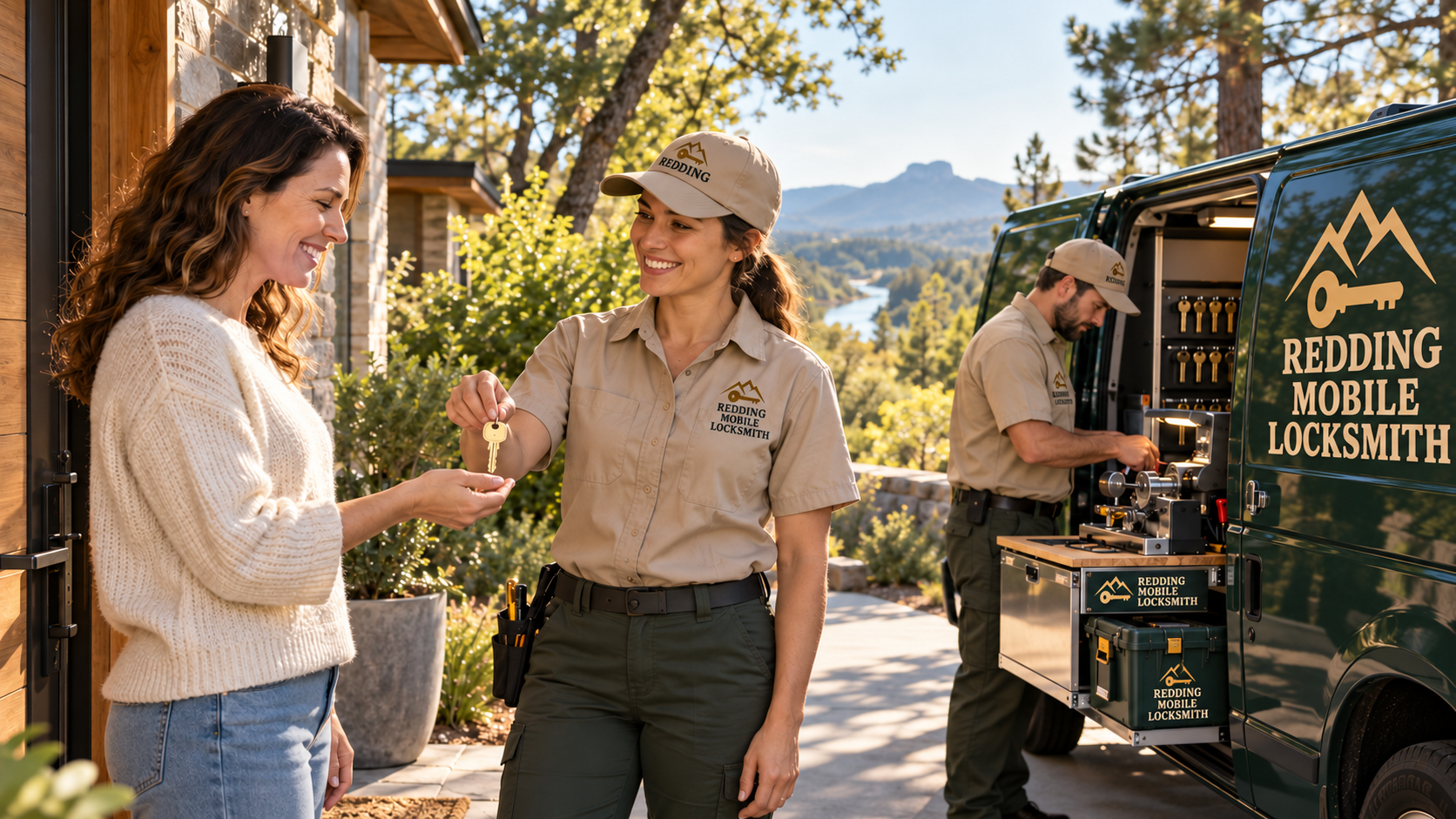
The same team serves the surrounding towns, so a group or household in Anderson, Cottonwood or Shasta Lake can use the same approach. The van carries professional tools and common hardware, so many installations can be finished in a single visit.
To start a request, use the form on the contact page. The phone line is coming soon. Tell us about the door, the material, whether it is an exterior or interior opening and what you are replacing, and a photo of the existing lock helps if you can add one.
Finally, plan the timing. An installation affects how people get in and out, so choose a moment when the building is not in use. If the work is for a hall that hosts regular meetings, mention the schedule when you ask, so the technician can arrive while the door can safely be opened up and tested.
Good to know
Common questions
Do I need to prepare the door before a new lock goes in?
The technician handles door preparation as part of installation. That means checking thickness and material, confirming the bore holes, and adjusting the latch recess and strike. If the door is warped or sagging, expect a conversation about fixing the alignment first, since a lock cannot work well in a door that does not hang right.
Why does the strike plate matter so much?
The strike receives the bolt, so it determines how much force the lock can resist. A strike anchored with long screws into solid framing holds up far better than one fastened to the thin jamb alone. Correct alignment also keeps the bolt moving freely, which prevents early wear on both the lock and the door.
Should a group choose keys or a keypad?
It depends on how often membership changes and how disciplined key handling is. Keys can be tracked but copied; keypads change codes easily but depend on batteries and discretion. Many groups choose a keyed system with restricted copying. Ask about options when you request an installation, and be honest about how the door is used.
Can a new lock be fitted to an old door?
Usually, yes, though older doors may need hole adjustments or repair first. A technician can enlarge or fill bores and install a latch plate cleanly. If the door itself is badly worn, repair or replacement of the door may be a better investment than any lock fitted to it.
How will I know the installation was done properly?
The key should turn smoothly, the bolt should extend and retract fully, and the door should latch without a shove. Handles should be tight. Ask to see the lock tested with the door open and closed. You should also receive every key and know how many exist.
How do I ask for an installation in Redding?
Use the request form on the contact page, since the phone line is coming soon and no number is published. Describe the door, what you want installed and any problems with it. Photos can help. The team works around the clock, so an urgent request such as a broken lock is welcome at any hour.