
Home / Weed / Key Programming and Fobs in Weed
Weed key programming
Key Programming and Fobs in Weed: Test Every Function
A new key or fob that opens the door is not necessarily finished work. This page walks through what to check before and after a replacement so nothing surprises you on the next long shift.
Weed key programming
The end of a long shift is a bad time to find out
Picture someone leaving work in Weed after a long shift, tired, hungry, thinking about nothing but the drive home. They press the fob and the lights flash. The door opens. They get in, turn on the vehicle, and head out. The next morning the trunk release does nothing, the remote start is silent, and the panic button has a mind of its own. The replacement key opened the door, so everyone assumed the job was complete.
This is the quiet trap of key programming. A key can look finished while still missing half of its abilities. Modern fobs often do five or six things: lock, unlock, release the trunk or tailgate, trigger a panic alarm, start the engine from outside, and sometimes open sliding doors or a power liftgate. Any of those can be missed during a hurried setup.
The solution is not complicated. It is a habit: test everything, both before the replacement work begins and after it ends. That habit costs a little patience and removes a long list of unpleasant surprises, the kind that show up at the worst moment, such as a late night in a parking area with the wind coming off the open fields and nobody around to help. The rest of this page lays out the routine in plain order so you can follow it at the vehicle or hand it to someone who is helping you.
What programming actually means
Programming is the process of introducing a key or fob to a vehicle's computer. Most modern keys contain a transponder chip, a tiny device that answers a radio query from the vehicle with a coded reply. The vehicle stores a list of codes it will accept. Programming adds a new code to that list, and in many cases removes old ones you no longer want to work.
A fob has two separate things that may need pairing. The first is the immobilizer side, which lets the engine start. The second is the remote side, which controls the lock buttons and other functions. Some vehicles treat these together and some treat them separately. That is why a new key can start the engine but not lock the doors, or the reverse.
Programming equipment connects to the vehicle, usually through a standard diagnostic port under the dashboard, and talks to the computer directly. Our service page on key programming and fobs explains the general process, and our neighbor guide on whether all car keys need programming clarifies when it is and is not needed.
Before the work: a baseline test
If your current key still works partly, take a few minutes to record what it does. Press each button on the fob and note the result. Does the lock button chirp the horn? Does the unlock button open only the driver door or all of them? Does the trunk release work when the vehicle is parked? Does the remote start function, and for how long does the engine run? Write down the answers, or even record a short video on your phone.
This baseline helps in two ways. It tells the locksmith what the vehicle is capable of, so the replacement can be matched to the right feature set. And it gives you a reference to compare against afterward. Without it, you may not remember whether the panic button used to work, and you will be left wondering if something was missed. People forget these small details surprisingly easily, especially the features they only use once in a while, like the trunk release or the remote start on a cold morning.
Also note how many keys and fobs you have. Some vehicles come with two or more, and the computer expects a certain number. Knowing how many exist, and where they all are, matters if you are replacing one that was lost. If a key was lost, you may want the old one removed from the vehicle's memory so a stranger who finds it cannot use it. Ask about that when you request the work.
- Press every fob button and write down what happens.
- Note whether the horn, lights, or both respond to lock and unlock.
- Try the trunk or tailgate release with the vehicle parked.
- Test remote start if your vehicle has it, and note how long the engine runs.
- Count every key and fob that belongs to the vehicle.
What to bring and what to say
A locksmith needs to confirm that you are entitled to have a key made. Expect to show identification and some proof that the vehicle is yours, such as registration or title paperwork. This is normal and it protects you, because the same step stops someone else from cutting a key to your vehicle. Our neighbor guide on how to know a locksmith is the real thing talks about the other side of that conversation.
Describe the vehicle clearly: the general type, the year, whether it has a push button start or a traditional ignition, and what kind of key or fob you currently have. If you have a photo of the old fob, even better. The more precise your description, the more likely the right parts are on the service van when it arrives.
Say what you want the new key to do. Many people only ask for the ability to start the engine, forgetting that they also want remote lock and unlock. If you want all functions, say so. If you only need an emergency spare that does not need remote buttons, say that instead. It affects the type of key that makes sense. A basic transponder key is a different object from a flip key with a built in remote, and both differ from a smart fob for push button start. Choosing the right one up front avoids a second visit.
At the vehicle: the programming visit
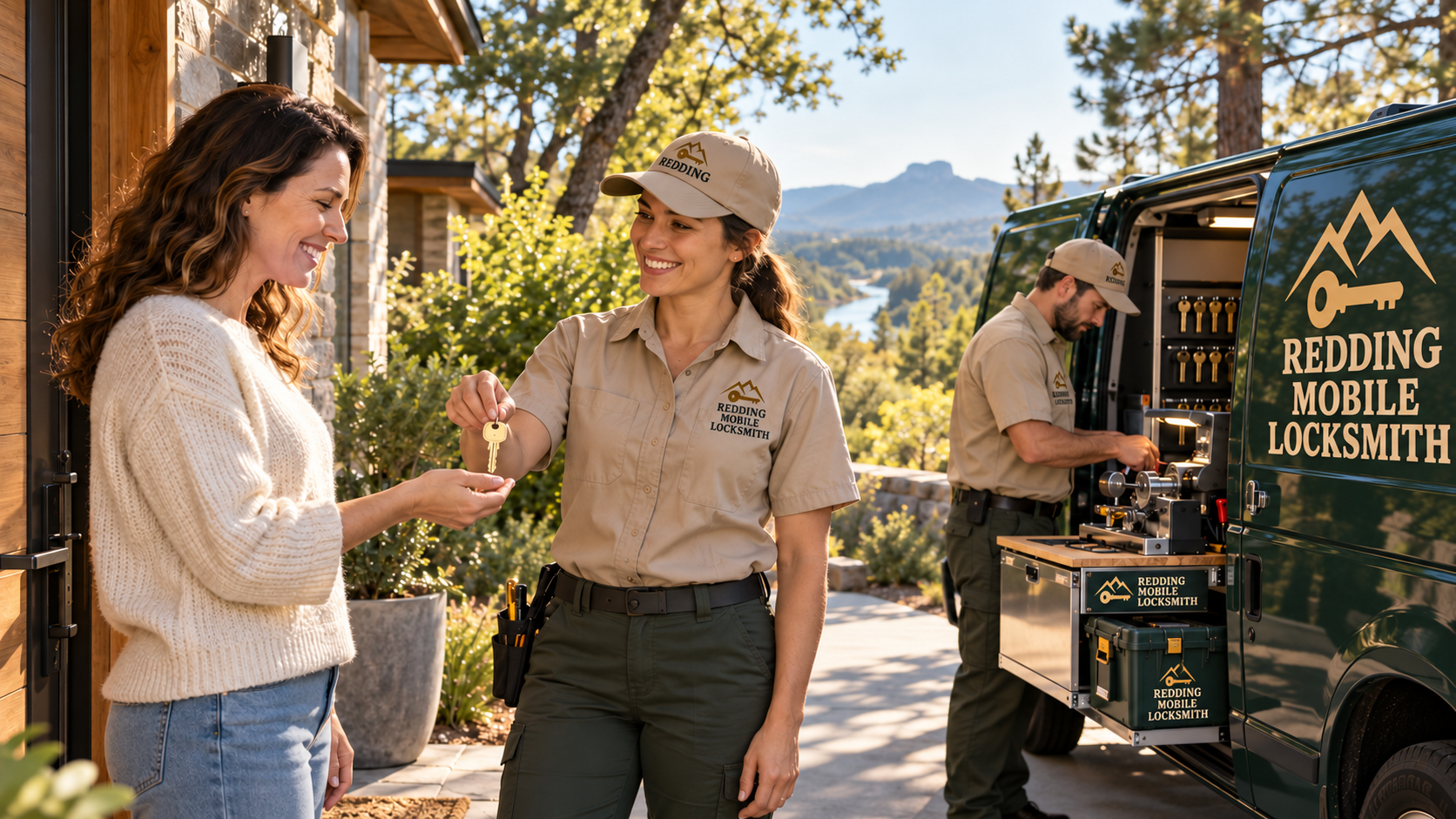
Redding Mobile Locksmith works from a branded service van that carries professional tools, key cutting and programming equipment, and common hardware. For a replacement key, the sequence usually goes like this: the locksmith verifies ownership, identifies the correct key blank or fob, cuts the blade if one is needed, and connects equipment to the vehicle to program the new transponder or remote.
Because the visit happens where the vehicle sits, you can watch what is happening and ask questions. You do not need to understand the equipment. What matters is that you are present when the key is tested, because that is the moment to catch problems. The locksmith may ask you to try the key in the ignition or press the start button while the vehicle is connected, which is a normal part of the process. Programming sessions often involve several steps, including entering the vehicle into a special mode, presenting each key in turn, and confirming that the computer has stored them. If a step fails, the locksmith can repeat it or try another method, which is far easier than discovering the failure at home.
If the vehicle is parked at work, the driveway at home, or along a rural road near Highway 97 or Interstate 5, the process is the same. Service reaches you rather than the other way around. For a bigger picture of how that works, our page on replacement car keys gives a full overview.
After the work: testing every function
This is the part that matters most. Before the locksmith leaves, go through the whole list together. Start with the mechanical side: insert the key in the driver's door and turn it both ways. Try the key in the ignition, if your vehicle has one, and confirm that it turns smoothly through every position. Then start the engine and let it run for a moment, rather than just clicking to the accessory position.
Move to the remote side. Press lock and listen for the horn or watch the lights. Press unlock once and see whether it opens just the driver door or all of them. Press it again, if your vehicle works that way. Press the trunk or tailgate release. Press the panic button, and turn it off again. If the vehicle has remote start, try it and check that it behaves as before.
For push button systems, walk away from the vehicle with the fob and see that the doors lock when you leave, if that feature was active before. Return and check that they unlock as you reach the handle. Place the fob in different spots in the cabin, such as a pocket, a cup holder, and the glove box, and see that the start button recognizes it. If anything differs from your baseline, mention it before the visit ends.
Spare keys, valet keys, and the second fob
A single working key is a single point of failure. If it is lost, broken, or left on a lake shore, you are back to a stressful situation. Once the first key is working, ask whether it makes sense to add a second. Having two programmed keys cuts risk dramatically, and it is usually easier to make an additional key while the equipment is already connected.
Some vehicles come with a valet key, a simpler key that opens the door and starts the engine but cannot open the trunk or glove box. These are rarely used, but they can be a useful spare for someone who just needs to move a vehicle. If your vehicle has one, check that it still works.
Think about how you store them as well. A spare kept in a magnetic box under the vehicle is a bad idea, because it is exactly where a thief will look. A spare kept at home in a drawer, or with a family member you trust, is far safer. Also think about who else uses the vehicle. A spouse, a teen driver, an older relative: each may benefit from their own key rather than sharing one. Our neighbor guide on teen drivers and spare keys has a few sensible thoughts on that.
Fob batteries and the small stuff
Not every fob problem needs programming. Many are caused by a tired battery, and replacing it takes a minute with a small tool. Cold weather weakens batteries, and Weed's winters can make a borderline cell give up. If the fob works only when held close to the vehicle, or if the range has been shrinking over time, try a new battery before deciding anything else.
Be gentle when opening a fob. The housing is usually held with small clips, and a coin or thin tool can pop it open. Note the orientation of the battery before removing it, and avoid touching the circuit board with bare fingers. If the fob is cracked, water damaged, or has worn buttons, replacement may be wiser than repair.
If you replaced the battery and the fob still does nothing, it may have lost its pairing, or the unit itself may have failed. Our guide on what to do when a key fob stops working walks through the steps, and it is worth reading before you call.
Used vehicles and unknown keys
If you recently bought a used vehicle in Weed, you may not know how many keys exist, or who holds them. A previous owner might still have a working fob. In that case, the cleanest approach is to have a locksmith program new keys and clear the old ones from the vehicle's memory, so only the keys you hold will start it.
Our neighbor guide on buying a used car and the extra key question covers the thinking behind that decision, and how many keys come with a used car helps you work out what you should expect.
Another good habit with a used vehicle is to ask for the paperwork that came with it, including any original key tag, since a tag can sometimes help identify the exact key type. Remember that not every vehicle supports every option. Some allow keys to be cleared; others only allow additions. Ask what is possible for yours. The honest answer is sometimes that it depends on the vehicle, and a locksmith with the right equipment can find out by connecting to the vehicle and asking it directly.
Getting help in Weed
If you need a key made, a fob replaced, or an existing key checked, use the request form on our contact page and share the details we discussed: the vehicle type, the symptoms, how many keys you have, and what you want the new key to do. Our phone line is coming soon, so the form is the way to reach us right now.
For wider context, read about service in Weed, or see our Weed page on cars and trucks for help telling an engine problem from a key problem. If your situation is an emergency lockout, our locked out of your car page explains what to do.
Whatever you decide, finish with the full test. A few minutes at the vehicle with the locksmith standing by is worth more than any amount of worry later, and it gives you something concrete to point to if a function turns out to be missing. The next long shift will end, you will walk to the lot, and everything will simply work, which is exactly how it should be.
Good to know
Common questions
What is the difference between cutting a key and programming it?
Cutting shapes the metal blade so it turns the lock. Programming teaches the vehicle's computer to accept the key's transponder chip or the fob's remote signal. Many vehicles need both. A key that is cut but not programmed may turn the lock yet still refuse to start the engine.
Which fob functions should I test after programming?
Test lock, unlock, trunk or tailgate release, panic, and remote start if your vehicle has it. For push button systems, also check that the doors lock as you walk away, unlock as you approach, and that the start button recognizes the fob in a pocket and in the cabin.
Can old keys be removed from the vehicle's memory?
On many vehicles, yes. This is useful after a lost key or a used vehicle purchase, so a stranger holding an old key cannot start the engine. Not every model allows it, so ask what your vehicle supports before the visit.
Does a dead fob battery mean I need programming?
Often not. A weak battery shortens the signal range, and a fresh one may solve the problem. If a new battery does not help, the fob may have lost its pairing or failed, and then programming or replacement is worth discussing.
What do I need to show before a key is made?
Expect to show identification and proof that the vehicle is yours, such as registration or title paperwork. This protects owners by making it harder for someone else to have a key cut. If you are unsure what counts, ask when you send your request.
How many keys should I have programmed?
At least two is a sensible goal, so a lost or broken key does not leave you stranded. Add more if several people drive the vehicle. Keep the spare somewhere separate from your daily keys and from the vehicle itself.