
Home / Etna / Home Lock Service in Etna
Close to Home: Etna
Home Lock Service for Etna Households
Picture a family pulling into the driveway after a day at the lake, tired and sunburned, with the door standing between them and dinner. Here is how the locks on an Etna home work, and what we do when one stops cooperating.
Close to Home: Etna
The door that stands between you and supper
Imagine a family heading back into Etna after a long day up at one of the mountain lakes. The kids are asleep in the back seat, the cooler is sweating in the trunk, and somebody has a fishing rod tangled in a jacket. Nobody is thinking about the front door until the key slides in and refuses to turn. That small, ordinary moment is where most people first learn how little they know about the lock they use six times a day.
We write this page for that moment, and for the quieter ones before it. A home lock is not one object. It is a small system of parts that have to agree with each other: a cylinder that reads the key, a bolt that does the actual holding, a strike that catches the bolt, and a door and frame that keep everything lined up. When any one of those drifts, the whole thing starts to misbehave.
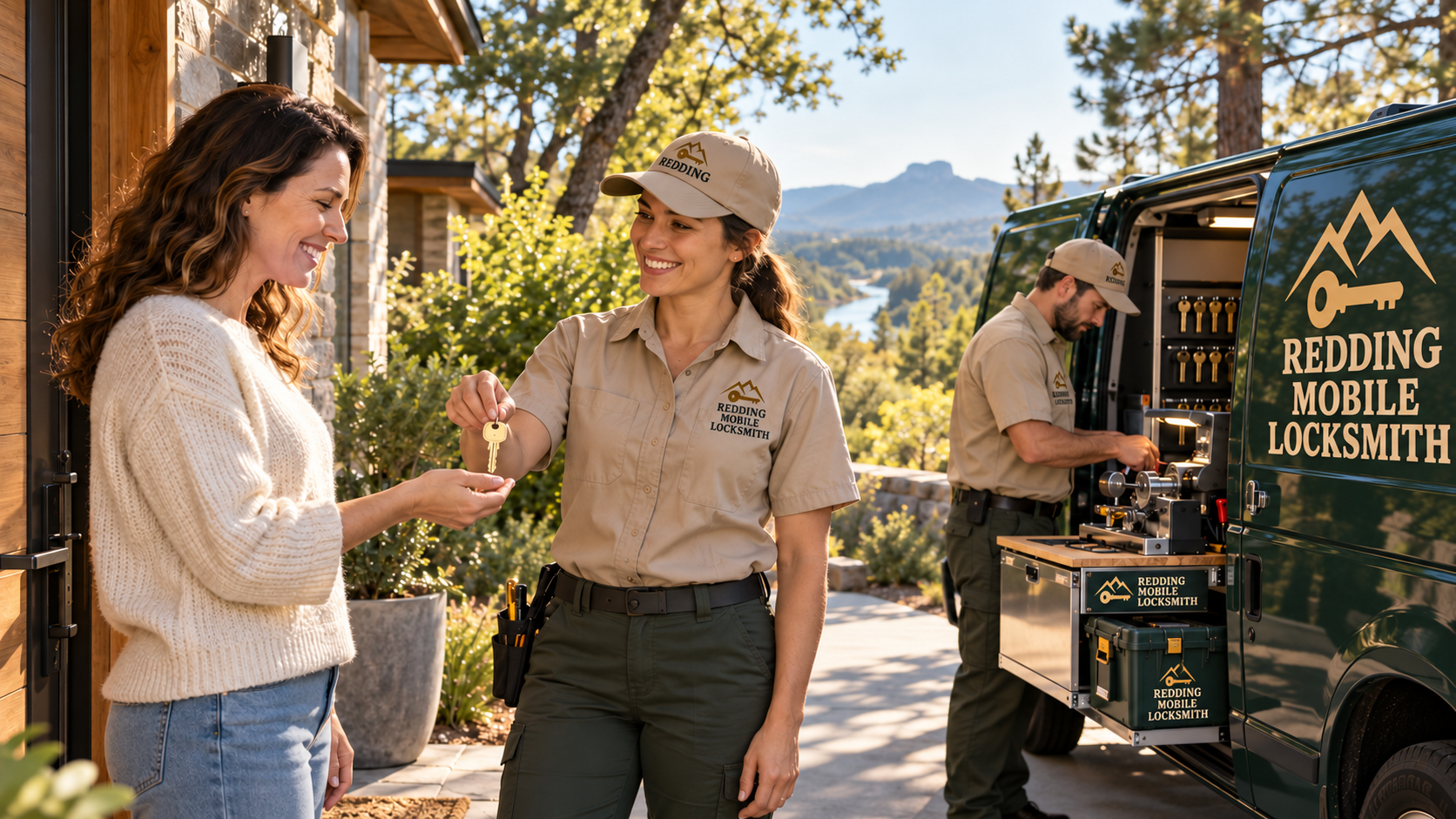
Redding Mobile Locksmith sends a branded team in uniforms and a branded service van to homes across Siskiyou County, and Etna is one of the communities we serve around the clock. This page walks through the pieces so that when you call, you can describe the trouble in plain words, and so that you can spot problems before they turn into a locked door at dusk.
Etna houses and the locks they tend to have
Etna sits in Scott Valley with mountain views on most sides, and the housing reflects that. You find older buildings near the downtown blocks, ranch properties with long driveways, and newer homes tucked at the edges of town. Each of those eras left its own fingerprint on the hardware. An older house may carry a mortise lock set deep inside the door, while a newer one will usually have a bored cylindrical lock and a separate deadbolt.
That mix matters because parts do not always swap neatly. A lock made for a thick old door may not fit a modern prep hole, and a deadbolt sized for a newer door can leave an ugly gap in an older one. When we come out, one of the first things we do is look at what is actually installed instead of assuming. The age of the house tells us a lot, but the door itself tells us more.
Ranch properties add another wrinkle. A main house, a guest cottage, a workshop and a barn office might each have a different lock bought in a different decade, with a drawer of keys nobody has sorted. If that sounds familiar, you are in good company, and tidying that key situation is one of the most useful things a locksmith can help you do. A labeled ring, a short list of who holds what, and one fresh spare in a safe place can spare a household a great deal of stress.
Cylinders: the part that reads your key
The cylinder is the round brass barrel that your key slides into. Inside, a row of small pin stacks sits in channels, held down by springs. Each stack is cut to a different height. When the right key goes in, its ridges and valleys lift every stack to exactly the same line, which lets the barrel rotate. The wrong key leaves some stacks too high or too low, and the barrel stays locked.
Because the cylinder is the part that wears from daily use, it is often where the first trouble shows. Pins and springs get gritty, keys wear their own edges smooth, and a worn key in a worn cylinder is a tired partnership. People say the lock feels sticky or that they have to jiggle the key. That jiggle is a message that the key and the pins no longer meet cleanly.
A cylinder can be rekeyed, which means changing the pins inside so a different key works and the old keys stop working, without replacing the whole lock. We do that right at your door with our service van tools. Rekeying is a good fit when the lock hardware itself is sound but you want a fresh set of keys, and you can read more about that on our rekey your home page.
Deadbolts and what they actually do
A deadbolt is a solid steel bolt that slides from the door edge into the frame. Unlike the angled latch in an ordinary knob, it does not spring back when pushed, which is why it is called dead. The bolt is the muscle of your door. The key and the cylinder only decide whether the muscle is allowed to move.
How far the bolt reaches into the frame matters, and so does what it reaches into. A bolt that bites into solid framing resists force far better than one that only catches a thin strip of trim. We often find a perfectly good deadbolt installed with short screws or a loose frame, and it ends up doing less than its owner thinks. Mounting is half the story, and it is the half most homeowners never see once the screws are in. A short look at the hardware often tells us more than the lock label ever could.
There are single cylinder deadbolts, keyed on the outside with a thumb turn inside, and double cylinder versions that need a key on both sides. Each has trade offs. A thumb turn makes leaving in a hurry easy, which matters in an emergency, while a double cylinder can slow a person down. If you are unsure which suits your home, our guide on deadbolts talks it through.
Strikes and frames, the quiet half of the lock
Walk up to your front door and look at the edge. The metal plate set into the frame, with the hole the bolt slides into, is the strike. It is the least glamorous part of the whole arrangement, and it is responsible for a surprising share of lock complaints. If the strike hole is a hair too low or too far back, the bolt has to scrape and fight to engage.
Doors move. Wood swells in damp weather and shrinks in dry, hinges loosen, and a house settles over many seasons. When the door shifts even slightly, the bolt and strike stop meeting where they used to. The usual symptom is a deadbolt that only throws if you lift the door or push it just so. That is not the lock failing so much as the door and frame wandering apart.
A good fix can be as simple as adjusting or repositioning a strike, tightening hinge screws, or setting the strike with longer screws that reach into the stud behind the trim. Our piece on strike plates goes deeper. The point is that a stiff lock is not always a bad lock, and we will check the frame before we recommend replacing anything.
Keys: the small things that cause big headaches
Most households carry more key problems than they realize. There is the key that was copied from a copy, and each generation of copying drifts a little from the original cuts. There is the spare hidden in a spot that is not as clever as it seemed. And there is the ring so crowded that the key you need is always the last one you try.
A worn or poorly cut key can make a healthy lock seem sick. Before anyone blames the cylinder, it is worth testing with a fresh key cut from the original, or cut by code if the lock is known. A clean cut key often brings back the smooth feel at once. If a key has ever been bent, even slightly, retire it rather than forcing it through again.
Think too about who holds keys. A family with a few grown children, a neighbor who waters plants, and a past contractor can add up to more people than you would count aloud. When the list of key holders gets fuzzy, rekeying resets it. You do not need a crisis to justify that, only the sense that the count is no longer certain.
Cold winters and what they do to locks
Etna winters are cold, and cold is hard on door hardware in ways people do not always connect. Metal contracts, moisture finds its way into keyways, and a lock that feels fine in September can stiffen in January. If the keyway ices, forcing the key is the worst response, because a bent or broken key in a frozen cylinder turns a nuisance into a repair.
Gentle is the rule. Use a dry, appropriate lock lubricant rather than whatever oil is on the garage shelf, since the wrong product can attract dust and gum up the pins. Our note on lubricants explains the difference. And if you suspect ice, ask for help instead of applying heat or force that could crack plastic parts or warp the door finish.
Warm seasons have their own quirks. Dry summer heat and swelling humidity at other times of year can both change how a wooden door sits in its frame. If your lock behaves differently from one season to the next, that is useful information, and it often points to the door, not the cylinder. See the weather and seasons guide for the longer version.
When the lock quits on you at the door
Back to our tired family in the driveway. If the key will not turn, the first honest step is to stop and breathe. Try the key gently once more, check that you are using the right one, and confirm the other doors truly are locked before anyone thinks about a window. Forcing a stubborn lock often snaps a key inside it, and a broken key is a bigger job than a stuck one.
If it is dark or cold, or if children are waiting, call for help rather than improvising. We dispatch around the clock, and our technicians arrive in a branded van with the tools and hardware to deal with most home locks on site. A professional approach to a lockout aims to keep the lock and the door intact, which is why we describe what we plan to do before we do it.
You can read the longer version of that decision in our guide about what to try first in a lockout, and the service details live on our locked out of your home page. For safety, tell the dispatcher about anyone vulnerable, such as small children or someone who needs medicine inside the house.
Repair, replace or rekey: choosing sensibly
People often assume a troublesome lock needs to be thrown out. Sometimes it does, but more often there are gentler choices. A sticky lock may need cleaning and the correct lubricant. A loose one may need tightened screws. A misaligned latch may need the strike moved. And a lock whose internals are truly worn may be better replaced than coaxed along.
Our rule of thumb is to ask what problem you are solving. If the worry is who has keys, rekey. If the lock is damaged or the door has been forced, repair or replace. If you simply want a nicer feel or a different style, replacement is about preference. The lock repair and adjustment page lays out how we think about that first call.
If you do end up wanting something new, our new lock installation service covers choosing and fitting it. Take a moment on the door type first. Wood, metal and fiberglass doors each take hardware differently, and a good install respects that rather than forcing a standard kit into the wrong door.
What to have ready, and what to expect from us
A short list makes any service call smoother. Know which door you are at, what the lock seems to be doing, and whether the key turns partway or not at all. If you can describe the lock style, such as a knob with a separate deadbolt or a lever handle, that helps us bring the right parts. Photos of the door edge and strike are welcome when you have them.
Because contact details are not published yet, our phone line is marked coming soon. In the meantime you can send your request through the request form on our contact page, and we will pick up from there. We do not quote prices on these pages, and we will talk through the work with you before starting so there are no surprises in what we are doing.
Etna is part of a wider circle of towns we serve, and you may find our pages for nearby Fort Jones and Etna as a whole useful for general context. If you are a neighbor who just wants to understand your door a bit better, that is a perfectly good reason to read on, and a perfectly good reason to ask us questions. Nobody expects you to be fluent in strikes and cylinders. That is our job, and we are glad to translate.
Good to know
Common questions
How can I tell whether my deadbolt or the door is the problem?
Try turning the bolt with the door open. If it moves freely there but sticks when the door is shut, the strike or frame is probably out of line, not the lock itself. If it is stiff even open, the cylinder or bolt mechanism may be worn or dirty. A technician can confirm in a short visit.
Can you work on older Etna homes with unusual locks?
Often yes. Older doors may carry mortise locks or thicker hardware, and our van carries tools and common parts for many styles. If something is truly specialized, we will say so honestly after seeing it and explain your options, which may include repair, a compatible replacement or a different lock that fits the door.
Is rekeying better than replacing the whole lock?
When the lock itself is sound, rekeying is usually a sensible choice because it changes which keys work without discarding good hardware. If the lock is damaged, badly worn or you simply want a different style, replacing makes more sense. We look at the lock before suggesting either path.
What should I do if a key breaks off in my front door?
Stop turning and do not try to dig it out with makeshift tools, which can push the piece deeper. Keep the broken half if you can. Call for help, and tell the dispatcher which door it is. A technician can remove the fragment and check whether the cylinder is still healthy.
Do you serve Etna at night and on holidays?
We run as an around the clock service and Etna is among the Siskiyou County communities we serve. Tell the dispatcher your situation and any safety concerns, such as children or medication inside. Our contact page request form is available while the phone line is marked coming soon.
How often should I look over the locks at my house?
A casual check every season is plenty. Turn each key, throw each deadbolt, and notice any stiffness, wobble or rattle. Look at the strike and the screws holding the hardware. Small changes caught early are usually minor fixes, while ignored ones can end in a lockout.