
Home / Lakehead / Emergency Help Any Hour in Lakehead
Lakehead, Shasta County
What to Do in the First Ten Minutes of a Lockout in Lakehead
A lockout at the edge of the lake feels bigger than it is, especially as the light goes. This page walks through the first ten minutes, the checks that help, the mistakes to skip, and how around the clock help works.
Lakehead, Shasta County
Start with the picture at the trailhead
Imagine an angler or hiker walking back to a parked truck at dusk. The day on the water or in the woods was a good one. The hands are cold, the pack is heavy, and the truck sits alone at the end of a gravel turnout with the last of the light going orange behind the ridge. They reach for the pocket where the keys always live and find nothing there. Or they find the keys, locked inside, visible on the seat through the glass.
This is a made up scene, but it is also the most Lakehead problem we can think of. The community sits at the northern end of Lake Shasta, close to Interstate 5, with marinas, cabins, vacation homes and a steady stream of visitors who arrive for a weekend and leave their routines at home. People park in unfamiliar places, set keys down in unfamiliar spots and walk away from their vehicles for hours at a time.
The first ten minutes decide whether the next hour is calm or miserable. Nothing about them requires special skill. It is mostly a matter of slowing down, checking in a sensible order, and avoiding a few well meant actions that make things worse.
Minute one: breathe and take stock
Before you do anything with your hands, do three things with your head. First, confirm that you are safe. Are you on a road shoulder with traffic, near water, on uneven ground, or somewhere an approaching vehicle could miss you? If so, move to a safer spot before anything else. Second, confirm that nobody is inside the vehicle. If a child or a pet is locked inside, stop reading and call emergency services first, because that situation cannot wait for any locksmith.
Third, take stock of what you know. Where were the keys last? Are they in your pocket, in the pack, on the dock, in the cabin, in the boat, on the dashboard? A surprising number of lockouts end when someone finds the keys in a jacket they took off an hour earlier. Pat down every pocket. Empty the pack. Check the pockets of anyone traveling with you.
Panic narrows your attention to the one place you already looked. Giving yourself a full minute to think often saves several minutes of repeating the same search.
Minutes two to four: check the simple things
Now go around the vehicle slowly. Try every door, including the rear doors and the tailgate or canopy, because it is not unusual for one latch to be unlocked when the others are not. Press the unlock button on the door itself if you have a key fob in your pocket and the doors are in range. If you have a second key at home, with a friend or in a lockbox, think about who could safely bring it.
Look through the windows without shining a light that hides the view. Is the key in the ignition, on the seat or in the cup holder? Is a window cracked open? Can you see whether the interior lock button is up or down? These details are useful for the technician, so make a mental note, or a note on your phone.
If you have a smartphone and a vehicle app, check it. Some vehicles can be unlocked from an app that the owner has set up in advance. That is a good moment to find out whether you ever did. If you hold a roadside plan through an insurer or a membership, that is another door to knock on, and calling them is perfectly reasonable alongside anything else.
The page on what a lockout is and what to try first goes through these steps in a little more detail.
What to avoid doing
There is a short list of things people do in the first ten minutes that cause real damage. Prying at the door frame with a screwdriver can bend the door skin and tear weatherstripping. Wedging a coat hanger in the window seal can scratch the paint, damage the electrical wiring that runs through the door, or trip the side airbag sensors in some vehicles. Breaking a window is the extreme version, and it leaves you with glass in the upholstery, a cold night ahead and a repair bill that dwarfs the cost of a service call.
It is also wiser not to force a stuck lock or spray oil into the cylinder. Oil attracts dust and makes a later key turn worse, and forcing can snap a key or damage internal parts.
And please do not follow a video that shows how to bypass a lock with a household item. Those methods vary a great deal by vehicle, they are easy to get wrong, and the vehicle is far more fragile than it looks. The job is better left to someone who has the right tools and has done it many times.
- Do not break a window to save time, since glass repair is a bigger problem than the lockout.
- Do not pry the door frame, because bent metal can leave a gap that lets in water and wind.
- Do not leave a child or a pet in a locked vehicle while you try things, and call emergency services if they are inside.
- Do not hand your keys or fob to anyone who is not clearly working for the company you called.
Minutes five to eight: gather what the technician will ask
While you wait on the next step, collect the details. Write down the make, model and approximate year of the vehicle, the color, and exactly where it is parked. For a trailhead, a boat ramp or a lakeside pullout, describe the landmarks that you can see from where you stand. Do not rely on a street address if there is not one. You may only have a highway name, a nearby marina, or the direction you were driving, and that is enough as long as you describe it clearly.
Have your identification and proof that the vehicle is yours ready: a registration, an insurance card, or a title photo on your phone. A responsible locksmith will ask to confirm ownership before opening a vehicle, and it is not a sign of distrust. It is how the job protects you from someone else doing the same thing to your truck.
Our guide on what to have ready when you call a locksmith has a fuller checklist.
Why Lakehead lockouts have their own flavor
Lockouts in a lake community do not look like lockouts in a city lot. A great many of them involve more than one set of keys: a boat key, a cabin key, a vehicle key, a gate key, sometimes a trailer hitch lock. People carry them on one ring, and then separate them for the water, which is how a vehicle key ends up in a dry bag on the dock while the truck is locked at the ramp.
Weather adds to it. A hot afternoon makes people shed layers and leave jackets, with keys inside, on seats and boat benches. A cold evening has them reaching for those jackets and finding them gone. Wet hands and wet pockets also make keys slip out, and a fob that has been dunked may stop responding even though it looks fine. If your fob went into the lake, let it dry thoroughly and tell the technician, because moisture can affect the electronics inside and a replacement may be the cleaner fix.
Seasonal visitors face a particular difficulty. A rental cabin may come with a key box, a keypad or a physical key, and a rental vehicle may have a fob that the visitor has barely handled. If you are renting, contact the owner or the rental company too, because they may hold a spare. For your own vehicle at a cabin you visit rarely, it is worth making a second key and leaving it with a person you trust rather than at the property itself.
Making the request
Our phone line is coming soon, so for now the way to reach Redding Mobile Locksmith is the request form on the contact page. Describe what happened, where you are, what the vehicle is, and whether anyone is in danger. If you do not have a data connection, that is a good reason to move toward a place with better coverage, such as a marina office or a spot nearer the highway, and send it from there.
We work around the clock, and you can read more about how that works on our page for emergency help any hour. We do not publish arrival times for any turnout, because mountain roads, weather and distance make any number unreliable. What you can count on is that the request is read, and that you will be told plainly what to expect.
A good request is short and concrete. Something like this works: a gray pickup, keys on the driver seat, parked at a gravel pullout by the water, no one inside, I am alone and the light is going. That is a handful of facts a dispatcher can use, and none of them required a long explanation. Add your name for the request and how you prefer to be reached, and the picture is complete.
It also helps to say what you have already tried. If you pulled every handle and checked the tailgate, say so. If a window is open a crack, say so. Each detail rules something out and saves the technician from repeating your steps, and it tells us whether the job is likely to be a simple opening or something that needs a key to be made.
Staying comfortable while you wait
Once the request is in, your job is to wait comfortably. Dusk near a lake cools off sharply, even after a warm day. Put on whatever layers you have in the pack, stay on the lit side of the lot if there is one, and keep your phone charged by reducing screen brightness. If you are alone, tell a friend or family member where you are and what is happening. Share your location through your phone if you can.
If you are waiting in the dark, stay near the vehicle and away from the roadway. Turn on your phone flashlight when a car approaches so the driver can see you, and keep your back to the lake or the brush rather than the road. If something feels wrong about the place or the people nearby, trust that feeling and go somewhere safer. Our page on what is the safe thing to do when locked out at night covers this in more depth.
What the technician does when they arrive
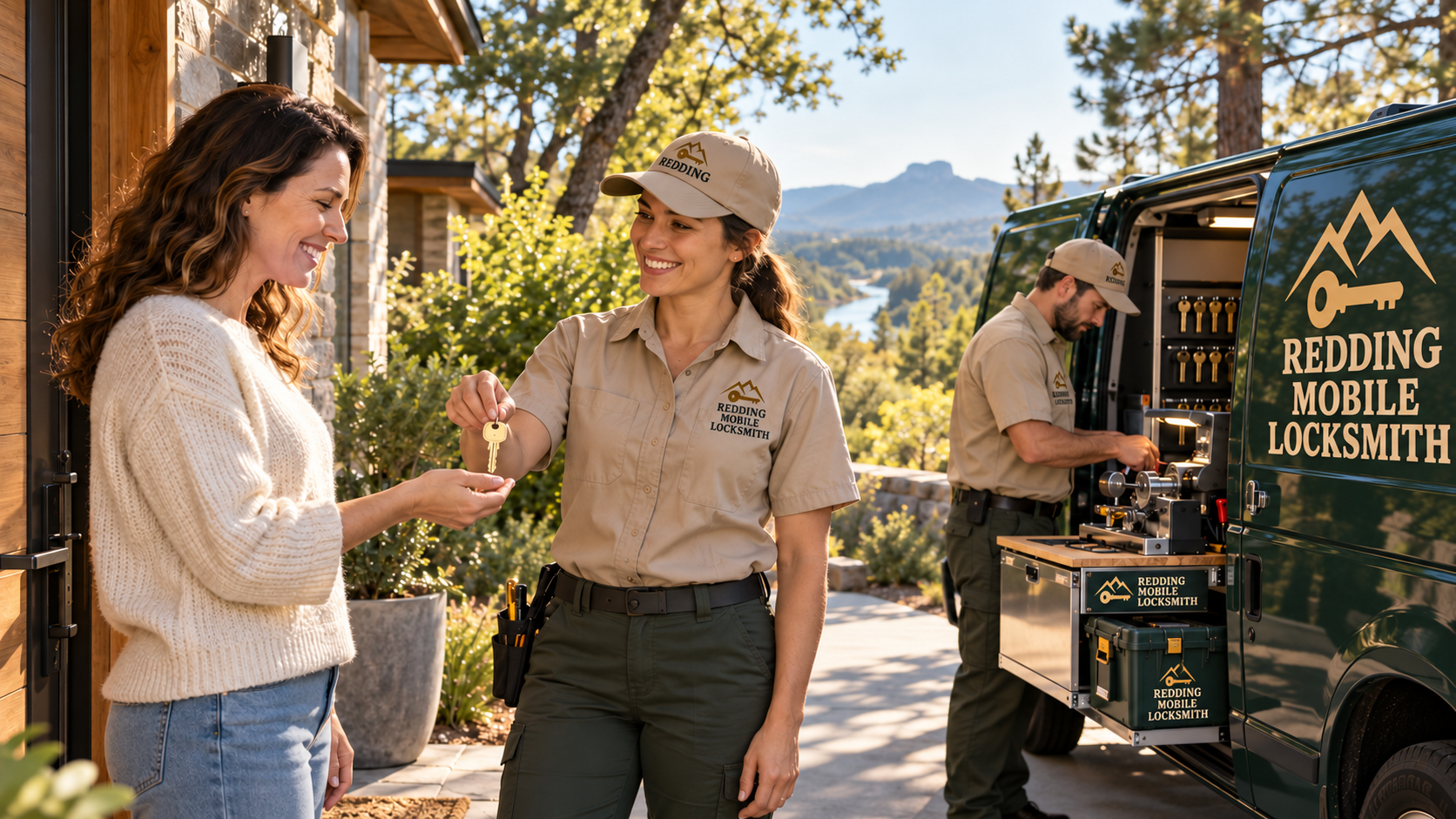
A mobile locksmith arrives in a branded van with uniformed staff, and the first things you should see are a greeting, an explanation and a request to confirm your ownership. The technician will look at the vehicle, ask a couple of questions, and describe what they plan to do and whether any risk exists to the paint, the weatherstripping or the electronics. You should be told about the cost before work starts, and you are welcome to ask questions at any point.
Then the work itself. Professionals use tools designed for the purpose, which open the door or the lock without damaging it. We will not explain the details here, because the point is that it is a trained process and not a trick. In most cases the vehicle is opened, the keys are returned to you, and the door still closes the way it did before.
If the key is lost rather than locked inside, the situation changes, and a new key may need to be cut or programmed. Our pages on locked out of your car and cars and trucks explain that side of the work.
If you are stuck at a home rather than a vehicle, the same ten minutes apply with small changes. Check every door and window you can legitimately reach without damaging anything, think about who has a spare, and avoid forcing the lock. The page on locked out of your home covers that side of the work.
After you are back in
When the door is open, take a moment before you drive away. Pick up your keys, make sure the spare is accounted for, and decide how to avoid a repeat. Some people attach a key to a lanyard that clips to a pack. Others hide a spare key in a magnetic box, though a hidden key is only as safe as its hiding place. A better answer for many is a second key kept with someone trusted, or a key made with a transponder chip so that it works for the ignition as well as the door.
If you came away from the trailhead with a new idea about where the key should live, that is a good outcome. A lockout is nearly always a story about a habit, and habits are easy to change once you notice them.
You might also look at our pages for Lakehead and the nearby communities of Sims and Shasta Lake. If you live in the area and want to be ready before something happens, the page on cars and trucks in Lakehead describes how mobile automotive service works.
Good to know
Common questions
Should I call emergency services for a normal lockout?
No. A normal lockout with nobody inside is not an emergency for the fire or police departments. Call emergency services first only if a child, a pet or a vulnerable person is locked inside, or if you feel unsafe where you are. Everything else can go to a locksmith.
Can you open a vehicle if I have no ID with me?
A responsible locksmith confirms that the vehicle is yours before opening it. Registration, an insurance card, a title photo or other proof tied to the vehicle can help. If you have none of these, tell us in your request, and we will explain what we can accept.
What if I do not know the exact address where I am parked?
Describe the location the way you would to a friend: the highway name, the closest marina or turnout, the direction you were driving, and any landmarks you can see. Share your phone location if you can. Accurate landmarks matter more than a street number in a rural area.
Will a locksmith damage my truck door?
A trained technician uses tools made for the job and takes care to protect the paint, the weatherstripping and the electronics. If any risk exists, a good technician tells you before beginning. The damage people usually see comes from coat hangers and pry bars, which we recommend you avoid.
Can I make the request from my phone?
Yes. The request form on the contact page works from a phone browser. Our phone line is coming soon. If you have limited coverage, move to a spot with a better connection if it is safe, and tell us where you are in plain words.
Does anyone answer at night?
Redding Mobile Locksmith is an around the clock service, so requests are watched at every hour. We do not publish arrival times, since distance, road conditions and weather change from one call to the next, but we will tell you honestly what to expect once we read your request.